

121
(WRAP 2018). Mosa Meat, a Dutch start-up, is still developing, focusing on
improving the taste by co-culturing fat cells and reducing costs. Other companies,
both in the US and other countries of the world, are pursuing similar goals. It is
estimated that current costs are around USD 11. Innovative financing mechanisms
for research, for example public financing, will support further technical development of farmed meat. An alternative source of animal protein is whey protein. Its
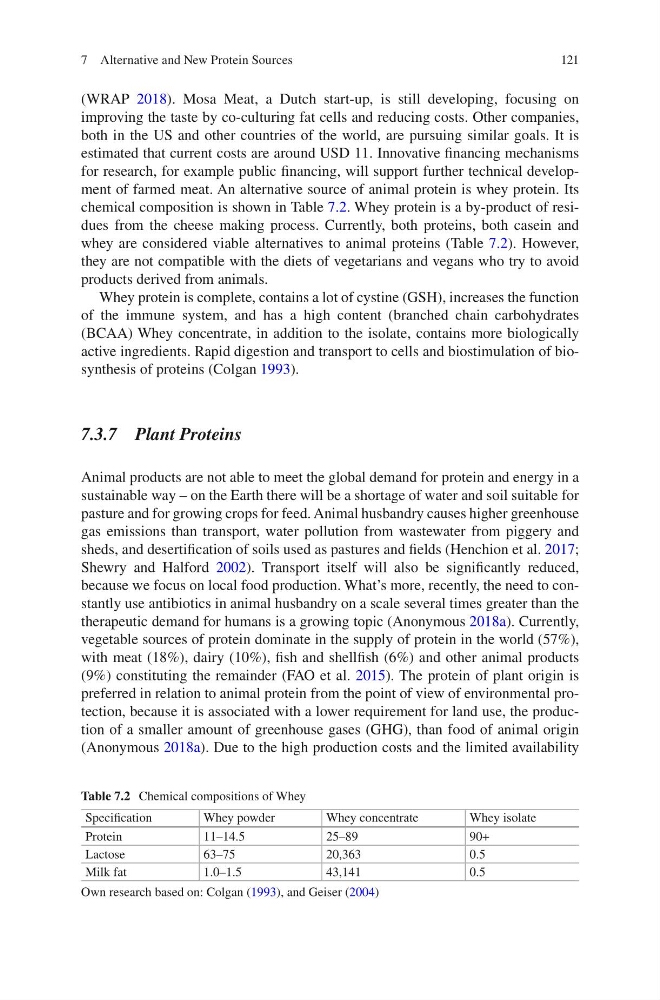
chemical composition is shown in Table 7.2. Whey protein is a by-product of residues from the cheese making process. Currently, both proteins, both casein and
whey are considered viable alternatives to animal proteins (Table 7.2). However,
they are not compatible with the diets of vegetarians and vegans who try to avoid
products derived from animals.
Whey protein is complete, contains a lot of cystine (GSH), increases the function
of the immune system, and has a high content (branched chain carbohydrates
(BCAA) Whey concentrate, in addition to the isolate, contains more biologically
active ingredients. Rapid digestion and transport to cells and biostimulation of biosynthesis of proteins (Colgan 1993).
7.3.7 Plant Proteins
Animal products are not able to meet the global demand for protein and energy in a
sustainable way – on the Earth there will be a shortage of water and soil suitable for
pasture and for growing crops for feed. Animal husbandry causes higher greenhouse
gas emissions than transport, water pollution from wastewater from piggery and
sheds, and desertification of soils used as pastures and fields (Henchion et al. 2017;
Shewry and Halford 2002). Transport itself will also be significantly reduced,
because we focus on local food production. What’s more, recently, the need to constantly use antibiotics in animal husbandry on a scale several times greater than the
therapeutic demand for humans is a growing topic (Anonymous 2018a). Currently,
vegetable sources of protein dominate in the supply of protein in the world (57%),
with meat (18%), dairy (10%), fish and shellfish (6%) and other animal products
(9%) constituting the remainder (FAO et al. 2015). The protein of plant origin is
preferred in relation to animal protein from the point of view of environmental protection, because it is associated with a lower requirement for land use, the production of a smaller amount of greenhouse gases (GHG), than food of animal origin
(Anonymous 2018a). Due to the high production costs and the limited availability
Table 7.2 Chemical compositions of Whey
Specification
Whey powder
Whey concentrate
Whey isolate
Protein
11–14.5
25–89
90+
Lactose
63–75
20,363
0.5
Milk fat
1.0–1.5
43,141
0.5
Own research based on: Colgan (1993), and Geiser (2004)
7 Alternative and New Protein Sources
(WRAP 2018). Mosa Meat, a Dutch start-up, is still developing, focusing on
improving the taste by co-culturing fat cells and reducing costs. Other companies,
both in the US and other countries of the world, are pursuing similar goals. It is
estimated that current costs are around USD 11. Innovative financing mechanisms
for research, for example public financing, will support further technical development of farmed meat. An alternative source of animal protein is whey protein. Its
chemical composition is shown in Table 7.2. Whey protein is a by-product of residues from the cheese making process. Currently, both proteins, both casein and
whey are considered viable alternatives to animal proteins (Table 7.2). However,
they are not compatible with the diets of vegetarians and vegans who try to avoid
products derived from animals.
Whey protein is complete, contains a lot of cystine (GSH), increases the function
of the immune system, and has a high content (branched chain carbohydrates
(BCAA) Whey concentrate, in addition to the isolate, contains more biologically
active ingredients. Rapid digestion and transport to cells and biostimulation of biosynthesis of proteins (Colgan 1993).
7.3.7 Plant Proteins
Animal products are not able to meet the global demand for protein and energy in a
sustainable way – on the Earth there will be a shortage of water and soil suitable for
pasture and for growing crops for feed. Animal husbandry causes higher greenhouse
gas emissions than transport, water pollution from wastewater from piggery and
sheds, and desertification of soils used as pastures and fields (Henchion et al. 2017;
Shewry and Halford 2002). Transport itself will also be significantly reduced,
because we focus on local food production. What’s more, recently, the need to constantly use antibiotics in animal husbandry on a scale several times greater than the
therapeutic demand for humans is a growing topic (Anonymous 2018a). Currently,
vegetable sources of protein dominate in the supply of protein in the world (57%),
with meat (18%), dairy (10%), fish and shellfish (6%) and other animal products
(9%) constituting the remainder (FAO et al. 2015). The protein of plant origin is
preferred in relation to animal protein from the point of view of environmental protection, because it is associated with a lower requirement for land use, the production of a smaller amount of greenhouse gases (GHG), than food of animal origin
(Anonymous 2018a). Due to the high production costs and the limited availability
Table 7.2 Chemical compositions of Whey
Specification
Whey powder
Whey concentrate
Whey isolate
Protein
11–14.5
25–89
90+
Lactose
63–75
20,363
0.5
Milk fat
1.0–1.5
43,141
0.5
Own research based on: Colgan (1993), and Geiser (2004)
7 Alternative and New Protein Sources