

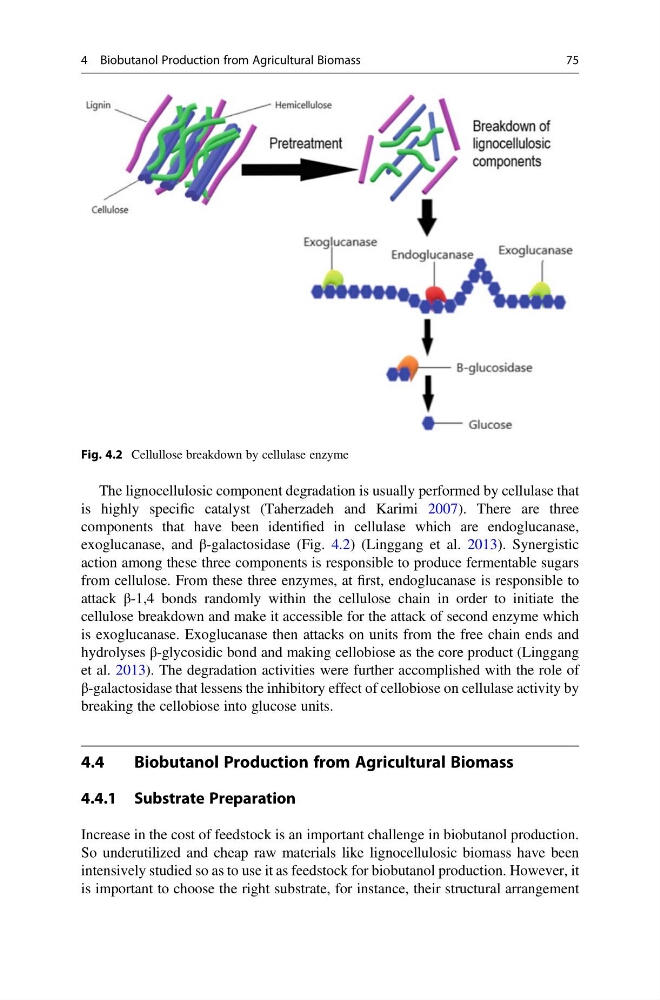
The lignocellulosic component degradation is usually performed by cellulase that
is highly specific catalyst (Taherzadeh and Karimi 2007). There are three
components that have been identified in cellulase which are endoglucanase,
exoglucanase, and β-galactosidase (Fig. 4.2) (Linggang et al. 2013). Synergistic
action among these three components is responsible to produce fermentable sugars
from cellulose. From these three enzymes, at first, endoglucanase is responsible to
attack β-1,4 bonds randomly within the cellulose chain in order to initiate the
cellulose breakdown and make it accessible for the attack of second enzyme which
is exoglucanase. Exoglucanase then attacks on units from the free chain ends and
hydrolyses β-glycosidic bond and making cellobiose as the core product (Linggang
et al. 2013). The degradation activities were further accomplished with the role of
β-galactosidase that lessens the inhibitory effect of cellobiose on cellulase activity by
breaking the cellobiose into glucose units.
4.4
Biobutanol Production from Agricultural Biomass
4.4.1 Substrate Preparation
Increase in the cost of feedstock is an important challenge in biobutanol production.
So underutilized and cheap raw materials like lignocellulosic biomass have been
intensively studied so as to use it as feedstock for biobutanol production. However, it
is important to choose the right substrate, for instance, their structural arrangement
Fig. 4.2 Cellullose breakdown by cellulase enzyme
4 Biobutanol Production from Agricultural Biomass
75
is highly specific catalyst (Taherzadeh and Karimi 2007). There are three
components that have been identified in cellulase which are endoglucanase,
exoglucanase, and β-galactosidase (Fig. 4.2) (Linggang et al. 2013). Synergistic
action among these three components is responsible to produce fermentable sugars
from cellulose. From these three enzymes, at first, endoglucanase is responsible to
attack β-1,4 bonds randomly within the cellulose chain in order to initiate the
cellulose breakdown and make it accessible for the attack of second enzyme which
is exoglucanase. Exoglucanase then attacks on units from the free chain ends and
hydrolyses β-glycosidic bond and making cellobiose as the core product (Linggang
et al. 2013). The degradation activities were further accomplished with the role of
β-galactosidase that lessens the inhibitory effect of cellobiose on cellulase activity by
breaking the cellobiose into glucose units.
4.4
Biobutanol Production from Agricultural Biomass
4.4.1 Substrate Preparation
Increase in the cost of feedstock is an important challenge in biobutanol production.
So underutilized and cheap raw materials like lignocellulosic biomass have been
intensively studied so as to use it as feedstock for biobutanol production. However, it
is important to choose the right substrate, for instance, their structural arrangement
Fig. 4.2 Cellullose breakdown by cellulase enzyme
4 Biobutanol Production from Agricultural Biomass
75