

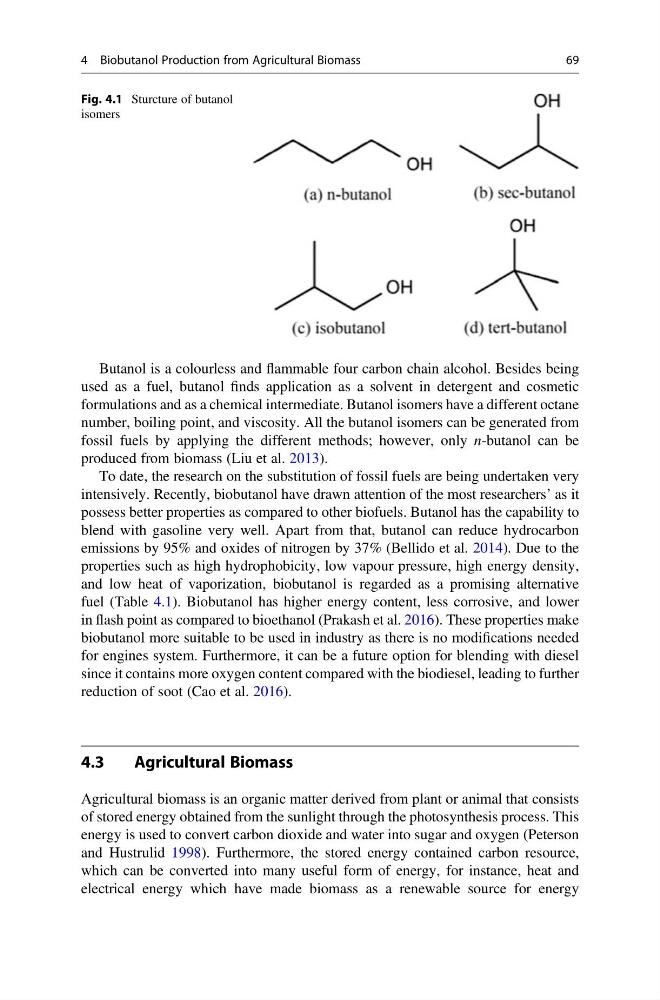
Butanol is a colourless and flammable four carbon chain alcohol. Besides being
used as a fuel, butanol finds application as a solvent in detergent and cosmetic
formulations and as a chemical intermediate. Butanol isomers have a different octane
number, boiling point, and viscosity. All the butanol isomers can be generated from
fossil fuels by applying the different methods; however, only n-butanol can be
produced from biomass (Liu et al. 2013).
To date, the research on the substitution of fossil fuels are being undertaken very
intensively. Recently, biobutanol have drawn attention of the most researchers’ as it
possess better properties as compared to other biofuels. Butanol has the capability to
blend with gasoline very well. Apart from that, butanol can reduce hydrocarbon
emissions by 95% and oxides of nitrogen by 37% (Bellido et al. 2014). Due to the
properties such as high hydrophobicity, low vapour pressure, high energy density,
and low heat of vaporization, biobutanol is regarded as a promising alternative
fuel (Table 4.1). Biobutanol has higher energy content, less corrosive, and lower
in flash point as compared to bioethanol (Prakash et al. 2016). These properties make
biobutanol more suitable to be used in industry as there is no modifications needed
for engines system. Furthermore, it can be a future option for blending with diesel
since it contains more oxygen content compared with the biodiesel, leading to further
reduction of soot (Cao et al. 2016).
4.3
Agricultural Biomass
Agricultural biomass is an organic matter derived from plant or animal that consists
of stored energy obtained from the sunlight through the photosynthesis process. This
energy is used to convert carbon dioxide and water into sugar and oxygen (Peterson
and Hustrulid 1998). Furthermore, the stored energy contained carbon resource,
which can be converted into many useful form of energy, for instance, heat and
electrical energy which have made biomass as a renewable source for energy
Fig. 4.1 Sturcture of butanol
isomers
4 Biobutanol Production from Agricultural Biomass
69
used as a fuel, butanol finds application as a solvent in detergent and cosmetic
formulations and as a chemical intermediate. Butanol isomers have a different octane
number, boiling point, and viscosity. All the butanol isomers can be generated from
fossil fuels by applying the different methods; however, only n-butanol can be
produced from biomass (Liu et al. 2013).
To date, the research on the substitution of fossil fuels are being undertaken very
intensively. Recently, biobutanol have drawn attention of the most researchers’ as it
possess better properties as compared to other biofuels. Butanol has the capability to
blend with gasoline very well. Apart from that, butanol can reduce hydrocarbon
emissions by 95% and oxides of nitrogen by 37% (Bellido et al. 2014). Due to the
properties such as high hydrophobicity, low vapour pressure, high energy density,
and low heat of vaporization, biobutanol is regarded as a promising alternative
fuel (Table 4.1). Biobutanol has higher energy content, less corrosive, and lower
in flash point as compared to bioethanol (Prakash et al. 2016). These properties make
biobutanol more suitable to be used in industry as there is no modifications needed
for engines system. Furthermore, it can be a future option for blending with diesel
since it contains more oxygen content compared with the biodiesel, leading to further
reduction of soot (Cao et al. 2016).
4.3
Agricultural Biomass
Agricultural biomass is an organic matter derived from plant or animal that consists
of stored energy obtained from the sunlight through the photosynthesis process. This
energy is used to convert carbon dioxide and water into sugar and oxygen (Peterson
and Hustrulid 1998). Furthermore, the stored energy contained carbon resource,
which can be converted into many useful form of energy, for instance, heat and
electrical energy which have made biomass as a renewable source for energy
Fig. 4.1 Sturcture of butanol
isomers
4 Biobutanol Production from Agricultural Biomass
69