

This calculation should be based on the estimated flow of contaminated water
sources in Ecuador. For this purpose, it is proposed to use the ratio between the
monitoring points of the National Institute of Meteorology and Hydrology
(INAMHI, by its Spanish acronym) where the concentration of fecal coliforms
exceeds 1000 MPN/100 mL, and the total number of monitoring points. This limit
is one of the criteria for defining suitable water for crop irrigation according to the
Unified Text of Secondary Environmental Legislation (TULSMA, by its Spanish
acronym). According to the most recent data available (2013), in 231 of 503 stations
in total the concentration of fecal coliforms exceeded the limit, i.e., in 46% of the
points. To put this percentage into perspective, it can be considered that according to
Ecuador’s National Water Secretariat (SENAGUA, by its Spanish acronym), 70% of
water sources below 2800 m (above sea level) have a considerable level of pollution.
3.7.5 Structure of the Input–Output Model to Assess the Future
Contribution of the Bioeconomy
For the structure of the alternative scenario, one in which the bioeconomy has a
greater participation in the social and productive structure, we propose the use of the
IOM with base year 2017. For this purpose, we rely on the criteria presented
previously. Two alternatives have been identified to address the objective.
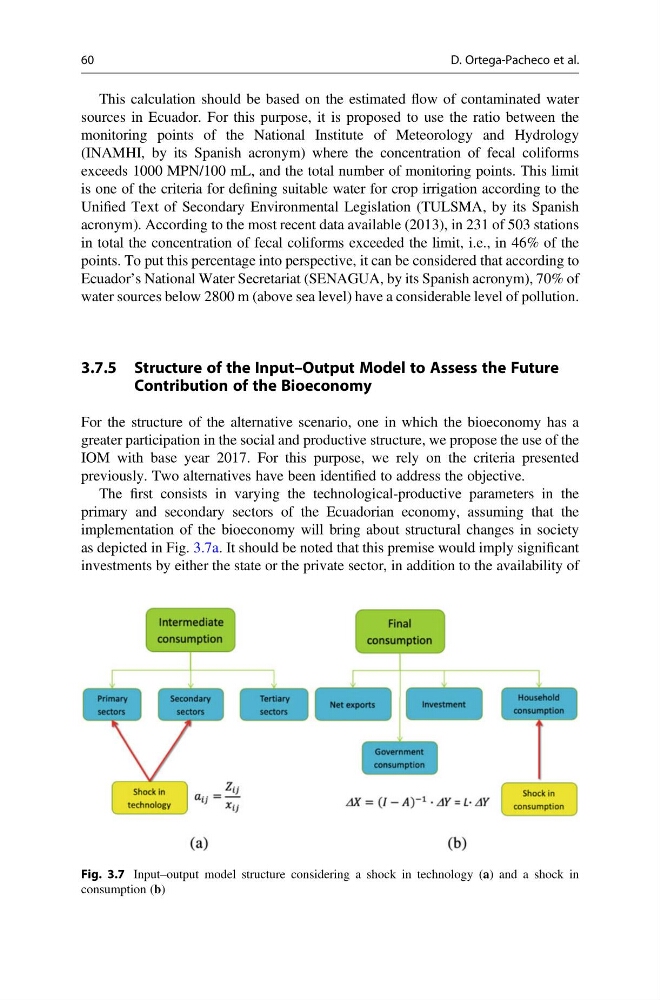
The first consists in varying the technological-productive parameters in the
primary and secondary sectors of the Ecuadorian economy, assuming that the
implementation of the bioeconomy will bring about structural changes in society
as depicted in Fig. 3.7a. It should be noted that this premise would imply significant
investments by either the state or the private sector, in addition to the availability of
Fig. 3.7 Input–output model structure considering a shock in technology (a) and a shock in
consumption (b)
60
D. Ortega-Pacheco et al.
sources in Ecuador. For this purpose, it is proposed to use the ratio between the
monitoring points of the National Institute of Meteorology and Hydrology
(INAMHI, by its Spanish acronym) where the concentration of fecal coliforms
exceeds 1000 MPN/100 mL, and the total number of monitoring points. This limit
is one of the criteria for defining suitable water for crop irrigation according to the
Unified Text of Secondary Environmental Legislation (TULSMA, by its Spanish
acronym). According to the most recent data available (2013), in 231 of 503 stations
in total the concentration of fecal coliforms exceeded the limit, i.e., in 46% of the
points. To put this percentage into perspective, it can be considered that according to
Ecuador’s National Water Secretariat (SENAGUA, by its Spanish acronym), 70% of
water sources below 2800 m (above sea level) have a considerable level of pollution.
3.7.5 Structure of the Input–Output Model to Assess the Future
Contribution of the Bioeconomy
For the structure of the alternative scenario, one in which the bioeconomy has a
greater participation in the social and productive structure, we propose the use of the
IOM with base year 2017. For this purpose, we rely on the criteria presented
previously. Two alternatives have been identified to address the objective.
The first consists in varying the technological-productive parameters in the
primary and secondary sectors of the Ecuadorian economy, assuming that the
implementation of the bioeconomy will bring about structural changes in society
as depicted in Fig. 3.7a. It should be noted that this premise would imply significant
investments by either the state or the private sector, in addition to the availability of
Fig. 3.7 Input–output model structure considering a shock in technology (a) and a shock in
consumption (b)
60
D. Ortega-Pacheco et al.