

This type of model combines the assumption that all markets are in perfect
equilibrium with realistic data derived from social accounting matrices (SAMs) to
represent the initial reference points in equilibrium, after a political intervention.
Equilibrium is guaranteed by price adjustments that cannot be influenced by internal
agents, such as households, firms, and government. Since they are sensitive to price
variation, consequently, they act as decision makers trying to maximize their welfare
(in the case of consumers) or profits (in the case of producers) under certain
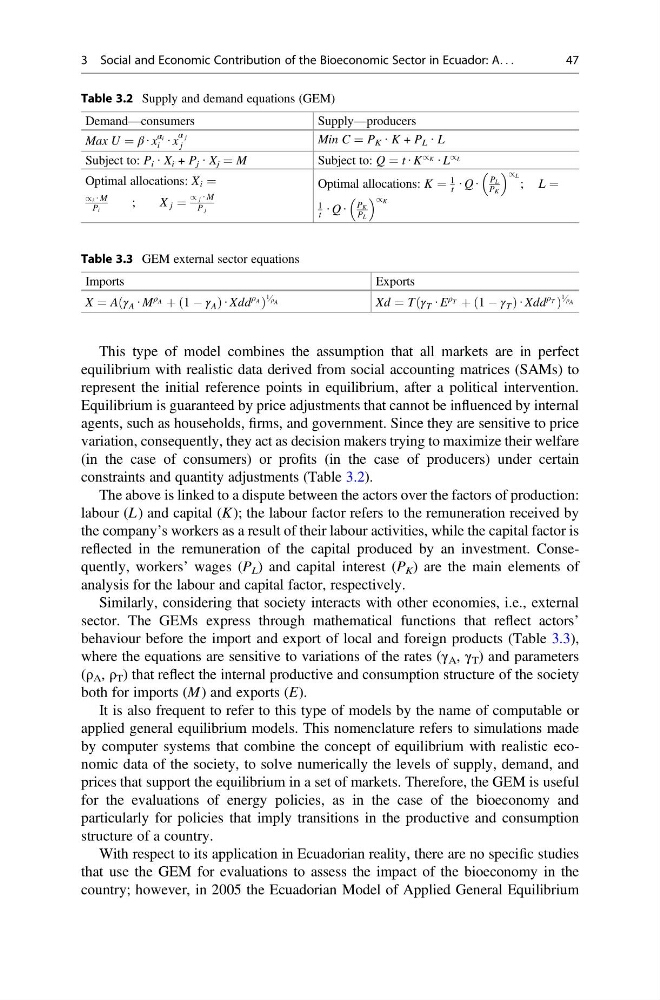
constraints and quantity adjustments (Table 3.2).
The above is linked to a dispute between the actors over the factors of production:
labour (L ) and capital (K ); the labour factor refers to the remuneration received by
the company’s workers as a result of their labour activities, while the capital factor is
reflected in the remuneration of the capital produced by an investment. Consequently, workers’ wages (P L ) and capital interest (P K ) are the main elements of
analysis for the labour and capital factor, respectively.
Similarly, considering that society interacts with other economies, i.e., external
sector. The GEMs express through mathematical functions that reflect actors’
behaviour before the import and export of local and foreign products (Table 3.3),
where the equations are sensitive to variations of the rates (γ A , γ T ) and parameters
(ρ A , ρ T ) that reflect the internal productive and consumption structure of the society
both for imports (M) and exports (E).
It is also frequent to refer to this type of models by the name of computable or
applied general equilibrium models. This nomenclature refers to simulations made
by computer systems that combine the concept of equilibrium with realistic economic data of the society, to solve numerically the levels of supply, demand, and
prices that support the equilibrium in a set of markets. Therefore, the GEM is useful
for the evaluations of energy policies, as in the case of the bioeconomy and
particularly for policies that imply transitions in the productive and consumption
structure of a country.
With respect to its application in Ecuadorian reality, there are no specific studies
that use the GEM for evaluations to assess the impact of the bioeconomy in the
country; however, in 2005 the Ecuadorian Model of Applied General Equilibrium
Table 3.2 Supply and demand equations (GEM)
Demand—consumers
Supply—producers
Max U ¼ β ∙ x
αi
i ∙ x
α j
j
Min C ¼ P K ∙ K + P L ∙ L
Subject to: P i ∙ X i + P j ∙ X j ¼ M
Subject to: Q ¼ t ∙ K
/K ∙ L
/L
Optimal allocations: X i ¼
/i ∙ M
Pi
;
X j ¼
/ j ∙ M
P j
Optimal allocations: K ¼
1
t ∙ Q ∙
PL
PK
/L
; L ¼
1
t ∙ Q ∙
PK
PL
/K
Table 3.3 GEM external sector equations
Imports
Exports
X ¼ Aðγ A ∙ M
ρ A þ ð1 À γ A Þ ∙ Xdd
ρ A Þ
1= ρ A
Xd ¼ Tðγ T ∙ E
ρ T þ ð1 À γ T Þ ∙ Xdd
ρ T Þ
1= ρ A
3 Social and Economic Contribution of the Bioeconomic Sector in Ecuador: A. . .
47
equilibrium with realistic data derived from social accounting matrices (SAMs) to
represent the initial reference points in equilibrium, after a political intervention.
Equilibrium is guaranteed by price adjustments that cannot be influenced by internal
agents, such as households, firms, and government. Since they are sensitive to price
variation, consequently, they act as decision makers trying to maximize their welfare
(in the case of consumers) or profits (in the case of producers) under certain
constraints and quantity adjustments (Table 3.2).
The above is linked to a dispute between the actors over the factors of production:
labour (L ) and capital (K ); the labour factor refers to the remuneration received by
the company’s workers as a result of their labour activities, while the capital factor is
reflected in the remuneration of the capital produced by an investment. Consequently, workers’ wages (P L ) and capital interest (P K ) are the main elements of
analysis for the labour and capital factor, respectively.
Similarly, considering that society interacts with other economies, i.e., external
sector. The GEMs express through mathematical functions that reflect actors’
behaviour before the import and export of local and foreign products (Table 3.3),
where the equations are sensitive to variations of the rates (γ A , γ T ) and parameters
(ρ A , ρ T ) that reflect the internal productive and consumption structure of the society
both for imports (M) and exports (E).
It is also frequent to refer to this type of models by the name of computable or
applied general equilibrium models. This nomenclature refers to simulations made
by computer systems that combine the concept of equilibrium with realistic economic data of the society, to solve numerically the levels of supply, demand, and
prices that support the equilibrium in a set of markets. Therefore, the GEM is useful
for the evaluations of energy policies, as in the case of the bioeconomy and
particularly for policies that imply transitions in the productive and consumption
structure of a country.
With respect to its application in Ecuadorian reality, there are no specific studies
that use the GEM for evaluations to assess the impact of the bioeconomy in the
country; however, in 2005 the Ecuadorian Model of Applied General Equilibrium
Table 3.2 Supply and demand equations (GEM)
Demand—consumers
Supply—producers
Max U ¼ β ∙ x
αi
i ∙ x
α j
j
Min C ¼ P K ∙ K + P L ∙ L
Subject to: P i ∙ X i + P j ∙ X j ¼ M
Subject to: Q ¼ t ∙ K
/K ∙ L
/L
Optimal allocations: X i ¼
/i ∙ M
Pi
;
X j ¼
/ j ∙ M
P j
Optimal allocations: K ¼
1
t ∙ Q ∙
PL
PK
/L
; L ¼
1
t ∙ Q ∙
PK
PL
/K
Table 3.3 GEM external sector equations
Imports
Exports
X ¼ Aðγ A ∙ M
ρ A þ ð1 À γ A Þ ∙ Xdd
ρ A Þ
1= ρ A
Xd ¼ Tðγ T ∙ E
ρ T þ ð1 À γ T Þ ∙ Xdd
ρ T Þ
1= ρ A
3 Social and Economic Contribution of the Bioeconomic Sector in Ecuador: A. . .
47