

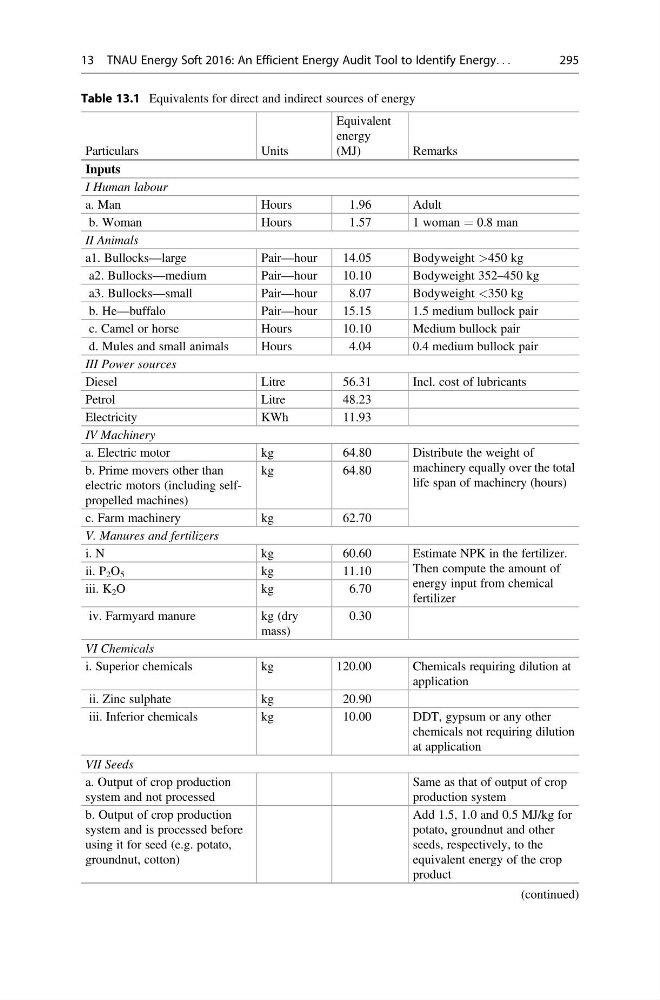
Table 13.1 Equivalents for direct and indirect sources of energy
Particulars
Units
Equivalent
energy
(MJ)
Remarks
Inputs
I Human labour
a. Man
Hours
1.96
Adult
b. Woman
Hours
1.57
1 woman ¼ 0.8 man
II Animals
a1. Bullocks—large
Pair—hour
14.05
Bodyweight >450 kg
a2. Bullocks—medium
Pair—hour
10.10
Bodyweight 352–450 kg
a3. Bullocks—small
Pair—hour
8.07
Bodyweight <350 kg
b. He—buffalo
Pair—hour
15.15
1.5 medium bullock pair
c. Camel or horse
Hours
10.10
Medium bullock pair
d. Mules and small animals
Hours
4.04
0.4 medium bullock pair
III Power sources
Diesel
Litre
56.31
Incl. cost of lubricants
Petrol
Litre
48.23
Electricity
KWh
11.93
IV Machinery
a. Electric motor
kg
64.80
Distribute the weight of
machinery equally over the total
life span of machinery (hours)
b. Prime movers other than
electric motors (including selfpropelled machines)
kg
64.80
c. Farm machinery
kg
62.70
V. Manures and fertilizers
i. N
kg
60.60
Estimate NPK in the fertilizer.
Then compute the amount of
energy input from chemical
fertilizer
ii. P 2 O 5
kg
11.10
iii. K 2 O
kg
6.70
iv. Farmyard manure
kg (dry
mass)
0.30
VI Chemicals
i. Superior chemicals
kg
120.00
Chemicals requiring dilution at
application
ii. Zinc sulphate
kg
20.90
iii. Inferior chemicals
kg
10.00
DDT, gypsum or any other
chemicals not requiring dilution
at application
VII Seeds
a. Output of crop production
system and not processed
Same as that of output of crop
production system
b. Output of crop production
system and is processed before
using it for seed (e.g. potato,
groundnut, cotton)
Add 1.5, 1.0 and 0.5 MJ/kg for
potato, groundnut and other
seeds, respectively, to the
equivalent energy of the crop
product
(continued)
13 TNAU Energy Soft 2016: An Efficient Energy Audit Tool to Identify Energy. . .
295
Particulars
Units
Equivalent
energy
(MJ)
Remarks
Inputs
I Human labour
a. Man
Hours
1.96
Adult
b. Woman
Hours
1.57
1 woman ¼ 0.8 man
II Animals
a1. Bullocks—large
Pair—hour
14.05
Bodyweight >450 kg
a2. Bullocks—medium
Pair—hour
10.10
Bodyweight 352–450 kg
a3. Bullocks—small
Pair—hour
8.07
Bodyweight <350 kg
b. He—buffalo
Pair—hour
15.15
1.5 medium bullock pair
c. Camel or horse
Hours
10.10
Medium bullock pair
d. Mules and small animals
Hours
4.04
0.4 medium bullock pair
III Power sources
Diesel
Litre
56.31
Incl. cost of lubricants
Petrol
Litre
48.23
Electricity
KWh
11.93
IV Machinery
a. Electric motor
kg
64.80
Distribute the weight of
machinery equally over the total
life span of machinery (hours)
b. Prime movers other than
electric motors (including selfpropelled machines)
kg
64.80
c. Farm machinery
kg
62.70
V. Manures and fertilizers
i. N
kg
60.60
Estimate NPK in the fertilizer.
Then compute the amount of
energy input from chemical
fertilizer
ii. P 2 O 5
kg
11.10
iii. K 2 O
kg
6.70
iv. Farmyard manure
kg (dry
mass)
0.30
VI Chemicals
i. Superior chemicals
kg
120.00
Chemicals requiring dilution at
application
ii. Zinc sulphate
kg
20.90
iii. Inferior chemicals
kg
10.00
DDT, gypsum or any other
chemicals not requiring dilution
at application
VII Seeds
a. Output of crop production
system and not processed
Same as that of output of crop
production system
b. Output of crop production
system and is processed before
using it for seed (e.g. potato,
groundnut, cotton)
Add 1.5, 1.0 and 0.5 MJ/kg for
potato, groundnut and other
seeds, respectively, to the
equivalent energy of the crop
product
(continued)
13 TNAU Energy Soft 2016: An Efficient Energy Audit Tool to Identify Energy. . .
295