

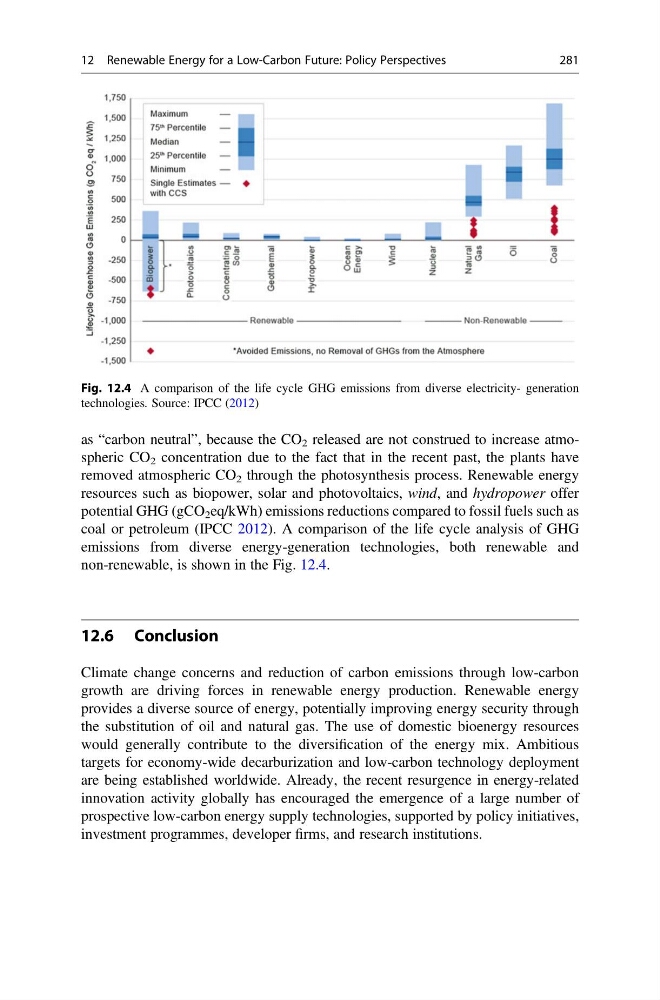
as “carbon neutral”, because the CO 2 released are not construed to increase atmospheric CO 2 concentration due to the fact that in the recent past, the plants have
removed atmospheric CO 2 through the photosynthesis process. Renewable energy
resources such as biopower, solar and photovoltaics, wind, and hydropower offer
potential GHG (gCO 2 eq/kWh) emissions reductions compared to fossil fuels such as
coal or petroleum (IPCC 2012). A comparison of the life cycle analysis of GHG
emissions from diverse energy-generation technologies, both renewable and
non-renewable, is shown in the Fig. 12.4.
12.6 Conclusion
Climate change concerns and reduction of carbon emissions through low-carbon
growth are driving forces in renewable energy production. Renewable energy
provides a diverse source of energy, potentially improving energy security through
the substitution of oil and natural gas. The use of domestic bioenergy resources
would generally contribute to the diversification of the energy mix. Ambitious
targets for economy-wide decarburization and low-carbon technology deployment
are being established worldwide. Already, the recent resurgence in energy-related
innovation activity globally has encouraged the emergence of a large number of
prospective low-carbon energy supply technologies, supported by policy initiatives,
investment programmes, developer firms, and research institutions.
Fig. 12.4 A comparison of the life cycle GHG emissions from diverse electricity- generation
technologies. Source: IPCC (2012)
12 Renewable Energy for a Low-Carbon Future: Policy Perspectives
281
removed atmospheric CO 2 through the photosynthesis process. Renewable energy
resources such as biopower, solar and photovoltaics, wind, and hydropower offer
potential GHG (gCO 2 eq/kWh) emissions reductions compared to fossil fuels such as
coal or petroleum (IPCC 2012). A comparison of the life cycle analysis of GHG
emissions from diverse energy-generation technologies, both renewable and
non-renewable, is shown in the Fig. 12.4.
12.6 Conclusion
Climate change concerns and reduction of carbon emissions through low-carbon
growth are driving forces in renewable energy production. Renewable energy
provides a diverse source of energy, potentially improving energy security through
the substitution of oil and natural gas. The use of domestic bioenergy resources
would generally contribute to the diversification of the energy mix. Ambitious
targets for economy-wide decarburization and low-carbon technology deployment
are being established worldwide. Already, the recent resurgence in energy-related
innovation activity globally has encouraged the emergence of a large number of
prospective low-carbon energy supply technologies, supported by policy initiatives,
investment programmes, developer firms, and research institutions.
Fig. 12.4 A comparison of the life cycle GHG emissions from diverse electricity- generation
technologies. Source: IPCC (2012)
12 Renewable Energy for a Low-Carbon Future: Policy Perspectives
281