

2030. It is perhaps an ambitious target. The national policy on climate change is also
tuned towards the use of clean energy sources. In the INDC, India has committed to
generate 40% of its total electricity consumption from non-fossil fuel sources by
2030. However, Central Electricity Authority’s strategy blueprint reveals a much
more ambitious goal of India. By the year 2027, the country aims to achieve about
60% of the total electricity generation from renewable sources. Towards this end, by
the year 2027, India aims to establish “275 GW from renewable energy, 72 GW of
hydroelectricity, 15 GW of nuclear power, and nearly 100 GW from other zero
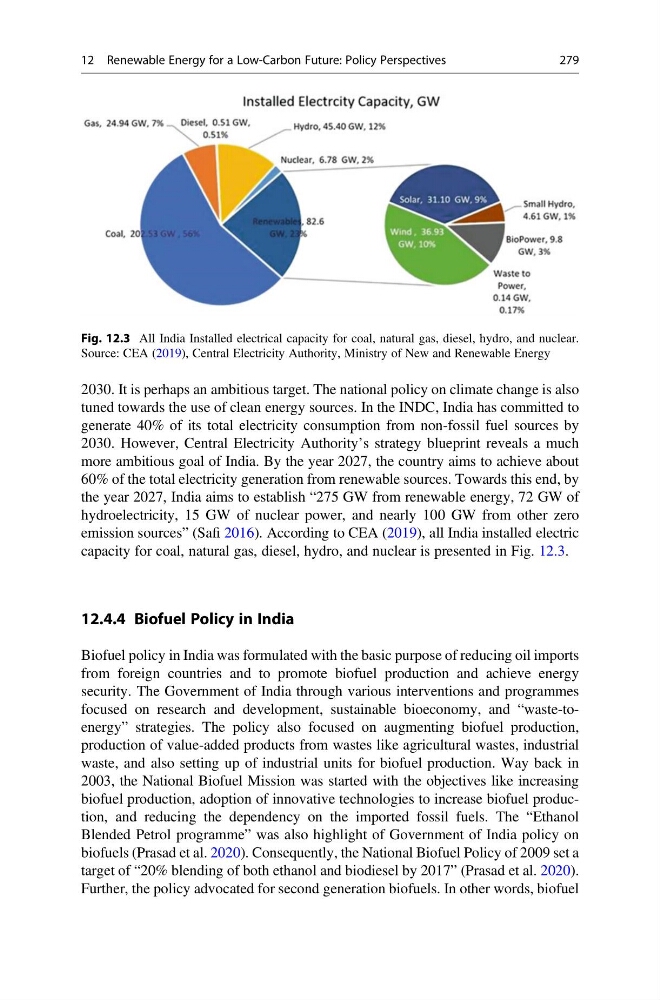
emission sources” (Safi 2016). According to CEA (2019), all India installed electric
capacity for coal, natural gas, diesel, hydro, and nuclear is presented in Fig. 12.3.
12.4.4 Biofuel Policy in India
Biofuel policy in India was formulated with the basic purpose of reducing oil imports
from foreign countries and to promote biofuel production and achieve energy
security. The Government of India through various interventions and programmes
focused on research and development, sustainable bioeconomy, and “waste-toenergy” strategies. The policy also focused on augmenting biofuel production,
production of value-added products from wastes like agricultural wastes, industrial
waste, and also setting up of industrial units for biofuel production. Way back in
2003, the National Biofuel Mission was started with the objectives like increasing
biofuel production, adoption of innovative technologies to increase biofuel production, and reducing the dependency on the imported fossil fuels. The “Ethanol
Blended Petrol programme” was also highlight of Government of India policy on
biofuels (Prasad et al. 2020). Consequently, the National Biofuel Policy of 2009 set a
target of “20% blending of both ethanol and biodiesel by 2017” (Prasad et al. 2020).
Further, the policy advocated for second generation biofuels. In other words, biofuel
Fig. 12.3 All India Installed electrical capacity for coal, natural gas, diesel, hydro, and nuclear.
Source: CEA (2019), Central Electricity Authority, Ministry of New and Renewable Energy
12 Renewable Energy for a Low-Carbon Future: Policy Perspectives
279
tuned towards the use of clean energy sources. In the INDC, India has committed to
generate 40% of its total electricity consumption from non-fossil fuel sources by
2030. However, Central Electricity Authority’s strategy blueprint reveals a much
more ambitious goal of India. By the year 2027, the country aims to achieve about
60% of the total electricity generation from renewable sources. Towards this end, by
the year 2027, India aims to establish “275 GW from renewable energy, 72 GW of
hydroelectricity, 15 GW of nuclear power, and nearly 100 GW from other zero
emission sources” (Safi 2016). According to CEA (2019), all India installed electric
capacity for coal, natural gas, diesel, hydro, and nuclear is presented in Fig. 12.3.
12.4.4 Biofuel Policy in India
Biofuel policy in India was formulated with the basic purpose of reducing oil imports
from foreign countries and to promote biofuel production and achieve energy
security. The Government of India through various interventions and programmes
focused on research and development, sustainable bioeconomy, and “waste-toenergy” strategies. The policy also focused on augmenting biofuel production,
production of value-added products from wastes like agricultural wastes, industrial
waste, and also setting up of industrial units for biofuel production. Way back in
2003, the National Biofuel Mission was started with the objectives like increasing
biofuel production, adoption of innovative technologies to increase biofuel production, and reducing the dependency on the imported fossil fuels. The “Ethanol
Blended Petrol programme” was also highlight of Government of India policy on
biofuels (Prasad et al. 2020). Consequently, the National Biofuel Policy of 2009 set a
target of “20% blending of both ethanol and biodiesel by 2017” (Prasad et al. 2020).
Further, the policy advocated for second generation biofuels. In other words, biofuel
Fig. 12.3 All India Installed electrical capacity for coal, natural gas, diesel, hydro, and nuclear.
Source: CEA (2019), Central Electricity Authority, Ministry of New and Renewable Energy
12 Renewable Energy for a Low-Carbon Future: Policy Perspectives
279