

canopy. This behaviour helps in the spread of the virus to cause infection in healthy
larvae. In commercial production, larvae are being harvested from the field or reared
in the laboratory and allowed to feed on the contaminated diet. Before the inoculation
of the virus, larvae are kept hungry for 24 h. Within three to four days larvae get
infected with the virus and hang upside down in tubes. Infected larvae are collected
and kept in water for purification. Purified larvae are crushed using mortar and pestle
with sterile chilled distilled water in a ratio of 1:2.5 (w/v). Homogenate filtered with
double layer muslin cloth and repeatedly washed with sterile distilled water in the
ratio of 1:7.5 to 12.5 (w/v) for the original weight of cadaver larva. The filtrate is
centrifuged to separate polyhedra from the debris. The pellets are repeatedly washed
and centrifuged three times with sterile distilled water and finally collected purified
polyhedra in the suspension are counted through haemocytometer. The dose of virus
is fixed as one larval equivalent (LE) that is 6 Â 10
9 . The effective lethal concentration (LC 50 ) of NPV is 1 Â 10
9
/mL for H. armigera larvae. For gram, pigeon pea and
cotton HNPV at 250–300 LE, 500 LE and 250 LE/ha should be used. Viruses are
very host-specific and can cause significant reduction in host populations. Examples
of some commercially available viruses include Helicoverpa zea single-enveloped
Nuclear polyhedrosis virus (HzSNVP), Spodoptera exigua multi-enveloped nuclear
polyhedrosis virus (SeMNPV) and Cydia pomonella granulovirus (CpGV).
Table 11.3 shows the list of commercially available viral biopesticides.
11.5.3 Advantages of Viral Biopesticides
• Viruses are safe to humans and other non-target organisms.
• The target organisms will not develop resistance against viral biopesticides.
• Viruses can be integrated with other methods of insect control including chemical
pesticides.
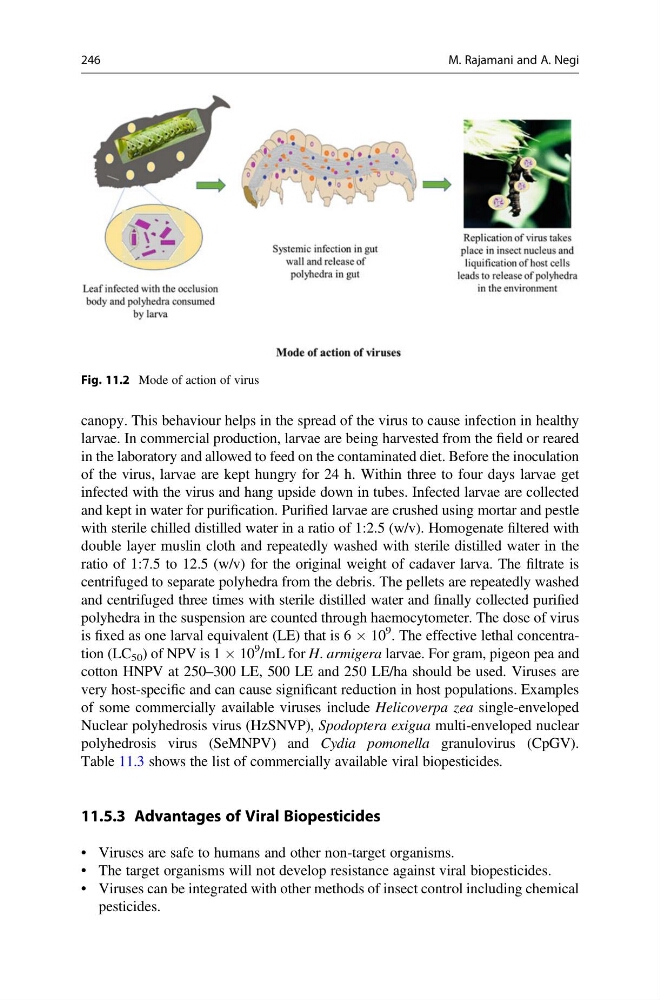
Fig. 11.2 Mode of action of virus
246
M. Rajamani and A. Negi
larvae. In commercial production, larvae are being harvested from the field or reared
in the laboratory and allowed to feed on the contaminated diet. Before the inoculation
of the virus, larvae are kept hungry for 24 h. Within three to four days larvae get
infected with the virus and hang upside down in tubes. Infected larvae are collected
and kept in water for purification. Purified larvae are crushed using mortar and pestle
with sterile chilled distilled water in a ratio of 1:2.5 (w/v). Homogenate filtered with
double layer muslin cloth and repeatedly washed with sterile distilled water in the
ratio of 1:7.5 to 12.5 (w/v) for the original weight of cadaver larva. The filtrate is
centrifuged to separate polyhedra from the debris. The pellets are repeatedly washed
and centrifuged three times with sterile distilled water and finally collected purified
polyhedra in the suspension are counted through haemocytometer. The dose of virus
is fixed as one larval equivalent (LE) that is 6 Â 10
9 . The effective lethal concentration (LC 50 ) of NPV is 1 Â 10
9
/mL for H. armigera larvae. For gram, pigeon pea and
cotton HNPV at 250–300 LE, 500 LE and 250 LE/ha should be used. Viruses are
very host-specific and can cause significant reduction in host populations. Examples
of some commercially available viruses include Helicoverpa zea single-enveloped
Nuclear polyhedrosis virus (HzSNVP), Spodoptera exigua multi-enveloped nuclear
polyhedrosis virus (SeMNPV) and Cydia pomonella granulovirus (CpGV).
Table 11.3 shows the list of commercially available viral biopesticides.
11.5.3 Advantages of Viral Biopesticides
• Viruses are safe to humans and other non-target organisms.
• The target organisms will not develop resistance against viral biopesticides.
• Viruses can be integrated with other methods of insect control including chemical
pesticides.
Fig. 11.2 Mode of action of virus
246
M. Rajamani and A. Negi