

depletion only deal with the environmental pillar of the sustainability assessment,
and the indicator is based on the problem of depletion only.
A considerable range of methodologies for assessing resource depletion in LCA
has been proposed, with different theoretical underpinnings. However, it is arguable
whether resource availability is an environmental or economic issue and whether this
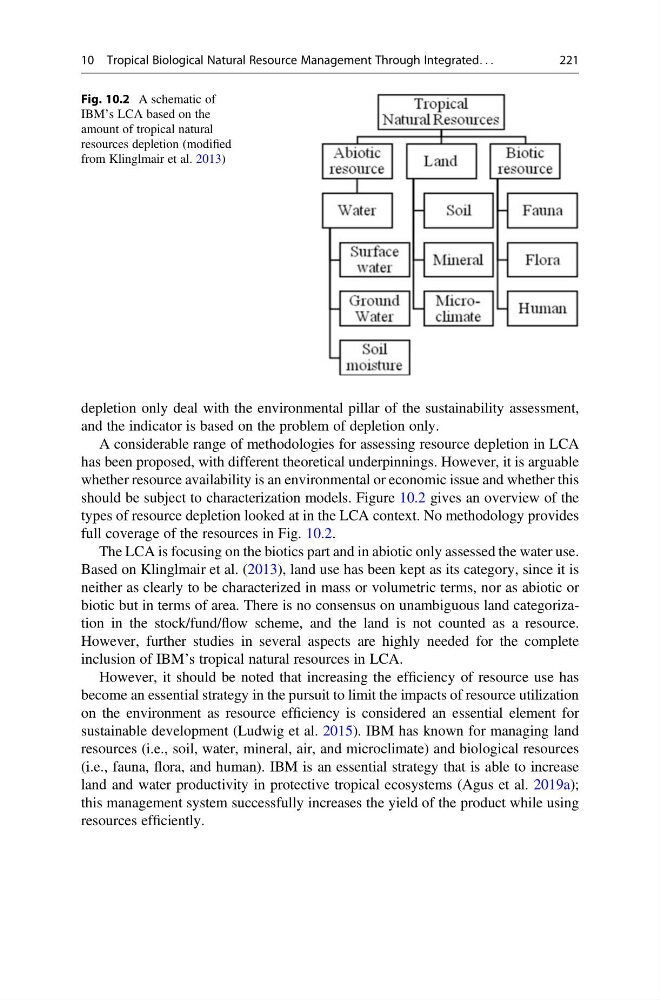
should be subject to characterization models. Figure 10.2 gives an overview of the
types of resource depletion looked at in the LCA context. No methodology provides
full coverage of the resources in Fig. 10.2.
The LCA is focusing on the biotics part and in abiotic only assessed the water use.
Based on Klinglmair et al. (2013), land use has been kept as its category, since it is
neither as clearly to be characterized in mass or volumetric terms, nor as abiotic or
biotic but in terms of area. There is no consensus on unambiguous land categorization in the stock/fund/flow scheme, and the land is not counted as a resource.
However, further studies in several aspects are highly needed for the complete
inclusion of IBM’s tropical natural resources in LCA.
However, it should be noted that increasing the efficiency of resource use has
become an essential strategy in the pursuit to limit the impacts of resource utilization
on the environment as resource efficiency is considered an essential element for
sustainable development (Ludwig et al. 2015). IBM has known for managing land
resources (i.e., soil, water, mineral, air, and microclimate) and biological resources
(i.e., fauna, flora, and human). IBM is an essential strategy that is able to increase
land and water productivity in protective tropical ecosystems (Agus et al. 2019a);
this management system successfully increases the yield of the product while using
resources efficiently.
Fig. 10.2 A schematic of
IBM’s LCA based on the
amount of tropical natural
resources depletion (modified
from Klinglmair et al. 2013)
10 Tropical Biological Natural Resource Management Through Integrated. . .
221
and the indicator is based on the problem of depletion only.
A considerable range of methodologies for assessing resource depletion in LCA
has been proposed, with different theoretical underpinnings. However, it is arguable
whether resource availability is an environmental or economic issue and whether this
should be subject to characterization models. Figure 10.2 gives an overview of the
types of resource depletion looked at in the LCA context. No methodology provides
full coverage of the resources in Fig. 10.2.
The LCA is focusing on the biotics part and in abiotic only assessed the water use.
Based on Klinglmair et al. (2013), land use has been kept as its category, since it is
neither as clearly to be characterized in mass or volumetric terms, nor as abiotic or
biotic but in terms of area. There is no consensus on unambiguous land categorization in the stock/fund/flow scheme, and the land is not counted as a resource.
However, further studies in several aspects are highly needed for the complete
inclusion of IBM’s tropical natural resources in LCA.
However, it should be noted that increasing the efficiency of resource use has
become an essential strategy in the pursuit to limit the impacts of resource utilization
on the environment as resource efficiency is considered an essential element for
sustainable development (Ludwig et al. 2015). IBM has known for managing land
resources (i.e., soil, water, mineral, air, and microclimate) and biological resources
(i.e., fauna, flora, and human). IBM is an essential strategy that is able to increase
land and water productivity in protective tropical ecosystems (Agus et al. 2019a);
this management system successfully increases the yield of the product while using
resources efficiently.
Fig. 10.2 A schematic of
IBM’s LCA based on the
amount of tropical natural
resources depletion (modified
from Klinglmair et al. 2013)
10 Tropical Biological Natural Resource Management Through Integrated. . .
221