

8.4
Testing Methods to Determine the Efficiency
of Phytochemicals against Stored Pests
8.4.1 Area Preference Test
Area preference test is the most commonly used test against stored pests which was
first validated by McDonald et al. (1970). Whatman filter paper can be used to
perform area preference test. It should be cut into halves and treated separately with
the extract and the solvent, respectively. After evaporating the solvents completely,
the halves of the filter paper were reattached using adhesive tape and placed inside a
petri dish leaving small gaps in between. The stored product insects, about 10 or
20 adults of same age were released in the middle of each petri plate and placed in a
dark environment. The number of insects that moved to the treated and
untreated sides of the filter paper were counted and noted down. The repellency
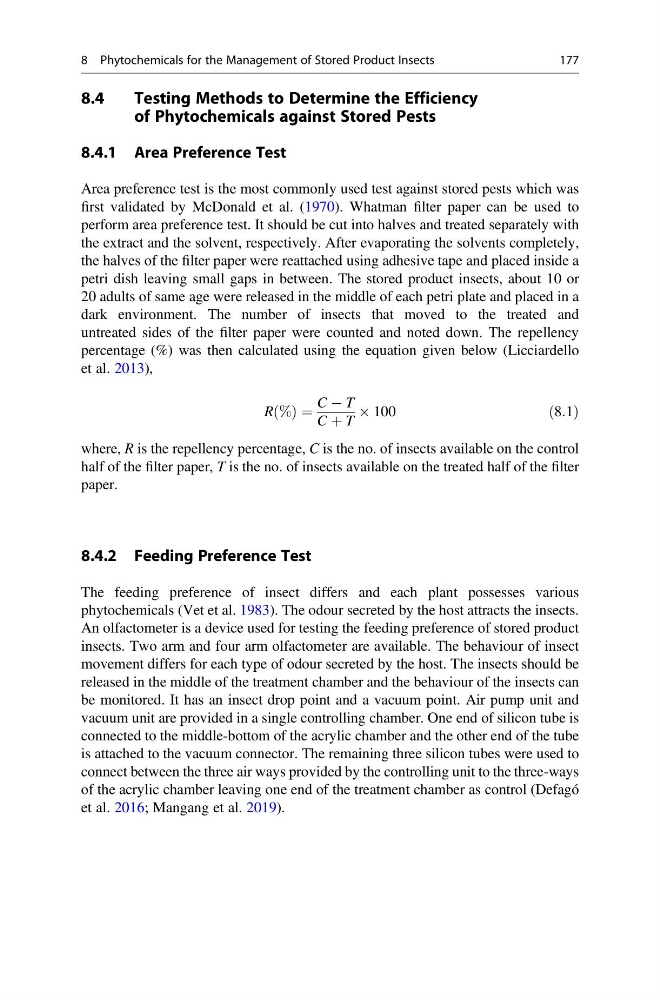
percentage (%) was then calculated using the equation given below (Licciardello
et al. 2013),
R %
ð Þ ¼
C À T
C þ T
 100
ð8:1Þ
where, R is the repellency percentage, C is the no. of insects available on the control
half of the filter paper, T is the no. of insects available on the treated half of the filter
paper.
8.4.2 Feeding Preference Test
The feeding preference of insect differs and each plant possesses various
phytochemicals (Vet et al. 1983). The odour secreted by the host attracts the insects.
An olfactometer is a device used for testing the feeding preference of stored product
insects. Two arm and four arm olfactometer are available. The behaviour of insect
movement differs for each type of odour secreted by the host. The insects should be
released in the middle of the treatment chamber and the behaviour of the insects can
be monitored. It has an insect drop point and a vacuum point. Air pump unit and
vacuum unit are provided in a single controlling chamber. One end of silicon tube is
connected to the middle-bottom of the acrylic chamber and the other end of the tube
is attached to the vacuum connector. The remaining three silicon tubes were used to
connect between the three air ways provided by the controlling unit to the three-ways
of the acrylic chamber leaving one end of the treatment chamber as control (Defagó
et al. 2016; Mangang et al. 2019).
8 Phytochemicals for the Management of Stored Product Insects
177
Testing Methods to Determine the Efficiency
of Phytochemicals against Stored Pests
8.4.1 Area Preference Test
Area preference test is the most commonly used test against stored pests which was
first validated by McDonald et al. (1970). Whatman filter paper can be used to
perform area preference test. It should be cut into halves and treated separately with
the extract and the solvent, respectively. After evaporating the solvents completely,
the halves of the filter paper were reattached using adhesive tape and placed inside a
petri dish leaving small gaps in between. The stored product insects, about 10 or
20 adults of same age were released in the middle of each petri plate and placed in a
dark environment. The number of insects that moved to the treated and
untreated sides of the filter paper were counted and noted down. The repellency
percentage (%) was then calculated using the equation given below (Licciardello
et al. 2013),
R %
ð Þ ¼
C À T
C þ T
 100
ð8:1Þ
where, R is the repellency percentage, C is the no. of insects available on the control
half of the filter paper, T is the no. of insects available on the treated half of the filter
paper.
8.4.2 Feeding Preference Test
The feeding preference of insect differs and each plant possesses various
phytochemicals (Vet et al. 1983). The odour secreted by the host attracts the insects.
An olfactometer is a device used for testing the feeding preference of stored product
insects. Two arm and four arm olfactometer are available. The behaviour of insect
movement differs for each type of odour secreted by the host. The insects should be
released in the middle of the treatment chamber and the behaviour of the insects can
be monitored. It has an insect drop point and a vacuum point. Air pump unit and
vacuum unit are provided in a single controlling chamber. One end of silicon tube is
connected to the middle-bottom of the acrylic chamber and the other end of the tube
is attached to the vacuum connector. The remaining three silicon tubes were used to
connect between the three air ways provided by the controlling unit to the three-ways
of the acrylic chamber leaving one end of the treatment chamber as control (Defagó
et al. 2016; Mangang et al. 2019).
8 Phytochemicals for the Management of Stored Product Insects
177