

complete package of technology for bioethanol production from lignocellulosic
feedstocks is still under development stage. Yeast and bacteria used in the fermentation process can yield alcohol and acid. The fermentable sugars are converted into
bioethanol/biobutanol with the help of yeast through the fermentation process.
6.3.2.3 Anaerobic Digestion
The agricultural crop residues can be converted into biogas and biodigesate through
the anaerobic digestion process. In this process, the microbial degradation of biomass materials takes place under anaerobic conditions. Most of the primary residues
require biomass pretreatment to enhance the biogas yield, and sometimes it performs
better for co-digestion of mixed residues with cow dung than crop residue alone. The
biodigesate can also be used as manure in the agricultural fields.
6.3.2.4 Hybrid Thermochemical: Biochemical Conversion Technology
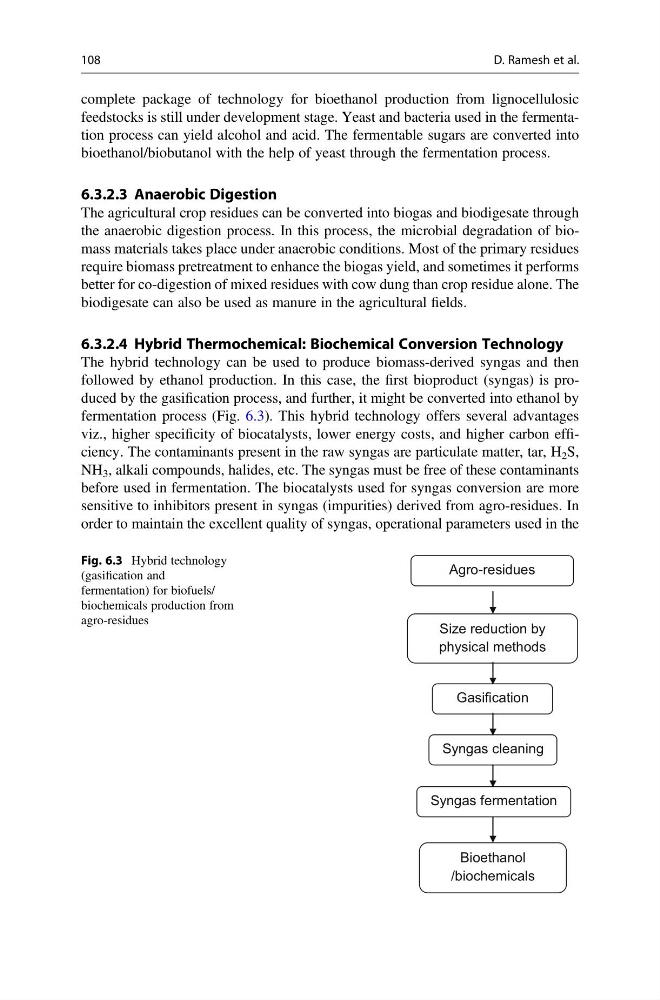
The hybrid technology can be used to produce biomass-derived syngas and then
followed by ethanol production. In this case, the first bioproduct (syngas) is produced by the gasification process, and further, it might be converted into ethanol by
fermentation process (Fig. 6.3). This hybrid technology offers several advantages
viz., higher specificity of biocatalysts, lower energy costs, and higher carbon efficiency. The contaminants present in the raw syngas are particulate matter, tar, H 2 S,
NH 3 , alkali compounds, halides, etc. The syngas must be free of these contaminants
before used in fermentation. The biocatalysts used for syngas conversion are more
sensitive to inhibitors present in syngas (impurities) derived from agro-residues. In
order to maintain the excellent quality of syngas, operational parameters used in the
Agro-residues
Bioethanol
/biochemicals
Size reduction by
physical methods
Gasification
Syngas cleaning
Syngas fermentation
Fig. 6.3 Hybrid technology
(gasification and
fermentation) for biofuels/
biochemicals production from
agro-residues
108
D. Ramesh et al.
feedstocks is still under development stage. Yeast and bacteria used in the fermentation process can yield alcohol and acid. The fermentable sugars are converted into
bioethanol/biobutanol with the help of yeast through the fermentation process.
6.3.2.3 Anaerobic Digestion
The agricultural crop residues can be converted into biogas and biodigesate through
the anaerobic digestion process. In this process, the microbial degradation of biomass materials takes place under anaerobic conditions. Most of the primary residues
require biomass pretreatment to enhance the biogas yield, and sometimes it performs
better for co-digestion of mixed residues with cow dung than crop residue alone. The
biodigesate can also be used as manure in the agricultural fields.
6.3.2.4 Hybrid Thermochemical: Biochemical Conversion Technology
The hybrid technology can be used to produce biomass-derived syngas and then
followed by ethanol production. In this case, the first bioproduct (syngas) is produced by the gasification process, and further, it might be converted into ethanol by
fermentation process (Fig. 6.3). This hybrid technology offers several advantages
viz., higher specificity of biocatalysts, lower energy costs, and higher carbon efficiency. The contaminants present in the raw syngas are particulate matter, tar, H 2 S,
NH 3 , alkali compounds, halides, etc. The syngas must be free of these contaminants
before used in fermentation. The biocatalysts used for syngas conversion are more
sensitive to inhibitors present in syngas (impurities) derived from agro-residues. In
order to maintain the excellent quality of syngas, operational parameters used in the
Agro-residues
Bioethanol
/biochemicals
Size reduction by
physical methods
Gasification
Syngas cleaning
Syngas fermentation
Fig. 6.3 Hybrid technology
(gasification and
fermentation) for biofuels/
biochemicals production from
agro-residues
108
D. Ramesh et al.