

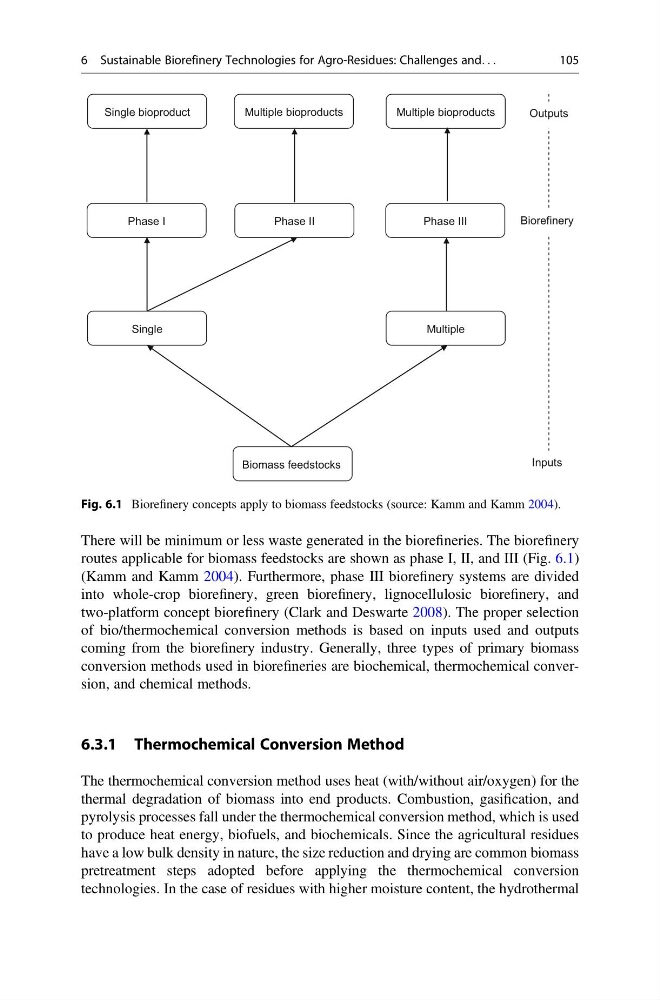
There will be minimum or less waste generated in the biorefineries. The biorefinery
routes applicable for biomass feedstocks are shown as phase I, II, and III (Fig. 6.1)
(Kamm and Kamm 2004). Furthermore, phase III biorefinery systems are divided
into whole-crop biorefinery, green biorefinery, lignocellulosic biorefinery, and
two-platform concept biorefinery (Clark and Deswarte 2008). The proper selection
of bio/thermochemical conversion methods is based on inputs used and outputs
coming from the biorefinery industry. Generally, three types of primary biomass
conversion methods used in biorefineries are biochemical, thermochemical conversion, and chemical methods.
6.3.1 Thermochemical Conversion Method
The thermochemical conversion method uses heat (with/without air/oxygen) for the
thermal degradation of biomass into end products. Combustion, gasification, and
pyrolysis processes fall under the thermochemical conversion method, which is used
to produce heat energy, biofuels, and biochemicals. Since the agricultural residues
have a low bulk density in nature, the size reduction and drying are common biomass
pretreatment steps adopted before applying the thermochemical conversion
technologies. In the case of residues with higher moisture content, the hydrothermal
Biomass feedstocks
Phase III
Phase II
Phase I
Multiple bioproducts
Multiple bioproducts
Single bioproduct
Multiple
Single
Inputs
Biorefinery
Outputs
Fig. 6.1 Biorefinery concepts apply to biomass feedstocks (source: Kamm and Kamm 2004).
6 Sustainable Biorefinery Technologies for Agro-Residues: Challenges and. . .
105
routes applicable for biomass feedstocks are shown as phase I, II, and III (Fig. 6.1)
(Kamm and Kamm 2004). Furthermore, phase III biorefinery systems are divided
into whole-crop biorefinery, green biorefinery, lignocellulosic biorefinery, and
two-platform concept biorefinery (Clark and Deswarte 2008). The proper selection
of bio/thermochemical conversion methods is based on inputs used and outputs
coming from the biorefinery industry. Generally, three types of primary biomass
conversion methods used in biorefineries are biochemical, thermochemical conversion, and chemical methods.
6.3.1 Thermochemical Conversion Method
The thermochemical conversion method uses heat (with/without air/oxygen) for the
thermal degradation of biomass into end products. Combustion, gasification, and
pyrolysis processes fall under the thermochemical conversion method, which is used
to produce heat energy, biofuels, and biochemicals. Since the agricultural residues
have a low bulk density in nature, the size reduction and drying are common biomass
pretreatment steps adopted before applying the thermochemical conversion
technologies. In the case of residues with higher moisture content, the hydrothermal
Biomass feedstocks
Phase III
Phase II
Phase I
Multiple bioproducts
Multiple bioproducts
Single bioproduct
Multiple
Single
Inputs
Biorefinery
Outputs
Fig. 6.1 Biorefinery concepts apply to biomass feedstocks (source: Kamm and Kamm 2004).
6 Sustainable Biorefinery Technologies for Agro-Residues: Challenges and. . .
105