

Bioethanol
Global demand for bioethanol has increased considerably. Currently biomass to
biofuels route are most commercialized and many pilot and industrial plants are
operated. Due to the increased demand, alternative feedstocks are explored simultaneously. It was observed that fermentation of food wastes at high solids content with
a vacuum recovery system yielded higher amounts of bioethanol than the conventional fermentation (Huang et al. 2015). Thus food waste can also be a suitable
substrate for bioethanol production as they do not require multi-step pretreatment
processes for biofuel production.
Biodiesel Production
Biodiesel is a mixture of esterified fatty acid and is conventionally produced from
non-edible and few edible oils, cooked oils, and fats from animal origin. However,
their supply is very limited and cannot meet the increasing demand. There are
microorganisms called oleaginous microorganisms that can accumulate lipid in
their biomass. These oleaginous microorganisms have potential to convert food
wastes into lipids. The lipids are trans-esterified with chloroform and methanol in
the presence of KOH (potassium hydroxide) to form biodiesel.
5.2.2.3 Chemicals Production from Food Wastes
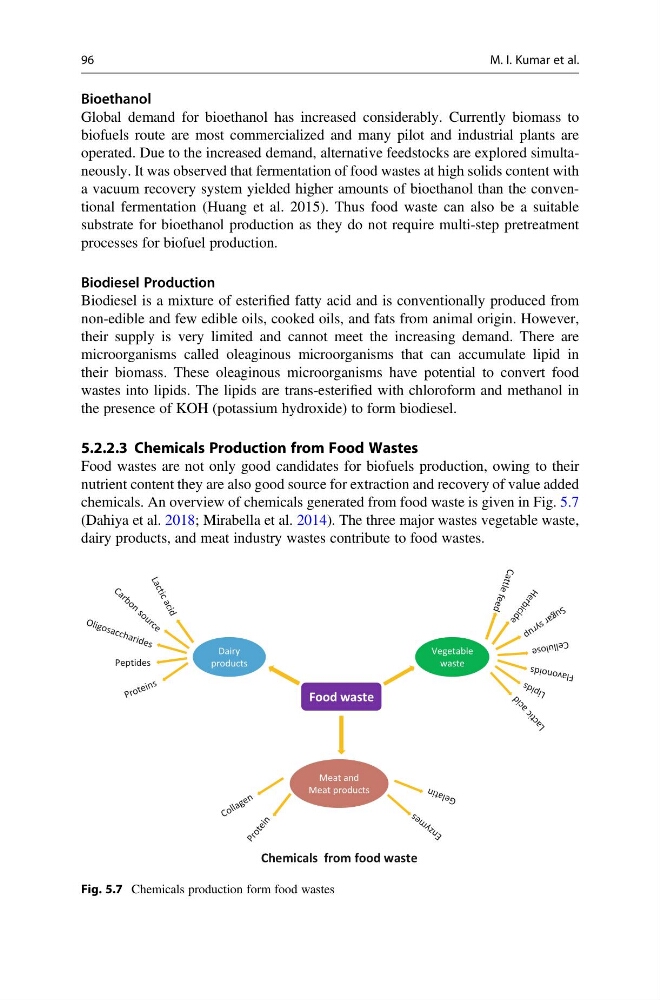
Food wastes are not only good candidates for biofuels production, owing to their
nutrient content they are also good source for extraction and recovery of value added
chemicals. An overview of chemicals generated from food waste is given in Fig. 5.7
(Dahiya et al. 2018; Mirabella et al. 2014). The three major wastes vegetable waste,
dairy products, and meat industry wastes contribute to food wastes.
Food waste
Dairy
products
Peptides
Vegetable
waste
Meat and
Meat products
Chemicals from food waste
Fig. 5.7 Chemicals production form food wastes
96
M. I. Kumar et al.
Global demand for bioethanol has increased considerably. Currently biomass to
biofuels route are most commercialized and many pilot and industrial plants are
operated. Due to the increased demand, alternative feedstocks are explored simultaneously. It was observed that fermentation of food wastes at high solids content with
a vacuum recovery system yielded higher amounts of bioethanol than the conventional fermentation (Huang et al. 2015). Thus food waste can also be a suitable
substrate for bioethanol production as they do not require multi-step pretreatment
processes for biofuel production.
Biodiesel Production
Biodiesel is a mixture of esterified fatty acid and is conventionally produced from
non-edible and few edible oils, cooked oils, and fats from animal origin. However,
their supply is very limited and cannot meet the increasing demand. There are
microorganisms called oleaginous microorganisms that can accumulate lipid in
their biomass. These oleaginous microorganisms have potential to convert food
wastes into lipids. The lipids are trans-esterified with chloroform and methanol in
the presence of KOH (potassium hydroxide) to form biodiesel.
5.2.2.3 Chemicals Production from Food Wastes
Food wastes are not only good candidates for biofuels production, owing to their
nutrient content they are also good source for extraction and recovery of value added
chemicals. An overview of chemicals generated from food waste is given in Fig. 5.7
(Dahiya et al. 2018; Mirabella et al. 2014). The three major wastes vegetable waste,
dairy products, and meat industry wastes contribute to food wastes.
Food waste
Dairy
products
Peptides
Vegetable
waste
Meat and
Meat products
Chemicals from food waste
Fig. 5.7 Chemicals production form food wastes
96
M. I. Kumar et al.