

Leisure Activities and Loneliness Among People with Disabilities
77
remaining explanatory variables included in our model, we find, for example, that
individuals who identified themselves as male, German, and living with a partner
or within a household with a higher number of members reported lower levels of
loneliness as compared to the reference person. We also find that age differences in
loneliness, as well as having higher real household income, and working statues (full
or part-timers) contribute to reporting lower loneliness scores.
To check the robustness of our results, we have also re-estimated our model for
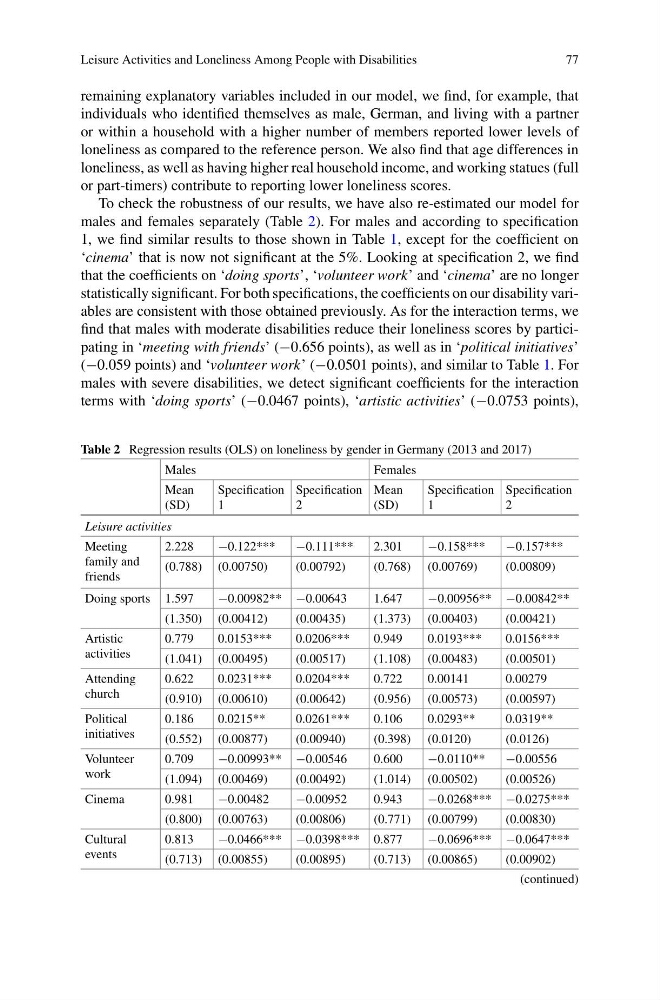
males and females separately (Table 2). For males and according to specification
1, we find similar results to those shown in Table 1, except for the coefficient on
‘cinema’ that is now not significant at the 5%. Looking at specification 2, we find
that the coefficients on ‘doing sports’, ‘volunteer work’ and ‘cinema’ are no longer
statistically significant. For both specifications, the coefficients on our disability variables are consistent with those obtained previously. As for the interaction terms, we
find that males with moderate disabilities reduce their loneliness scores by participating in ‘meeting with friends’ (−0.656 points), as well as in ‘political initiatives’
(−0.059 points) and ‘volunteer work’ (−0.0501 points), and similar to Table 1. For
males with severe disabilities, we detect significant coefficients for the interaction
terms with ‘doing sports’ (−0.0467 points), ‘artistic activities’ (−0.0753 points),
Table 2 Regression results (OLS) on loneliness by gender in Germany (2013 and 2017)
Males
Females
Mean
(SD)
Specification
1
Specification
2
Mean
(SD)
Specification
1
Specification
2
Leisure activities
Meeting
family and
friends
2.228
−0.122***
−0.111***
2.301
−0.158***
−0.157***
(0.788) (0.00750)
(0.00792)
(0.768) (0.00769)
(0.00809)
Doing sports 1.597
−0.00982** −0.00643
1.647
−0.00956** −0.00842**
(1.350) (0.00412)
(0.00435)
(1.373) (0.00403)
(0.00421)
Artistic
activities
0.779
0.0153***
0.0206***
0.949
0.0193***
0.0156***
(1.041) (0.00495)
(0.00517)
(1.108) (0.00483)
(0.00501)
Attending
church
0.622
0.0231***
0.0204***
0.722
0.00141
0.00279
(0.910) (0.00610)
(0.00642)
(0.956) (0.00573)
(0.00597)
Political
initiatives
0.186
0.0215**
0.0261***
0.106
0.0293**
0.0319**
(0.552) (0.00877)
(0.00940)
(0.398) (0.0120)
(0.0126)
Volunteer
work
0.709
−0.00993** −0.00546
0.600
−0.0110**
−0.00556
(1.094) (0.00469)
(0.00492)
(1.014) (0.00502)
(0.00526)
Cinema
0.981
−0.00482
−0.00952
0.943
−0.0268*** −0.0275***
(0.800) (0.00763)
(0.00806)
(0.771) (0.00799)
(0.00830)
Cultural
events
0.813
−0.0466*** −0.0398*** 0.877
−0.0696*** −0.0647***
(0.713) (0.00855)
(0.00895)
(0.713) (0.00865)
(0.00902)
(continued)
77
remaining explanatory variables included in our model, we find, for example, that
individuals who identified themselves as male, German, and living with a partner
or within a household with a higher number of members reported lower levels of
loneliness as compared to the reference person. We also find that age differences in
loneliness, as well as having higher real household income, and working statues (full
or part-timers) contribute to reporting lower loneliness scores.
To check the robustness of our results, we have also re-estimated our model for
males and females separately (Table 2). For males and according to specification
1, we find similar results to those shown in Table 1, except for the coefficient on
‘cinema’ that is now not significant at the 5%. Looking at specification 2, we find
that the coefficients on ‘doing sports’, ‘volunteer work’ and ‘cinema’ are no longer
statistically significant. For both specifications, the coefficients on our disability variables are consistent with those obtained previously. As for the interaction terms, we
find that males with moderate disabilities reduce their loneliness scores by participating in ‘meeting with friends’ (−0.656 points), as well as in ‘political initiatives’
(−0.059 points) and ‘volunteer work’ (−0.0501 points), and similar to Table 1. For
males with severe disabilities, we detect significant coefficients for the interaction
terms with ‘doing sports’ (−0.0467 points), ‘artistic activities’ (−0.0753 points),
Table 2 Regression results (OLS) on loneliness by gender in Germany (2013 and 2017)
Males
Females
Mean
(SD)
Specification
1
Specification
2
Mean
(SD)
Specification
1
Specification
2
Leisure activities
Meeting
family and
friends
2.228
−0.122***
−0.111***
2.301
−0.158***
−0.157***
(0.788) (0.00750)
(0.00792)
(0.768) (0.00769)
(0.00809)
Doing sports 1.597
−0.00982** −0.00643
1.647
−0.00956** −0.00842**
(1.350) (0.00412)
(0.00435)
(1.373) (0.00403)
(0.00421)
Artistic
activities
0.779
0.0153***
0.0206***
0.949
0.0193***
0.0156***
(1.041) (0.00495)
(0.00517)
(1.108) (0.00483)
(0.00501)
Attending
church
0.622
0.0231***
0.0204***
0.722
0.00141
0.00279
(0.910) (0.00610)
(0.00642)
(0.956) (0.00573)
(0.00597)
Political
initiatives
0.186
0.0215**
0.0261***
0.106
0.0293**
0.0319**
(0.552) (0.00877)
(0.00940)
(0.398) (0.0120)
(0.0126)
Volunteer
work
0.709
−0.00993** −0.00546
0.600
−0.0110**
−0.00556
(1.094) (0.00469)
(0.00492)
(1.014) (0.00502)
(0.00526)
Cinema
0.981
−0.00482
−0.00952
0.943
−0.0268*** −0.0275***
(0.800) (0.00763)
(0.00806)
(0.771) (0.00799)
(0.00830)
Cultural
events
0.813
−0.0466*** −0.0398*** 0.877
−0.0696*** −0.0647***
(0.713) (0.00855)
(0.00895)
(0.713) (0.00865)
(0.00902)
(continued)