

228
A. Machnik
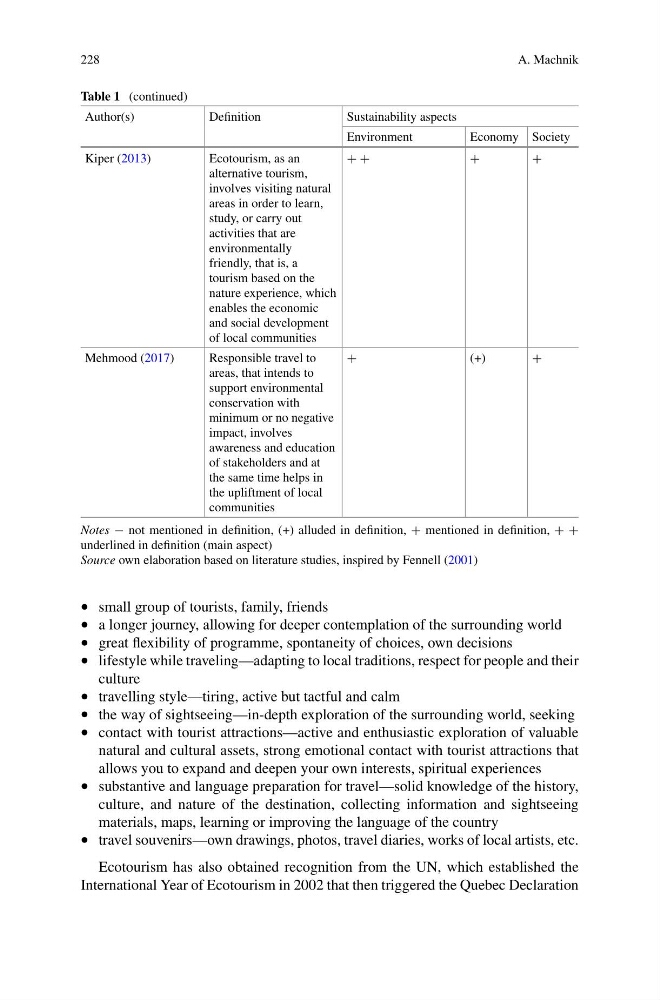
Table 1 (continued)
Author(s)
Definition
Sustainability aspects
Environment
Economy Society
Kiper (2013)
Ecotourism, as an
alternative tourism,
involves visiting natural
areas in order to learn,
study, or carry out
activities that are
environmentally
friendly, that is, a
tourism based on the
nature experience, which
enables the economic
and social development
of local communities
+ +
+
+
Mehmood (2017)
Responsible travel to
areas, that intends to
support environmental
conservation with
minimum or no negative
impact, involves
awareness and education
of stakeholders and at
the same time helps in
the upliftment of local
communities
+
(+)
+
Notes − not mentioned in definition, (+) alluded in definition, + mentioned in definition, + +
underlined in definition (main aspect)
Source own elaboration based on literature studies, inspired by Fennell (2001)
• small group of tourists, family, friends
• a longer journey, allowing for deeper contemplation of the surrounding world
• great flexibility of programme, spontaneity of choices, own decisions
• lifestyle while traveling—adapting to local traditions, respect for people and their
culture
• travelling style—tiring, active but tactful and calm
• the way of sightseeing—in-depth exploration of the surrounding world, seeking
• contact with tourist attractions—active and enthusiastic exploration of valuable
natural and cultural assets, strong emotional contact with tourist attractions that
allows you to expand and deepen your own interests, spiritual experiences
• substantive and language preparation for travel—solid knowledge of the history,
culture, and nature of the destination, collecting information and sightseeing
materials, maps, learning or improving the language of the country
• travel souvenirs—own drawings, photos, travel diaries, works of local artists, etc.
Ecotourism has also obtained recognition from the UN, which established the
International Year of Ecotourism in 2002 that then triggered the Quebec Declaration
A. Machnik
Table 1 (continued)
Author(s)
Definition
Sustainability aspects
Environment
Economy Society
Kiper (2013)
Ecotourism, as an
alternative tourism,
involves visiting natural
areas in order to learn,
study, or carry out
activities that are
environmentally
friendly, that is, a
tourism based on the
nature experience, which
enables the economic
and social development
of local communities
+ +
+
+
Mehmood (2017)
Responsible travel to
areas, that intends to
support environmental
conservation with
minimum or no negative
impact, involves
awareness and education
of stakeholders and at
the same time helps in
the upliftment of local
communities
+
(+)
+
Notes − not mentioned in definition, (+) alluded in definition, + mentioned in definition, + +
underlined in definition (main aspect)
Source own elaboration based on literature studies, inspired by Fennell (2001)
• small group of tourists, family, friends
• a longer journey, allowing for deeper contemplation of the surrounding world
• great flexibility of programme, spontaneity of choices, own decisions
• lifestyle while traveling—adapting to local traditions, respect for people and their
culture
• travelling style—tiring, active but tactful and calm
• the way of sightseeing—in-depth exploration of the surrounding world, seeking
• contact with tourist attractions—active and enthusiastic exploration of valuable
natural and cultural assets, strong emotional contact with tourist attractions that
allows you to expand and deepen your own interests, spiritual experiences
• substantive and language preparation for travel—solid knowledge of the history,
culture, and nature of the destination, collecting information and sightseeing
materials, maps, learning or improving the language of the country
• travel souvenirs—own drawings, photos, travel diaries, works of local artists, etc.
Ecotourism has also obtained recognition from the UN, which established the
International Year of Ecotourism in 2002 that then triggered the Quebec Declaration