

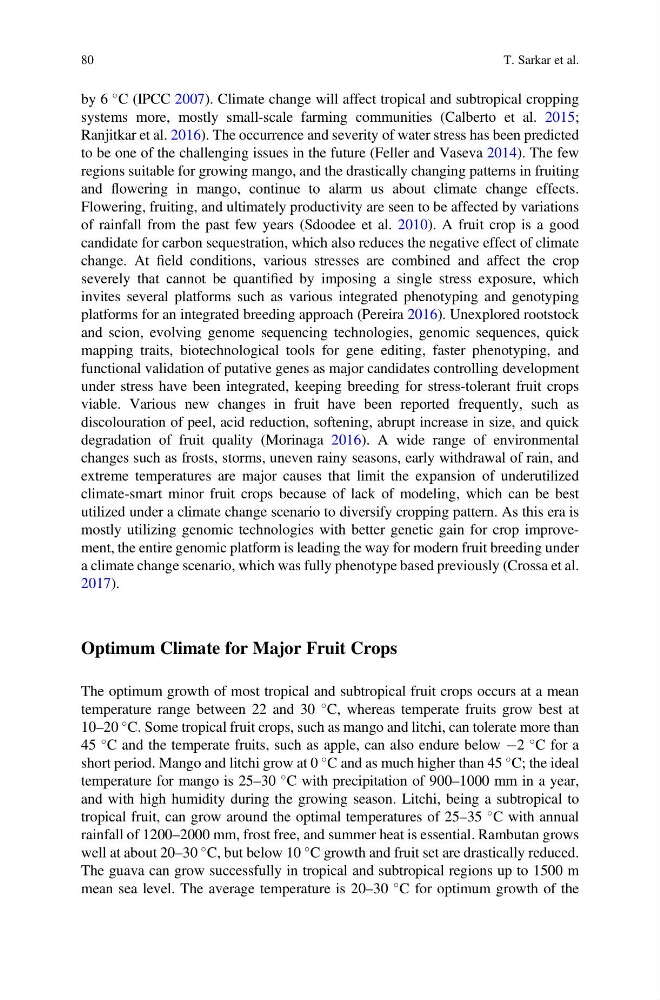
by 6
C (IPCC 2007). Climate change will affect tropical and subtropical cropping
systems more, mostly small-scale farming communities (Calberto et al. 2015;
Ranjitkar et al. 2016). The occurrence and severity of water stress has been predicted
to be one of the challenging issues in the future (Feller and Vaseva 2014). The few
regions suitable for growing mango, and the drastically changing patterns in fruiting
and flowering in mango, continue to alarm us about climate change effects.
Flowering, fruiting, and ultimately productivity are seen to be affected by variations
of rainfall from the past few years (Sdoodee et al. 2010). A fruit crop is a good
candidate for carbon sequestration, which also reduces the negative effect of climate
change. At field conditions, various stresses are combined and affect the crop
severely that cannot be quantified by imposing a single stress exposure, which
invites several platforms such as various integrated phenotyping and genotyping
platforms for an integrated breeding approach (Pereira 2016). Unexplored rootstock
and scion, evolving genome sequencing technologies, genomic sequences, quick
mapping traits, biotechnological tools for gene editing, faster phenotyping, and
functional validation of putative genes as major candidates controlling development
under stress have been integrated, keeping breeding for stress-tolerant fruit crops
viable. Various new changes in fruit have been reported frequently, such as
discolouration of peel, acid reduction, softening, abrupt increase in size, and quick
degradation of fruit quality (Morinaga 2016). A wide range of environmental
changes such as frosts, storms, uneven rainy seasons, early withdrawal of rain, and
extreme temperatures are major causes that limit the expansion of underutilized
climate-smart minor fruit crops because of lack of modeling, which can be best
utilized under a climate change scenario to diversify cropping pattern. As this era is
mostly utilizing genomic technologies with better genetic gain for crop improvement, the entire genomic platform is leading the way for modern fruit breeding under
a climate change scenario, which was fully phenotype based previously (Crossa et al.
2017).
Optimum Climate for Major Fruit Crops
The optimum growth of most tropical and subtropical fruit crops occurs at a mean
temperature range between 22 and 30
C, whereas temperate fruits grow best at
10–20
C. Some tropical fruit crops, such as mango and litchi, can tolerate more than
45
C and the temperate fruits, such as apple, can also endure below À2
C for a
short period. Mango and litchi grow at 0
C and as much higher than 45
C; the ideal
temperature for mango is 25–30
C with precipitation of 900–1000 mm in a year,
and with high humidity during the growing season. Litchi, being a subtropical to
tropical fruit, can grow around the optimal temperatures of 25–35
C with annual
rainfall of 1200–2000 mm, frost free, and summer heat is essential. Rambutan grows
well at about 20–30
C, but below 10
C growth and fruit set are drastically reduced.
The guava can grow successfully in tropical and subtropical regions up to 1500 m
mean sea level. The average temperature is 20–30
C for optimum growth of the
80
T. Sarkar et al.
C (IPCC 2007). Climate change will affect tropical and subtropical cropping
systems more, mostly small-scale farming communities (Calberto et al. 2015;
Ranjitkar et al. 2016). The occurrence and severity of water stress has been predicted
to be one of the challenging issues in the future (Feller and Vaseva 2014). The few
regions suitable for growing mango, and the drastically changing patterns in fruiting
and flowering in mango, continue to alarm us about climate change effects.
Flowering, fruiting, and ultimately productivity are seen to be affected by variations
of rainfall from the past few years (Sdoodee et al. 2010). A fruit crop is a good
candidate for carbon sequestration, which also reduces the negative effect of climate
change. At field conditions, various stresses are combined and affect the crop
severely that cannot be quantified by imposing a single stress exposure, which
invites several platforms such as various integrated phenotyping and genotyping
platforms for an integrated breeding approach (Pereira 2016). Unexplored rootstock
and scion, evolving genome sequencing technologies, genomic sequences, quick
mapping traits, biotechnological tools for gene editing, faster phenotyping, and
functional validation of putative genes as major candidates controlling development
under stress have been integrated, keeping breeding for stress-tolerant fruit crops
viable. Various new changes in fruit have been reported frequently, such as
discolouration of peel, acid reduction, softening, abrupt increase in size, and quick
degradation of fruit quality (Morinaga 2016). A wide range of environmental
changes such as frosts, storms, uneven rainy seasons, early withdrawal of rain, and
extreme temperatures are major causes that limit the expansion of underutilized
climate-smart minor fruit crops because of lack of modeling, which can be best
utilized under a climate change scenario to diversify cropping pattern. As this era is
mostly utilizing genomic technologies with better genetic gain for crop improvement, the entire genomic platform is leading the way for modern fruit breeding under
a climate change scenario, which was fully phenotype based previously (Crossa et al.
2017).
Optimum Climate for Major Fruit Crops
The optimum growth of most tropical and subtropical fruit crops occurs at a mean
temperature range between 22 and 30
C, whereas temperate fruits grow best at
10–20
C. Some tropical fruit crops, such as mango and litchi, can tolerate more than
45
C and the temperate fruits, such as apple, can also endure below À2
C for a
short period. Mango and litchi grow at 0
C and as much higher than 45
C; the ideal
temperature for mango is 25–30
C with precipitation of 900–1000 mm in a year,
and with high humidity during the growing season. Litchi, being a subtropical to
tropical fruit, can grow around the optimal temperatures of 25–35
C with annual
rainfall of 1200–2000 mm, frost free, and summer heat is essential. Rambutan grows
well at about 20–30
C, but below 10
C growth and fruit set are drastically reduced.
The guava can grow successfully in tropical and subtropical regions up to 1500 m
mean sea level. The average temperature is 20–30
C for optimum growth of the
80
T. Sarkar et al.