

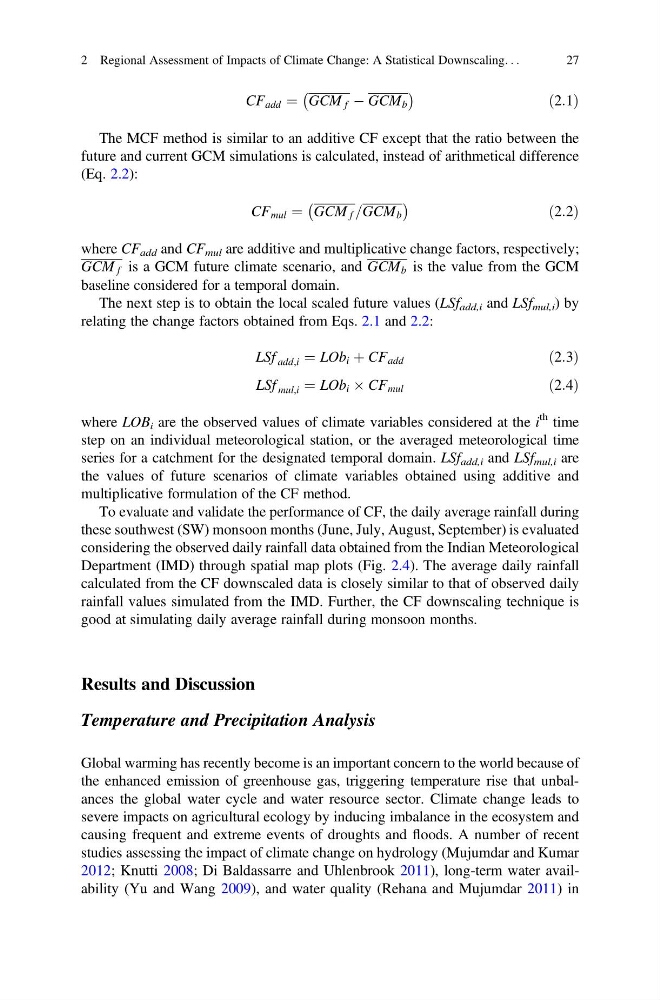
CF add ¼ GCM f À GCM b
À
Á
ð2:1Þ
The MCF method is similar to an additive CF except that the ratio between the
future and current GCM simulations is calculated, instead of arithmetical difference
(Eq. 2.2):
CF mul ¼ GCM f =GCM b
À
Á
ð2:2Þ
where CF add and CF mul are additive and multiplicative change factors, respectively;
GCM f is a GCM future climate scenario, and GCM b is the value from the GCM
baseline considered for a temporal domain.
The next step is to obtain the local scaled future values (LSf add,i and LSf mul,i ) by
relating the change factors obtained from Eqs. 2.1 and 2.2:
LSf add,i ¼ LOb i þ CF add
ð2:3Þ
LSf mul,i ¼ LOb i  CF mul
ð2:4Þ
where LOB i are the observed values of climate variables considered at the i
th time
step on an individual meteorological station, or the averaged meteorological time
series for a catchment for the designated temporal domain. LSf add,i and LSf mul,i are
the values of future scenarios of climate variables obtained using additive and
multiplicative formulation of the CF method.
To evaluate and validate the performance of CF, the daily average rainfall during
these southwest (SW) monsoon months (June, July, August, September) is evaluated
considering the observed daily rainfall data obtained from the Indian Meteorological
Department (IMD) through spatial map plots (Fig. 2.4). The average daily rainfall
calculated from the CF downscaled data is closely similar to that of observed daily
rainfall values simulated from the IMD. Further, the CF downscaling technique is
good at simulating daily average rainfall during monsoon months.
Results and Discussion
Temperature and Precipitation Analysis
Global warming has recently become is an important concern to the world because of
the enhanced emission of greenhouse gas, triggering temperature rise that unbalances the global water cycle and water resource sector. Climate change leads to
severe impacts on agricultural ecology by inducing imbalance in the ecosystem and
causing frequent and extreme events of droughts and floods. A number of recent
studies assessing the impact of climate change on hydrology (Mujumdar and Kumar
2012; Knutti 2008; Di Baldassarre and Uhlenbrook 2011), long-term water availability (Yu and Wang 2009), and water quality (Rehana and Mujumdar 2011) in
2 Regional Assessment of Impacts of Climate Change: A Statistical Downscaling. . .
27
À
Á
ð2:1Þ
The MCF method is similar to an additive CF except that the ratio between the
future and current GCM simulations is calculated, instead of arithmetical difference
(Eq. 2.2):
CF mul ¼ GCM f =GCM b
À
Á
ð2:2Þ
where CF add and CF mul are additive and multiplicative change factors, respectively;
GCM f is a GCM future climate scenario, and GCM b is the value from the GCM
baseline considered for a temporal domain.
The next step is to obtain the local scaled future values (LSf add,i and LSf mul,i ) by
relating the change factors obtained from Eqs. 2.1 and 2.2:
LSf add,i ¼ LOb i þ CF add
ð2:3Þ
LSf mul,i ¼ LOb i  CF mul
ð2:4Þ
where LOB i are the observed values of climate variables considered at the i
th time
step on an individual meteorological station, or the averaged meteorological time
series for a catchment for the designated temporal domain. LSf add,i and LSf mul,i are
the values of future scenarios of climate variables obtained using additive and
multiplicative formulation of the CF method.
To evaluate and validate the performance of CF, the daily average rainfall during
these southwest (SW) monsoon months (June, July, August, September) is evaluated
considering the observed daily rainfall data obtained from the Indian Meteorological
Department (IMD) through spatial map plots (Fig. 2.4). The average daily rainfall
calculated from the CF downscaled data is closely similar to that of observed daily
rainfall values simulated from the IMD. Further, the CF downscaling technique is
good at simulating daily average rainfall during monsoon months.
Results and Discussion
Temperature and Precipitation Analysis
Global warming has recently become is an important concern to the world because of
the enhanced emission of greenhouse gas, triggering temperature rise that unbalances the global water cycle and water resource sector. Climate change leads to
severe impacts on agricultural ecology by inducing imbalance in the ecosystem and
causing frequent and extreme events of droughts and floods. A number of recent
studies assessing the impact of climate change on hydrology (Mujumdar and Kumar
2012; Knutti 2008; Di Baldassarre and Uhlenbrook 2011), long-term water availability (Yu and Wang 2009), and water quality (Rehana and Mujumdar 2011) in
2 Regional Assessment of Impacts of Climate Change: A Statistical Downscaling. . .
27