

The Framework for Adaptation and Mitigation
Geothermal developments contribute to mitigation by eliminating sources
dependent on fossil fuel for generating power or heat. These processes also
lead to adaptation by cascading usage of climate-sensitive sectors that enhance
adaptive capability, although the possibility of enforcing geothermal infrastructure
projects in a grid-based converter network, or in an off-grid mini-grid, offers
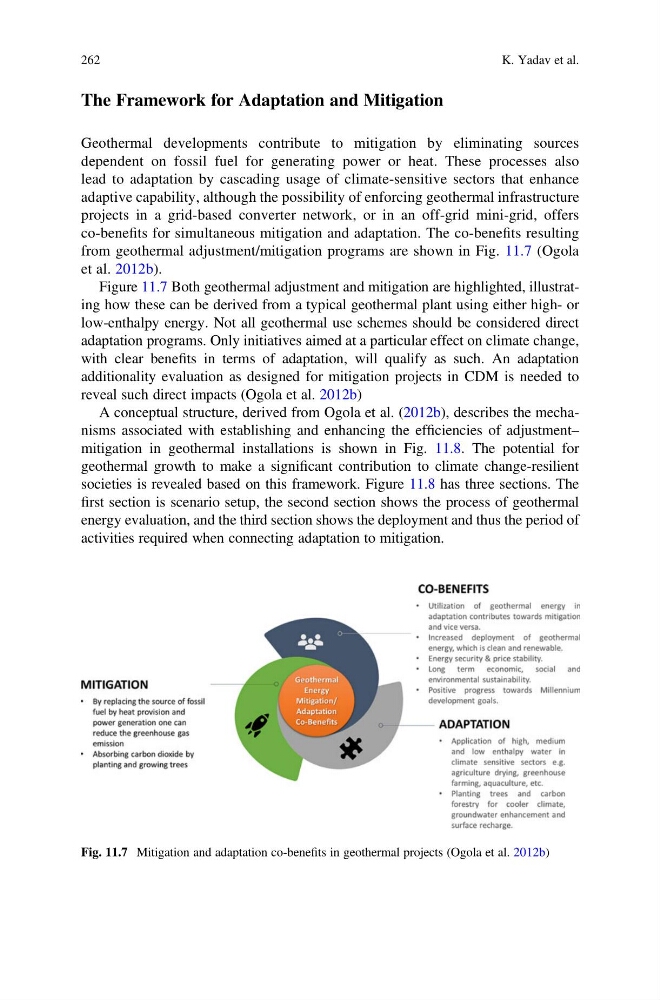
co-benefits for simultaneous mitigation and adaptation. The co-benefits resulting
from geothermal adjustment/mitigation programs are shown in Fig. 11.7 (Ogola
et al. 2012b).
Figure 11.7 Both geothermal adjustment and mitigation are highlighted, illustrating how these can be derived from a typical geothermal plant using either high- or
low-enthalpy energy. Not all geothermal use schemes should be considered direct
adaptation programs. Only initiatives aimed at a particular effect on climate change,
with clear benefits in terms of adaptation, will qualify as such. An adaptation
additionality evaluation as designed for mitigation projects in CDM is needed to
reveal such direct impacts (Ogola et al. 2012b)
A conceptual structure, derived from Ogola et al. (2012b), describes the mechanisms associated with establishing and enhancing the efficiencies of adjustment–
mitigation in geothermal installations is shown in Fig. 11.8. The potential for
geothermal growth to make a significant contribution to climate change-resilient
societies is revealed based on this framework. Figure 11.8 has three sections. The
first section is scenario setup, the second section shows the process of geothermal
energy evaluation, and the third section shows the deployment and thus the period of
activities required when connecting adaptation to mitigation.
Fig. 11.7 Mitigation and adaptation co-benefits in geothermal projects (Ogola et al. 2012b)
262
K. Yadav et al.
Geothermal developments contribute to mitigation by eliminating sources
dependent on fossil fuel for generating power or heat. These processes also
lead to adaptation by cascading usage of climate-sensitive sectors that enhance
adaptive capability, although the possibility of enforcing geothermal infrastructure
projects in a grid-based converter network, or in an off-grid mini-grid, offers
co-benefits for simultaneous mitigation and adaptation. The co-benefits resulting
from geothermal adjustment/mitigation programs are shown in Fig. 11.7 (Ogola
et al. 2012b).
Figure 11.7 Both geothermal adjustment and mitigation are highlighted, illustrating how these can be derived from a typical geothermal plant using either high- or
low-enthalpy energy. Not all geothermal use schemes should be considered direct
adaptation programs. Only initiatives aimed at a particular effect on climate change,
with clear benefits in terms of adaptation, will qualify as such. An adaptation
additionality evaluation as designed for mitigation projects in CDM is needed to
reveal such direct impacts (Ogola et al. 2012b)
A conceptual structure, derived from Ogola et al. (2012b), describes the mechanisms associated with establishing and enhancing the efficiencies of adjustment–
mitigation in geothermal installations is shown in Fig. 11.8. The potential for
geothermal growth to make a significant contribution to climate change-resilient
societies is revealed based on this framework. Figure 11.8 has three sections. The
first section is scenario setup, the second section shows the process of geothermal
energy evaluation, and the third section shows the deployment and thus the period of
activities required when connecting adaptation to mitigation.
Fig. 11.7 Mitigation and adaptation co-benefits in geothermal projects (Ogola et al. 2012b)
262
K. Yadav et al.