

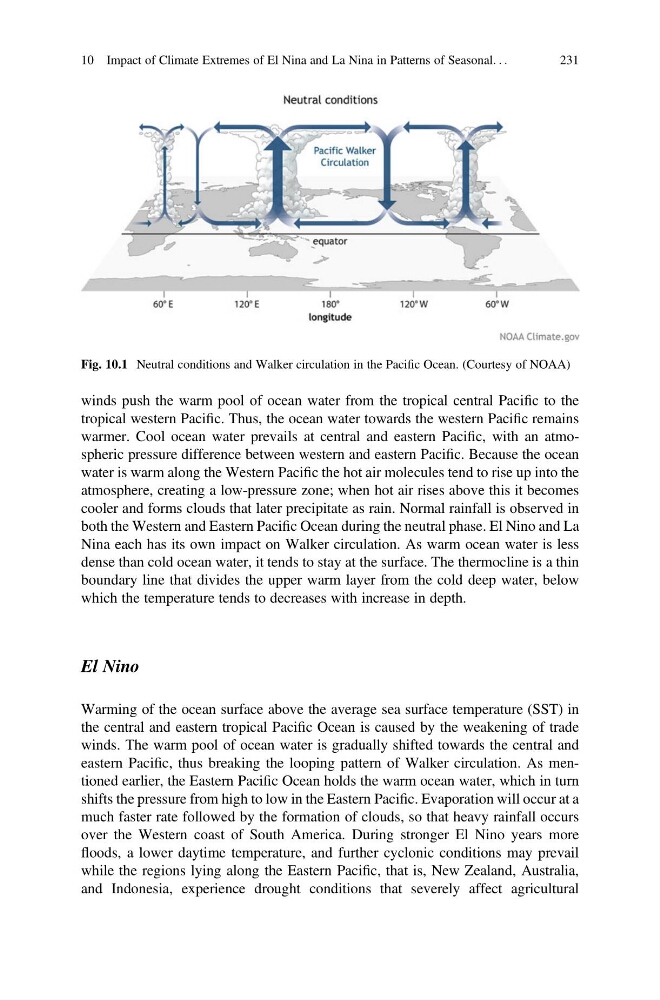
winds push the warm pool of ocean water from the tropical central Pacific to the
tropical western Pacific. Thus, the ocean water towards the western Pacific remains
warmer. Cool ocean water prevails at central and eastern Pacific, with an atmospheric pressure difference between western and eastern Pacific. Because the ocean
water is warm along the Western Pacific the hot air molecules tend to rise up into the
atmosphere, creating a low-pressure zone; when hot air rises above this it becomes
cooler and forms clouds that later precipitate as rain. Normal rainfall is observed in
both the Western and Eastern Pacific Ocean during the neutral phase. El Nino and La
Nina each has its own impact on Walker circulation. As warm ocean water is less
dense than cold ocean water, it tends to stay at the surface. The thermocline is a thin
boundary line that divides the upper warm layer from the cold deep water, below
which the temperature tends to decreases with increase in depth.
El Nino
Warming of the ocean surface above the average sea surface temperature (SST) in
the central and eastern tropical Pacific Ocean is caused by the weakening of trade
winds. The warm pool of ocean water is gradually shifted towards the central and
eastern Pacific, thus breaking the looping pattern of Walker circulation. As mentioned earlier, the Eastern Pacific Ocean holds the warm ocean water, which in turn
shifts the pressure from high to low in the Eastern Pacific. Evaporation will occur at a
much faster rate followed by the formation of clouds, so that heavy rainfall occurs
over the Western coast of South America. During stronger El Nino years more
floods, a lower daytime temperature, and further cyclonic conditions may prevail
while the regions lying along the Eastern Pacific, that is, New Zealand, Australia,
and Indonesia, experience drought conditions that severely affect agricultural
Fig. 10.1 Neutral conditions and Walker circulation in the Pacific Ocean. (Courtesy of NOAA)
10 Impact of Climate Extremes of El Nina and La Nina in Patterns of Seasonal. . .
231
tropical western Pacific. Thus, the ocean water towards the western Pacific remains
warmer. Cool ocean water prevails at central and eastern Pacific, with an atmospheric pressure difference between western and eastern Pacific. Because the ocean
water is warm along the Western Pacific the hot air molecules tend to rise up into the
atmosphere, creating a low-pressure zone; when hot air rises above this it becomes
cooler and forms clouds that later precipitate as rain. Normal rainfall is observed in
both the Western and Eastern Pacific Ocean during the neutral phase. El Nino and La
Nina each has its own impact on Walker circulation. As warm ocean water is less
dense than cold ocean water, it tends to stay at the surface. The thermocline is a thin
boundary line that divides the upper warm layer from the cold deep water, below
which the temperature tends to decreases with increase in depth.
El Nino
Warming of the ocean surface above the average sea surface temperature (SST) in
the central and eastern tropical Pacific Ocean is caused by the weakening of trade
winds. The warm pool of ocean water is gradually shifted towards the central and
eastern Pacific, thus breaking the looping pattern of Walker circulation. As mentioned earlier, the Eastern Pacific Ocean holds the warm ocean water, which in turn
shifts the pressure from high to low in the Eastern Pacific. Evaporation will occur at a
much faster rate followed by the formation of clouds, so that heavy rainfall occurs
over the Western coast of South America. During stronger El Nino years more
floods, a lower daytime temperature, and further cyclonic conditions may prevail
while the regions lying along the Eastern Pacific, that is, New Zealand, Australia,
and Indonesia, experience drought conditions that severely affect agricultural
Fig. 10.1 Neutral conditions and Walker circulation in the Pacific Ocean. (Courtesy of NOAA)
10 Impact of Climate Extremes of El Nina and La Nina in Patterns of Seasonal. . .
231