

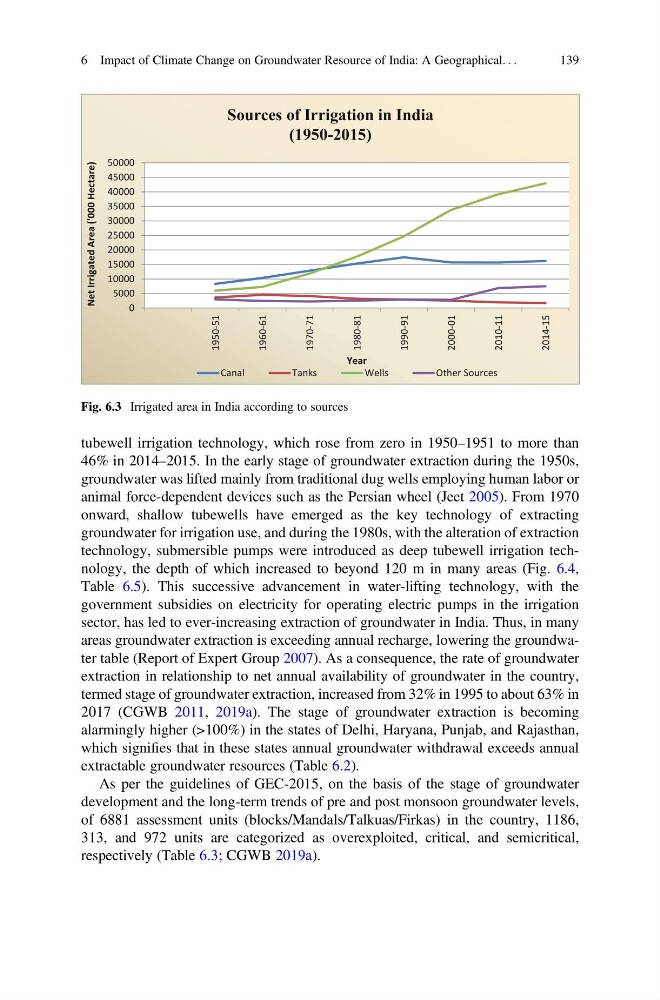
tubewell irrigation technology, which rose from zero in 1950–1951 to more than
46% in 2014–2015. In the early stage of groundwater extraction during the 1950s,
groundwater was lifted mainly from traditional dug wells employing human labor or
animal force-dependent devices such as the Persian wheel (Jeet 2005). From 1970
onward, shallow tubewells have emerged as the key technology of extracting
groundwater for irrigation use, and during the 1980s, with the alteration of extraction
technology, submersible pumps were introduced as deep tubewell irrigation technology, the depth of which increased to beyond 120 m in many areas (Fig. 6.4,
Table 6.5). This successive advancement in water-lifting technology, with the
government subsidies on electricity for operating electric pumps in the irrigation
sector, has led to ever-increasing extraction of groundwater in India. Thus, in many
areas groundwater extraction is exceeding annual recharge, lowering the groundwater table (Report of Expert Group 2007). As a consequence, the rate of groundwater
extraction in relationship to net annual availability of groundwater in the country,
termed stage of groundwater extraction, increased from 32% in 1995 to about 63% in
2017 (CGWB 2011, 2019a). The stage of groundwater extraction is becoming
alarmingly higher (>100%) in the states of Delhi, Haryana, Punjab, and Rajasthan,
which signifies that in these states annual groundwater withdrawal exceeds annual
extractable groundwater resources (Table 6.2).
As per the guidelines of GEC-2015, on the basis of the stage of groundwater
development and the long-term trends of pre and post monsoon groundwater levels,
of 6881 assessment units (blocks/Mandals/Talkuas/Firkas) in the country, 1186,
313, and 972 units are categorized as overexploited, critical, and semicritical,
respectively (Table 6.3; CGWB 2019a).
0
5000
10000
15000
20000
25000
30000
35000
40000
45000
50000
1950-51
1960-61
1970-71
1980-81
1990-91
2000-01
2010-11
2014-15
)
e
r
a
t
c
e
H
0
0
0
'
(
a
e
r
A
d
e
t
a
g
i
r
r
I
t
e
N
Year
Sources of Irrigation in India
(1950-2015)
Canal
Tanks
Wells
Other Sources
Fig. 6.3 Irrigated area in India according to sources
6 Impact of Climate Change on Groundwater Resource of India: A Geographical. . .
139
46% in 2014–2015. In the early stage of groundwater extraction during the 1950s,
groundwater was lifted mainly from traditional dug wells employing human labor or
animal force-dependent devices such as the Persian wheel (Jeet 2005). From 1970
onward, shallow tubewells have emerged as the key technology of extracting
groundwater for irrigation use, and during the 1980s, with the alteration of extraction
technology, submersible pumps were introduced as deep tubewell irrigation technology, the depth of which increased to beyond 120 m in many areas (Fig. 6.4,
Table 6.5). This successive advancement in water-lifting technology, with the
government subsidies on electricity for operating electric pumps in the irrigation
sector, has led to ever-increasing extraction of groundwater in India. Thus, in many
areas groundwater extraction is exceeding annual recharge, lowering the groundwater table (Report of Expert Group 2007). As a consequence, the rate of groundwater
extraction in relationship to net annual availability of groundwater in the country,
termed stage of groundwater extraction, increased from 32% in 1995 to about 63% in
2017 (CGWB 2011, 2019a). The stage of groundwater extraction is becoming
alarmingly higher (>100%) in the states of Delhi, Haryana, Punjab, and Rajasthan,
which signifies that in these states annual groundwater withdrawal exceeds annual
extractable groundwater resources (Table 6.2).
As per the guidelines of GEC-2015, on the basis of the stage of groundwater
development and the long-term trends of pre and post monsoon groundwater levels,
of 6881 assessment units (blocks/Mandals/Talkuas/Firkas) in the country, 1186,
313, and 972 units are categorized as overexploited, critical, and semicritical,
respectively (Table 6.3; CGWB 2019a).
0
5000
10000
15000
20000
25000
30000
35000
40000
45000
50000
1950-51
1960-61
1970-71
1980-81
1990-91
2000-01
2010-11
2014-15
)
e
r
a
t
c
e
H
0
0
0
'
(
a
e
r
A
d
e
t
a
g
i
r
r
I
t
e
N
Year
Sources of Irrigation in India
(1950-2015)
Canal
Tanks
Wells
Other Sources
Fig. 6.3 Irrigated area in India according to sources
6 Impact of Climate Change on Groundwater Resource of India: A Geographical. . .
139