

66
3 Vibrational Up-Pumping: Predicting Impact Sensitivity of Some …
of the material through . For naphthalene, V/V o = 0.793 at 4 GPa, while for αNaN 3 this value is ca. 0.860 [10], and ca. 0.915 for AgN 3 [11]. Thus the values of
(NaN 3 ) [12] ≈ (AgN 3 ) [13], whilst (naphthalene) is nearly 2.5-fold higher [6].
The proportion of impact energy that is converted to heat is therefore expected to be
lower for the inorganic azide materials. The energy that is introduced into the material affects only the lattice vibrations, which equilibrate very rapidly. This leads to a
highly excited phonon region, or bath [7, 8, 14]. Noting that the heat capacity of the
phonon bath is much lower than for the bulk material, it was found that the phonon
quasi-temperatures reach approximately 2300 K, corresponding to ca. 1.2 eV per
molecule in napthalene [6].
In addition to the impact-induced heating of the material, a second process, fracture, can occur [3]. Within the contact surface, stresses build beyond the elastic limit
of the material. This leads to plastic deformation in the form of dislocations or fracture
[15]. Analogous to the rupture of a loaded spring, the sudden rupture of non-covalent
(or covalent) interactions along a fracture surface leads to rapid excitation of lattice
vibrations associated with the ruptured interaction [16]. Rapid equilibration again
leads to formation of a ‘hot’ phonon bath.
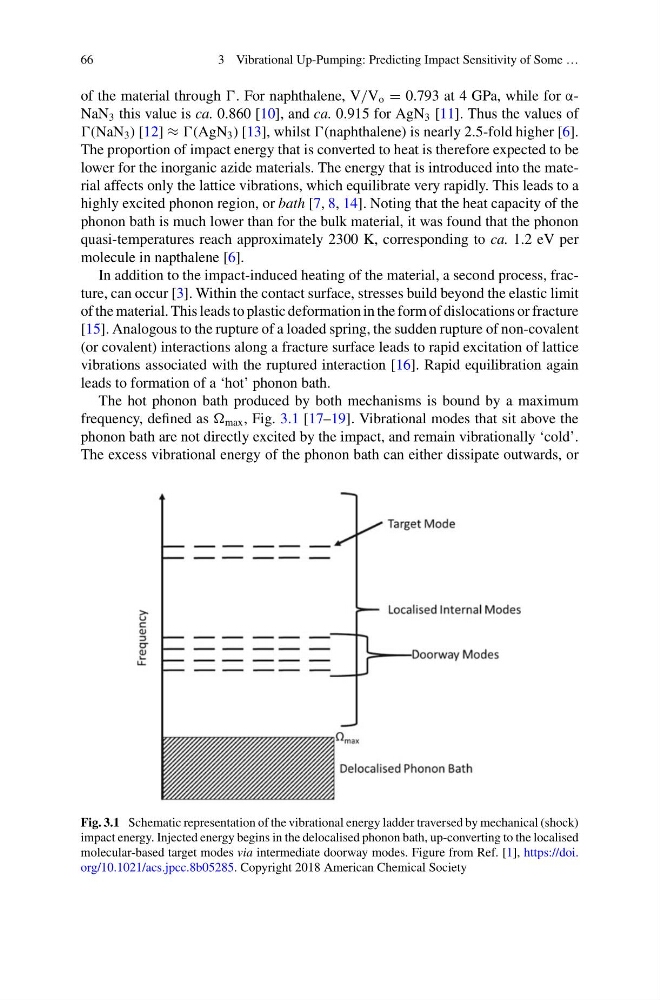
The hot phonon bath produced by both mechanisms is bound by a maximum
frequency, defined as max , Fig. 3.1 [17–19]. Vibrational modes that sit above the
phonon bath are not directly excited by the impact, and remain vibrationally ‘cold’.
The excess vibrational energy of the phonon bath can either dissipate outwards, or
Fig. 3.1 Schematic representation of the vibrational energy ladder traversed by mechanical (shock)
impact energy. Injected energy begins in the delocalised phonon bath, up-converting to the localised
molecular-based target modes via intermediate doorway modes. Figure from Ref. [1], https://doi.
org/10.1021/acs.jpcc.8b05285. Copyright 2018 American Chemical Society
3 Vibrational Up-Pumping: Predicting Impact Sensitivity of Some …
of the material through . For naphthalene, V/V o = 0.793 at 4 GPa, while for αNaN 3 this value is ca. 0.860 [10], and ca. 0.915 for AgN 3 [11]. Thus the values of
(NaN 3 ) [12] ≈ (AgN 3 ) [13], whilst (naphthalene) is nearly 2.5-fold higher [6].
The proportion of impact energy that is converted to heat is therefore expected to be
lower for the inorganic azide materials. The energy that is introduced into the material affects only the lattice vibrations, which equilibrate very rapidly. This leads to a
highly excited phonon region, or bath [7, 8, 14]. Noting that the heat capacity of the
phonon bath is much lower than for the bulk material, it was found that the phonon
quasi-temperatures reach approximately 2300 K, corresponding to ca. 1.2 eV per
molecule in napthalene [6].
In addition to the impact-induced heating of the material, a second process, fracture, can occur [3]. Within the contact surface, stresses build beyond the elastic limit
of the material. This leads to plastic deformation in the form of dislocations or fracture
[15]. Analogous to the rupture of a loaded spring, the sudden rupture of non-covalent
(or covalent) interactions along a fracture surface leads to rapid excitation of lattice
vibrations associated with the ruptured interaction [16]. Rapid equilibration again
leads to formation of a ‘hot’ phonon bath.
The hot phonon bath produced by both mechanisms is bound by a maximum
frequency, defined as max , Fig. 3.1 [17–19]. Vibrational modes that sit above the
phonon bath are not directly excited by the impact, and remain vibrationally ‘cold’.
The excess vibrational energy of the phonon bath can either dissipate outwards, or
Fig. 3.1 Schematic representation of the vibrational energy ladder traversed by mechanical (shock)
impact energy. Injected energy begins in the delocalised phonon bath, up-converting to the localised
molecular-based target modes via intermediate doorway modes. Figure from Ref. [1], https://doi.
org/10.1021/acs.jpcc.8b05285. Copyright 2018 American Chemical Society