

56
2 Experimental and Computational Methods
1, where the INS beamline is located). These protons have immense energy (ca.
800 MeV), which excites nuclei in the target. This induces an intranuclear cascade,
which in turn leads to emission of high energy neutrons (approximately 15 per proton)
Hence, an intense neutron pulse is generated. The neutrons that result from this
process have energies on the order of ~2 MeV, termed epithermal neutrons. However,
these are too energetic for most practical applications. To reduce the energy of these
neutrons, they are therefore passed through a moderator. For the TOSCA beamline,
this is ambient temperature (300 K) water [70]. The neutrons undergo numerous
inelastic collisions with the water molecules, and their energy is therefore subdued.
The resulting neutrons (known as thermal neutrons) adhere to a Maxwell-Boltzmann
distribution of energies, about a peak flux that is characteristic of the moderator. For
water, the peak flux is approximately 200 cm
−1 . It is these thermal neutrons that are
finally passed to the instrument and used for INS.
2.2.2.2 The TOSCA Instrument
The TOSCA instrument was used for collection of INS spectra in this work [69–
71]. TOSCA is an indirect geometry time-of-flight (ToF) neutron spectrometer with
resolution ω/ω ≈ 2 − 3%. As an indirect instrument, the experiment works by
fixing the final energy of the detected neutrons that are scattered from the sample, and
scans the incident energies. As described above, the incident neutron beam contains
a distribution of neutron energies (i.e. it is a white beam), which are characterised by
their kinetic energy and hence the rate at which they reach the sample. To maximise
signal, TOSCA utilises both forward and backward scattering detectors. Only the
neutrons which scatter at fixed angles (45
o or 135
o ) will impinge on the analyser
crystals (the (002) plane of pyrolytic graphite). It follows from Bragg’s law, Eq. 2.41
that since the scattering Bragg plane is fixed, only a single wavelength (and its
higher orders) of neutron will be passed from the analyser crystal to the detector.
All remaining neutrons will pass through the analyser crystal and are absorbed by
the spectrometer shield. The neutrons that are scattered by the analyser are passed
through a beryllium filter, scattering away neutrons with multiples of the fundamental
wavelength. Finally the remaining neutrons are detected by a bank of
3 He filled
detector tubes. The result of using both the graphite analyser in parallel with the
beryllium filters is to create a narrow band-pass filter.
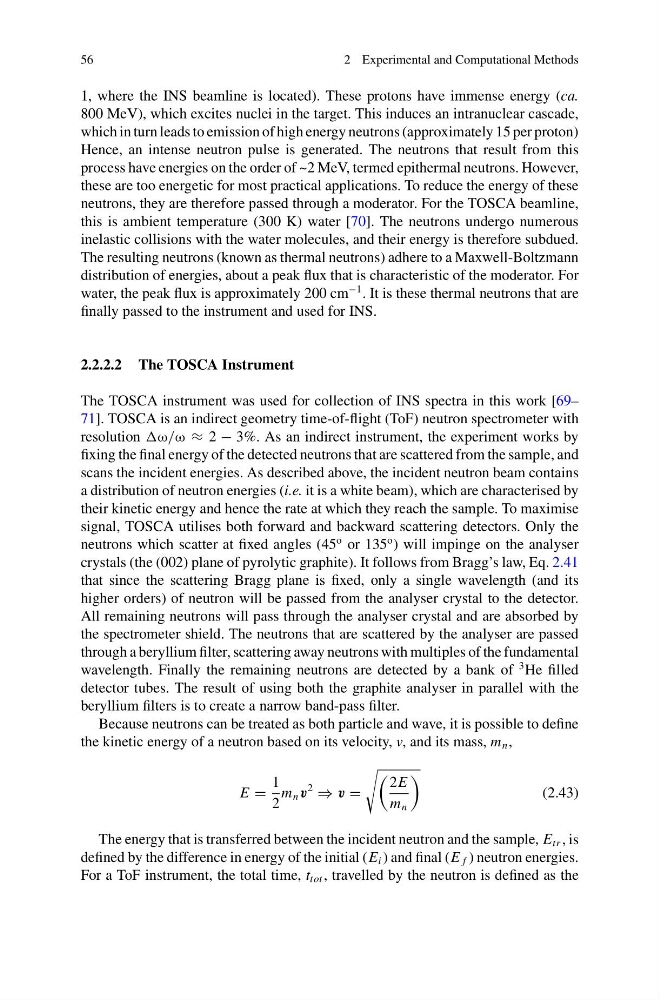
Because neutrons can be treated as both particle and wave, it is possible to define
the kinetic energy of a neutron based on its velocity, v, and its mass, m n ,
E =
1
2
m n v
2
⇒ v =
2E
m n
(2.43)
The energy that is transferred between the incident neutron and the sample, E tr , is
defined by the difference in energy of the initial (E i ) and final (E f ) neutron energies.
For a ToF instrument, the total time, t tot , travelled by the neutron is defined as the
2 Experimental and Computational Methods
1, where the INS beamline is located). These protons have immense energy (ca.
800 MeV), which excites nuclei in the target. This induces an intranuclear cascade,
which in turn leads to emission of high energy neutrons (approximately 15 per proton)
Hence, an intense neutron pulse is generated. The neutrons that result from this
process have energies on the order of ~2 MeV, termed epithermal neutrons. However,
these are too energetic for most practical applications. To reduce the energy of these
neutrons, they are therefore passed through a moderator. For the TOSCA beamline,
this is ambient temperature (300 K) water [70]. The neutrons undergo numerous
inelastic collisions with the water molecules, and their energy is therefore subdued.
The resulting neutrons (known as thermal neutrons) adhere to a Maxwell-Boltzmann
distribution of energies, about a peak flux that is characteristic of the moderator. For
water, the peak flux is approximately 200 cm
−1 . It is these thermal neutrons that are
finally passed to the instrument and used for INS.
2.2.2.2 The TOSCA Instrument
The TOSCA instrument was used for collection of INS spectra in this work [69–
71]. TOSCA is an indirect geometry time-of-flight (ToF) neutron spectrometer with
resolution ω/ω ≈ 2 − 3%. As an indirect instrument, the experiment works by
fixing the final energy of the detected neutrons that are scattered from the sample, and
scans the incident energies. As described above, the incident neutron beam contains
a distribution of neutron energies (i.e. it is a white beam), which are characterised by
their kinetic energy and hence the rate at which they reach the sample. To maximise
signal, TOSCA utilises both forward and backward scattering detectors. Only the
neutrons which scatter at fixed angles (45
o or 135
o ) will impinge on the analyser
crystals (the (002) plane of pyrolytic graphite). It follows from Bragg’s law, Eq. 2.41
that since the scattering Bragg plane is fixed, only a single wavelength (and its
higher orders) of neutron will be passed from the analyser crystal to the detector.
All remaining neutrons will pass through the analyser crystal and are absorbed by
the spectrometer shield. The neutrons that are scattered by the analyser are passed
through a beryllium filter, scattering away neutrons with multiples of the fundamental
wavelength. Finally the remaining neutrons are detected by a bank of
3 He filled
detector tubes. The result of using both the graphite analyser in parallel with the
beryllium filters is to create a narrow band-pass filter.
Because neutrons can be treated as both particle and wave, it is possible to define
the kinetic energy of a neutron based on its velocity, v, and its mass, m n ,
E =
1
2
m n v
2
⇒ v =
2E
m n
(2.43)
The energy that is transferred between the incident neutron and the sample, E tr , is
defined by the difference in energy of the initial (E i ) and final (E f ) neutron energies.
For a ToF instrument, the total time, t tot , travelled by the neutron is defined as the