

50
2 Experimental and Computational Methods
The base of ab initio lattice dynamics therefore is to obtain the force constant,
l,l
α,α which, according to Eq. 2.34, are the second derivatives of the total energy.
Thus,
l,l
α,α describes a Hessian matrix.
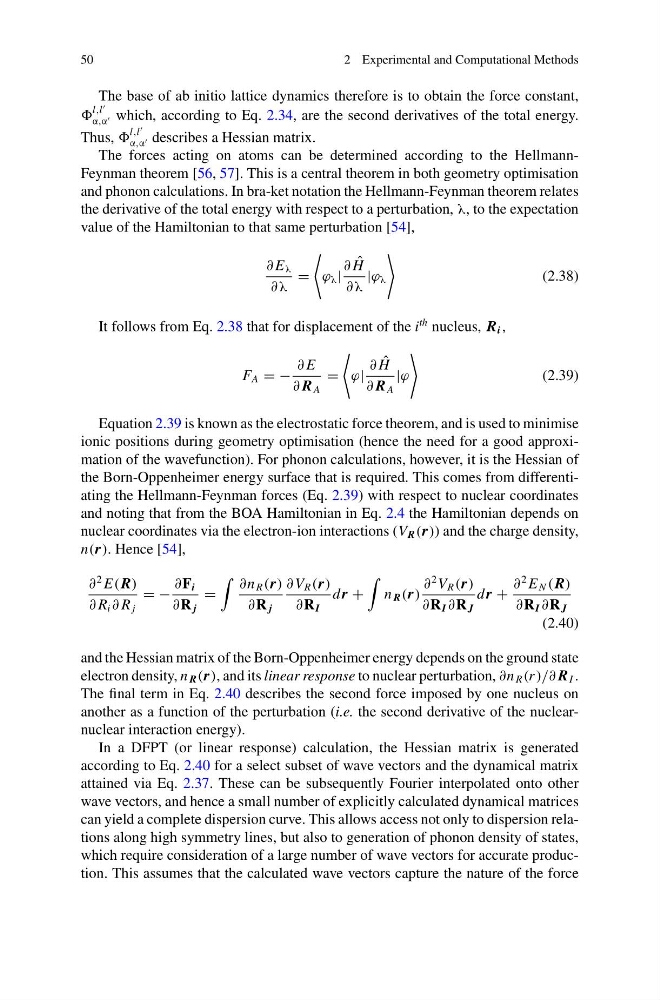
The forces acting on atoms can be determined according to the HellmannFeynman theorem [56, 57]. This is a central theorem in both geometry optimisation
and phonon calculations. In bra-ket notation the Hellmann-Feynman theorem relates
the derivative of the total energy with respect to a perturbation, λ, to the expectation
value of the Hamiltonian to that same perturbation [54],
∂ E λ
∂λ
=
ϕ λ |
∂ ˆ
H
∂λ
|ϕ λ
(2.38)
It follows from Eq. 2.38 that for displacement of the i
th nucleus, R i ,
F A = −
∂ E
∂ R A
=
ϕ|
∂ ˆ
H
∂ R A
|ϕ
(2.39)
Equation 2.39 is known as the electrostatic force theorem, and is used to minimise
ionic positions during geometry optimisation (hence the need for a good approximation of the wavefunction). For phonon calculations, however, it is the Hessian of
the Born-Oppenheimer energy surface that is required. This comes from differentiating the Hellmann-Feynman forces (Eq. 2.39) with respect to nuclear coordinates
and noting that from the BOA Hamiltonian in Eq. 2.4 the Hamiltonian depends on
nuclear coordinates via the electron-ion interactions (V R (r)) and the charge density,
n(r). Hence [54],
∂
2 E(R)
∂ R i ∂ R j
= −
∂F i
∂R j
=
∂n R (r)
∂R j
∂ V R (r)
∂R I
d r +
n R (r)
∂
2 V R (r)
∂R I ∂R J
d r +
∂
2 E N (R)
∂R I ∂R J
(2.40)
and the Hessian matrix of the Born-Oppenheimer energy depends on the ground state
electron density, n R (r), and its linear response to nuclear perturbation, ∂n R (r )/∂ R I .
The final term in Eq. 2.40 describes the second force imposed by one nucleus on
another as a function of the perturbation (i.e. the second derivative of the nuclearnuclear interaction energy).
In a DFPT (or linear response) calculation, the Hessian matrix is generated
according to Eq. 2.40 for a select subset of wave vectors and the dynamical matrix
attained via Eq. 2.37. These can be subsequently Fourier interpolated onto other
wave vectors, and hence a small number of explicitly calculated dynamical matrices
can yield a complete dispersion curve. This allows access not only to dispersion relations along high symmetry lines, but also to generation of phonon density of states,
which require consideration of a large number of wave vectors for accurate production. This assumes that the calculated wave vectors capture the nature of the force
2 Experimental and Computational Methods
The base of ab initio lattice dynamics therefore is to obtain the force constant,
l,l
α,α which, according to Eq. 2.34, are the second derivatives of the total energy.
Thus,
l,l
α,α describes a Hessian matrix.
The forces acting on atoms can be determined according to the HellmannFeynman theorem [56, 57]. This is a central theorem in both geometry optimisation
and phonon calculations. In bra-ket notation the Hellmann-Feynman theorem relates
the derivative of the total energy with respect to a perturbation, λ, to the expectation
value of the Hamiltonian to that same perturbation [54],
∂ E λ
∂λ
=
ϕ λ |
∂ ˆ
H
∂λ
|ϕ λ
(2.38)
It follows from Eq. 2.38 that for displacement of the i
th nucleus, R i ,
F A = −
∂ E
∂ R A
=
ϕ|
∂ ˆ
H
∂ R A
|ϕ
(2.39)
Equation 2.39 is known as the electrostatic force theorem, and is used to minimise
ionic positions during geometry optimisation (hence the need for a good approximation of the wavefunction). For phonon calculations, however, it is the Hessian of
the Born-Oppenheimer energy surface that is required. This comes from differentiating the Hellmann-Feynman forces (Eq. 2.39) with respect to nuclear coordinates
and noting that from the BOA Hamiltonian in Eq. 2.4 the Hamiltonian depends on
nuclear coordinates via the electron-ion interactions (V R (r)) and the charge density,
n(r). Hence [54],
∂
2 E(R)
∂ R i ∂ R j
= −
∂F i
∂R j
=
∂n R (r)
∂R j
∂ V R (r)
∂R I
d r +
n R (r)
∂
2 V R (r)
∂R I ∂R J
d r +
∂
2 E N (R)
∂R I ∂R J
(2.40)
and the Hessian matrix of the Born-Oppenheimer energy depends on the ground state
electron density, n R (r), and its linear response to nuclear perturbation, ∂n R (r )/∂ R I .
The final term in Eq. 2.40 describes the second force imposed by one nucleus on
another as a function of the perturbation (i.e. the second derivative of the nuclearnuclear interaction energy).
In a DFPT (or linear response) calculation, the Hessian matrix is generated
according to Eq. 2.40 for a select subset of wave vectors and the dynamical matrix
attained via Eq. 2.37. These can be subsequently Fourier interpolated onto other
wave vectors, and hence a small number of explicitly calculated dynamical matrices
can yield a complete dispersion curve. This allows access not only to dispersion relations along high symmetry lines, but also to generation of phonon density of states,
which require consideration of a large number of wave vectors for accurate production. This assumes that the calculated wave vectors capture the nature of the force