

42
2 Experimental and Computational Methods
confined to the spaces occupied by the molecules. Therefore, for molecular systems
like those studied in this thesis, the Generalised Gradient Approximation (GGA)
becomes more appropriate. The GGA approximation [21, 22] accounts for rapidly
changing properties of the electron density by considering both the charge density
at a point, and the gradient of the charge density to account for local deviations.
The most common GGA functionals are the PBE [23] (Perdew, Burke and Ernzerhof), PW91 [24, 25] (Perdew and Wang) and BLYP (Beck 88 exchange functional
[26] with the correlation functional of Lee, Yang and Parr [27]). PBE is particularly
popular for modelling of molecular crystals, and has been previously demonstrated to
perform well for structural and vibrational properties of molecular energetic materials
[28–31]. It has therefore been used in this thesis.
In contrast to HF theory, DFT does not treat exchange explicitly, but rather approximates both correlation and exchange. To rectify this, hybrid DFT functionals are
used. These functionals work by introducing a component of exact HF exchange into
the functional. The amount of HF that is included is based on substantial paramaterisation against experimental data, and many hybrid DFT functionals are developed
‘for purpose’, and on a specific class of compounds. The most common hybrid functional, B3LYP [11], is obtained by adding gradient corrections to the LDA method,
the exchange of Becke and the correlation function of Lee, Yang and Parr. Generally,
hybrid functionals perform very well and are less computationally demanding than
wavefunction methods, particularly for larger systems.
DFT exchange-correlation functionals are inherently local and they therefore are
not capable of accounting for the long-range dynamic correlation that results in
van der Waals interactions. These interactions are vital to the correct description
of molecular materials, such as those studied in this thesis. As such, a number of
empirical and semi-empirical corrections have been developed. Most notable are
those by Tkatchenko and Scheffler (TS) [32] and Grimme [33, 34]. In the popular
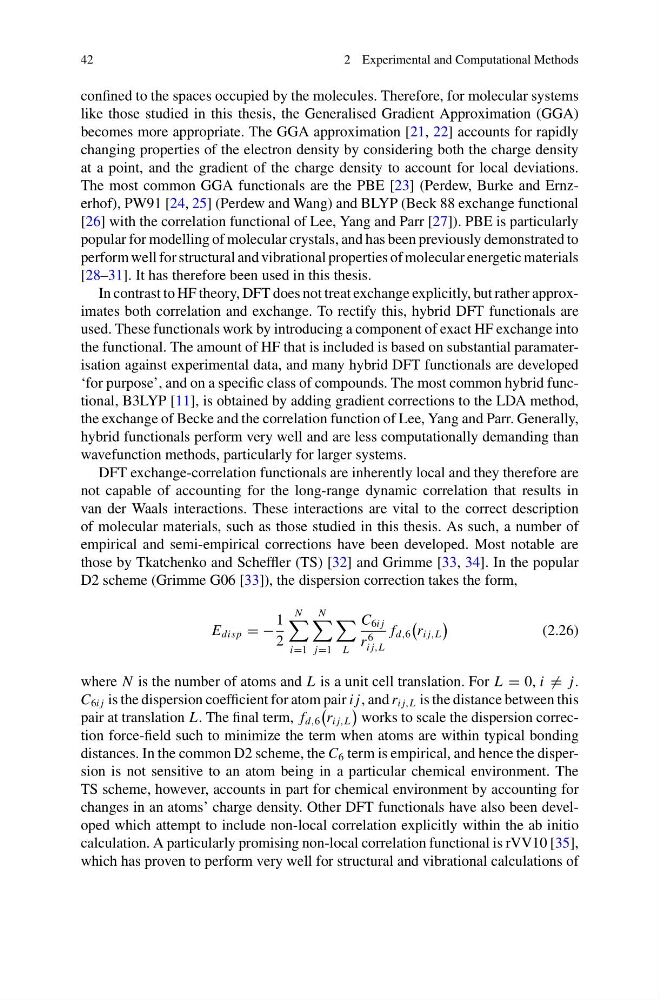
D2 scheme (Grimme G06 [33]), the dispersion correction takes the form,
E disp = −
1
2
N
i=1
N
j=1
L
C 6i j
r
6
i j,L
f d,6
r i j,L
(2.26)
where N is the number of atoms and L is a unit cell translation. For L = 0, i = j.
C 6i j is the dispersion coefficient for atom pair i j, and r i j,L is the distance between this
pair at translation L. The final term, f d,6
r i j,L
works to scale the dispersion correction force-field such to minimize the term when atoms are within typical bonding
distances. In the common D2 scheme, the C 6 term is empirical, and hence the dispersion is not sensitive to an atom being in a particular chemical environment. The
TS scheme, however, accounts in part for chemical environment by accounting for
changes in an atoms’ charge density. Other DFT functionals have also been developed which attempt to include non-local correlation explicitly within the ab initio
calculation. A particularly promising non-local correlation functional is rVV10 [35],
which has proven to perform very well for structural and vibrational calculations of
2 Experimental and Computational Methods
confined to the spaces occupied by the molecules. Therefore, for molecular systems
like those studied in this thesis, the Generalised Gradient Approximation (GGA)
becomes more appropriate. The GGA approximation [21, 22] accounts for rapidly
changing properties of the electron density by considering both the charge density
at a point, and the gradient of the charge density to account for local deviations.
The most common GGA functionals are the PBE [23] (Perdew, Burke and Ernzerhof), PW91 [24, 25] (Perdew and Wang) and BLYP (Beck 88 exchange functional
[26] with the correlation functional of Lee, Yang and Parr [27]). PBE is particularly
popular for modelling of molecular crystals, and has been previously demonstrated to
perform well for structural and vibrational properties of molecular energetic materials
[28–31]. It has therefore been used in this thesis.
In contrast to HF theory, DFT does not treat exchange explicitly, but rather approximates both correlation and exchange. To rectify this, hybrid DFT functionals are
used. These functionals work by introducing a component of exact HF exchange into
the functional. The amount of HF that is included is based on substantial paramaterisation against experimental data, and many hybrid DFT functionals are developed
‘for purpose’, and on a specific class of compounds. The most common hybrid functional, B3LYP [11], is obtained by adding gradient corrections to the LDA method,
the exchange of Becke and the correlation function of Lee, Yang and Parr. Generally,
hybrid functionals perform very well and are less computationally demanding than
wavefunction methods, particularly for larger systems.
DFT exchange-correlation functionals are inherently local and they therefore are
not capable of accounting for the long-range dynamic correlation that results in
van der Waals interactions. These interactions are vital to the correct description
of molecular materials, such as those studied in this thesis. As such, a number of
empirical and semi-empirical corrections have been developed. Most notable are
those by Tkatchenko and Scheffler (TS) [32] and Grimme [33, 34]. In the popular
D2 scheme (Grimme G06 [33]), the dispersion correction takes the form,
E disp = −
1
2
N
i=1
N
j=1
L
C 6i j
r
6
i j,L
f d,6
r i j,L
(2.26)
where N is the number of atoms and L is a unit cell translation. For L = 0, i = j.
C 6i j is the dispersion coefficient for atom pair i j, and r i j,L is the distance between this
pair at translation L. The final term, f d,6
r i j,L
works to scale the dispersion correction force-field such to minimize the term when atoms are within typical bonding
distances. In the common D2 scheme, the C 6 term is empirical, and hence the dispersion is not sensitive to an atom being in a particular chemical environment. The
TS scheme, however, accounts in part for chemical environment by accounting for
changes in an atoms’ charge density. Other DFT functionals have also been developed which attempt to include non-local correlation explicitly within the ab initio
calculation. A particularly promising non-local correlation functional is rVV10 [35],
which has proven to perform very well for structural and vibrational calculations of