

40
2 Experimental and Computational Methods
state density. Hence, there should exist a universal function, ˆ
E[ρ(r)], that could be
used to obtain the exact ground state density and energy. The only problem is that
its actual form is not known.
2.1.4.2 Kohn-Sham Equations
Whilst the theories proposed by Hohenberg and Kohn suggest the existence of a
universal functional, they offer no means to determine what form this functional
should take. Following from Eq. 2.18, Kohn and Sham [15] made further developments to render a more tractable form of DFT which enjoys widespread use
today.
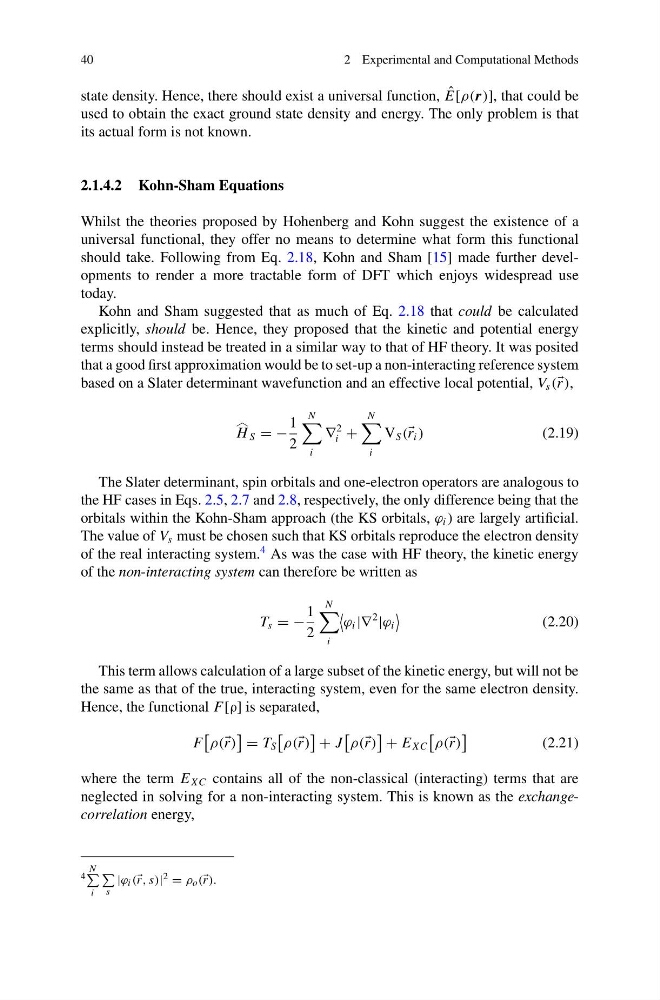
Kohn and Sham suggested that as much of Eq. 2.18 that could be calculated
explicitly, should be. Hence, they proposed that the kinetic and potential energy
terms should instead be treated in a similar way to that of HF theory. It was posited
that a good first approximation would be to set-up a non-interacting reference system
based on a Slater determinant wavefunction and an effective local potential, V s ( r ),
H
S = −
1
2
N
i
∇
2
i +
N
i
V S ( r i )
(2.19)
The Slater determinant, spin orbitals and one-electron operators are analogous to
the HF cases in Eqs. 2.5, 2.7 and 2.8, respectively, the only difference being that the
orbitals within the Kohn-Sham approach (the KS orbitals, ϕ i ) are largely artificial.
The value of V s must be chosen such that KS orbitals reproduce the electron density
of the real interacting system.
4 As was the case with HF theory, the kinetic energy
of the non-interacting system can therefore be written as
T s = −
1
2
N
i
ϕ i |∇
2
|ϕ i
(2.20)
This term allows calculation of a large subset of the kinetic energy, but will not be
the same as that of the true, interacting system, even for the same electron density.
Hence, the functional F[ρ] is separated,
F
ρ( r)
= T S
ρ( r)
+ J
ρ( r)
+ E XC
ρ( r)
(2.21)
where the term E XC contains all of the non-classical (interacting) terms that are
neglected in solving for a non-interacting system. This is known as the exchangecorrelation energy,
4
N
i
s
|ϕ i ( r, s)| 2 = ρ o ( r).
2 Experimental and Computational Methods
state density. Hence, there should exist a universal function, ˆ
E[ρ(r)], that could be
used to obtain the exact ground state density and energy. The only problem is that
its actual form is not known.
2.1.4.2 Kohn-Sham Equations
Whilst the theories proposed by Hohenberg and Kohn suggest the existence of a
universal functional, they offer no means to determine what form this functional
should take. Following from Eq. 2.18, Kohn and Sham [15] made further developments to render a more tractable form of DFT which enjoys widespread use
today.
Kohn and Sham suggested that as much of Eq. 2.18 that could be calculated
explicitly, should be. Hence, they proposed that the kinetic and potential energy
terms should instead be treated in a similar way to that of HF theory. It was posited
that a good first approximation would be to set-up a non-interacting reference system
based on a Slater determinant wavefunction and an effective local potential, V s ( r ),
H
S = −
1
2
N
i
∇
2
i +
N
i
V S ( r i )
(2.19)
The Slater determinant, spin orbitals and one-electron operators are analogous to
the HF cases in Eqs. 2.5, 2.7 and 2.8, respectively, the only difference being that the
orbitals within the Kohn-Sham approach (the KS orbitals, ϕ i ) are largely artificial.
The value of V s must be chosen such that KS orbitals reproduce the electron density
of the real interacting system.
4 As was the case with HF theory, the kinetic energy
of the non-interacting system can therefore be written as
T s = −
1
2
N
i
ϕ i |∇
2
|ϕ i
(2.20)
This term allows calculation of a large subset of the kinetic energy, but will not be
the same as that of the true, interacting system, even for the same electron density.
Hence, the functional F[ρ] is separated,
F
ρ( r)
= T S
ρ( r)
+ J
ρ( r)
+ E XC
ρ( r)
(2.21)
where the term E XC contains all of the non-classical (interacting) terms that are
neglected in solving for a non-interacting system. This is known as the exchangecorrelation energy,
4
N
i
s
|ϕ i ( r, s)| 2 = ρ o ( r).