

38
2 Experimental and Computational Methods
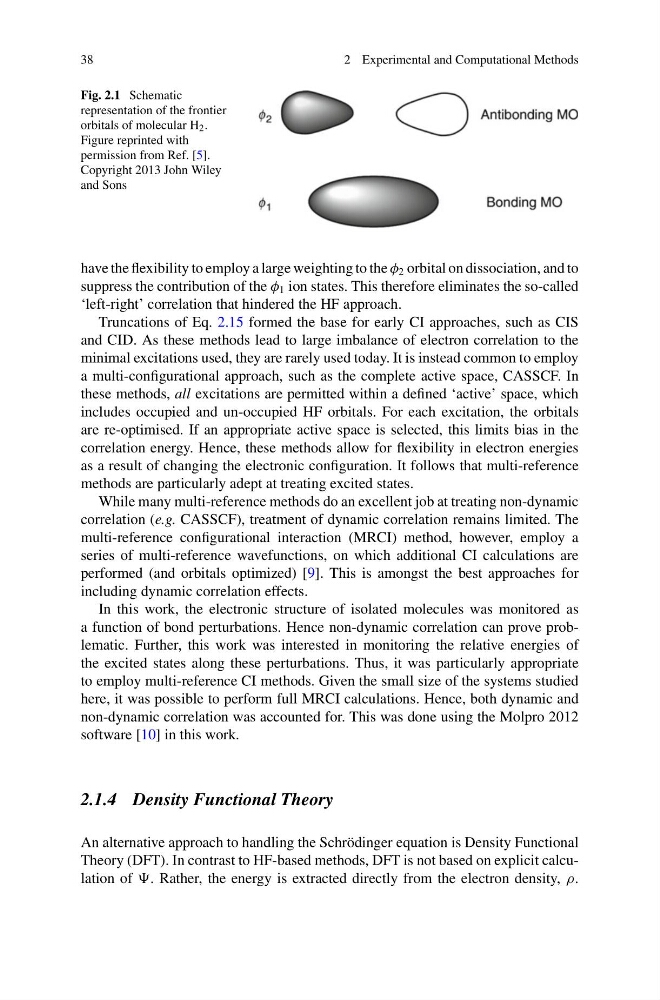
Fig. 2.1 Schematic
representation of the frontier
orbitals of molecular H 2 .
Figure reprinted with
permission from Ref. [5].
Copyright 2013 John Wiley
and Sons
have the flexibility to employ a large weighting to the φ 2 orbital on dissociation, and to
suppress the contribution of the φ 1 ion states. This therefore eliminates the so-called
‘left-right’ correlation that hindered the HF approach.
Truncations of Eq. 2.15 formed the base for early CI approaches, such as CIS
and CID. As these methods lead to large imbalance of electron correlation to the
minimal excitations used, they are rarely used today. It is instead common to employ
a multi-configurational approach, such as the complete active space, CASSCF. In
these methods, all excitations are permitted within a defined ‘active’ space, which
includes occupied and un-occupied HF orbitals. For each excitation, the orbitals
are re-optimised. If an appropriate active space is selected, this limits bias in the
correlation energy. Hence, these methods allow for flexibility in electron energies
as a result of changing the electronic configuration. It follows that multi-reference
methods are particularly adept at treating excited states.
While many multi-reference methods do an excellent job at treating non-dynamic
correlation (e.g. CASSCF), treatment of dynamic correlation remains limited. The
multi-reference configurational interaction (MRCI) method, however, employ a
series of multi-reference wavefunctions, on which additional CI calculations are
performed (and orbitals optimized) [9]. This is amongst the best approaches for
including dynamic correlation effects.
In this work, the electronic structure of isolated molecules was monitored as
a function of bond perturbations. Hence non-dynamic correlation can prove problematic. Further, this work was interested in monitoring the relative energies of
the excited states along these perturbations. Thus, it was particularly appropriate
to employ multi-reference CI methods. Given the small size of the systems studied
here, it was possible to perform full MRCI calculations. Hence, both dynamic and
non-dynamic correlation was accounted for. This was done using the Molpro 2012
software [10] in this work.
2.1.4 Density Functional Theory
An alternative approach to handling the Schrödinger equation is Density Functional
Theory (DFT). In contrast to HF-based methods, DFT is not based on explicit calculation of . Rather, the energy is extracted directly from the electron density, ρ.
2 Experimental and Computational Methods
Fig. 2.1 Schematic
representation of the frontier
orbitals of molecular H 2 .
Figure reprinted with
permission from Ref. [5].
Copyright 2013 John Wiley
and Sons
have the flexibility to employ a large weighting to the φ 2 orbital on dissociation, and to
suppress the contribution of the φ 1 ion states. This therefore eliminates the so-called
‘left-right’ correlation that hindered the HF approach.
Truncations of Eq. 2.15 formed the base for early CI approaches, such as CIS
and CID. As these methods lead to large imbalance of electron correlation to the
minimal excitations used, they are rarely used today. It is instead common to employ
a multi-configurational approach, such as the complete active space, CASSCF. In
these methods, all excitations are permitted within a defined ‘active’ space, which
includes occupied and un-occupied HF orbitals. For each excitation, the orbitals
are re-optimised. If an appropriate active space is selected, this limits bias in the
correlation energy. Hence, these methods allow for flexibility in electron energies
as a result of changing the electronic configuration. It follows that multi-reference
methods are particularly adept at treating excited states.
While many multi-reference methods do an excellent job at treating non-dynamic
correlation (e.g. CASSCF), treatment of dynamic correlation remains limited. The
multi-reference configurational interaction (MRCI) method, however, employ a
series of multi-reference wavefunctions, on which additional CI calculations are
performed (and orbitals optimized) [9]. This is amongst the best approaches for
including dynamic correlation effects.
In this work, the electronic structure of isolated molecules was monitored as
a function of bond perturbations. Hence non-dynamic correlation can prove problematic. Further, this work was interested in monitoring the relative energies of
the excited states along these perturbations. Thus, it was particularly appropriate
to employ multi-reference CI methods. Given the small size of the systems studied
here, it was possible to perform full MRCI calculations. Hence, both dynamic and
non-dynamic correlation was accounted for. This was done using the Molpro 2012
software [10] in this work.
2.1.4 Density Functional Theory
An alternative approach to handling the Schrödinger equation is Density Functional
Theory (DFT). In contrast to HF-based methods, DFT is not based on explicit calculation of . Rather, the energy is extracted directly from the electron density, ρ.