

1.3 Prediction and Rationalisation of Energetic Material Sensitivity
23
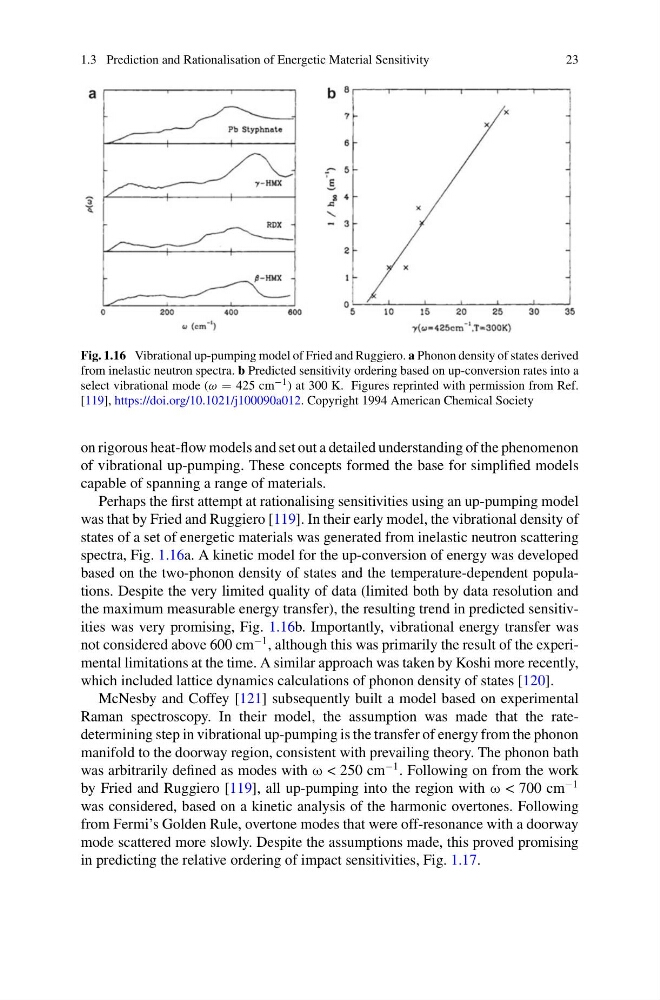
Fig. 1.16 Vibrational up-pumping model of Fried and Ruggiero. a Phonon density of states derived
from inelastic neutron spectra. b Predicted sensitivity ordering based on up-conversion rates into a
select vibrational mode (ω = 425 cm −1 ) at 300 K. Figures reprinted with permission from Ref.
[119], https://doi.org/10.1021/j100090a012. Copyright 1994 American Chemical Society
on rigorous heat-flow models and set out a detailed understanding of the phenomenon
of vibrational up-pumping. These concepts formed the base for simplified models
capable of spanning a range of materials.
Perhaps the first attempt at rationalising sensitivities using an up-pumping model
was that by Fried and Ruggiero [119]. In their early model, the vibrational density of
states of a set of energetic materials was generated from inelastic neutron scattering
spectra, Fig. 1.16a. A kinetic model for the up-conversion of energy was developed
based on the two-phonon density of states and the temperature-dependent populations. Despite the very limited quality of data (limited both by data resolution and
the maximum measurable energy transfer), the resulting trend in predicted sensitivities was very promising, Fig. 1.16b. Importantly, vibrational energy transfer was
not considered above 600 cm
−1 , although this was primarily the result of the experimental limitations at the time. A similar approach was taken by Koshi more recently,
which included lattice dynamics calculations of phonon density of states [120].
McNesby and Coffey [121] subsequently built a model based on experimental
Raman spectroscopy. In their model, the assumption was made that the ratedetermining step in vibrational up-pumping is the transfer of energy from the phonon
manifold to the doorway region, consistent with prevailing theory. The phonon bath
was arbitrarily defined as modes with ω < 250 cm
−1 . Following on from the work
by Fried and Ruggiero [119], all up-pumping into the region with ω < 700 cm
−1
was considered, based on a kinetic analysis of the harmonic overtones. Following
from Fermi’s Golden Rule, overtone modes that were off-resonance with a doorway
mode scattered more slowly. Despite the assumptions made, this proved promising
in predicting the relative ordering of impact sensitivities, Fig. 1.17.
23
Fig. 1.16 Vibrational up-pumping model of Fried and Ruggiero. a Phonon density of states derived
from inelastic neutron spectra. b Predicted sensitivity ordering based on up-conversion rates into a
select vibrational mode (ω = 425 cm −1 ) at 300 K. Figures reprinted with permission from Ref.
[119], https://doi.org/10.1021/j100090a012. Copyright 1994 American Chemical Society
on rigorous heat-flow models and set out a detailed understanding of the phenomenon
of vibrational up-pumping. These concepts formed the base for simplified models
capable of spanning a range of materials.
Perhaps the first attempt at rationalising sensitivities using an up-pumping model
was that by Fried and Ruggiero [119]. In their early model, the vibrational density of
states of a set of energetic materials was generated from inelastic neutron scattering
spectra, Fig. 1.16a. A kinetic model for the up-conversion of energy was developed
based on the two-phonon density of states and the temperature-dependent populations. Despite the very limited quality of data (limited both by data resolution and
the maximum measurable energy transfer), the resulting trend in predicted sensitivities was very promising, Fig. 1.16b. Importantly, vibrational energy transfer was
not considered above 600 cm
−1 , although this was primarily the result of the experimental limitations at the time. A similar approach was taken by Koshi more recently,
which included lattice dynamics calculations of phonon density of states [120].
McNesby and Coffey [121] subsequently built a model based on experimental
Raman spectroscopy. In their model, the assumption was made that the ratedetermining step in vibrational up-pumping is the transfer of energy from the phonon
manifold to the doorway region, consistent with prevailing theory. The phonon bath
was arbitrarily defined as modes with ω < 250 cm
−1 . Following on from the work
by Fried and Ruggiero [119], all up-pumping into the region with ω < 700 cm
−1
was considered, based on a kinetic analysis of the harmonic overtones. Following
from Fermi’s Golden Rule, overtone modes that were off-resonance with a doorway
mode scattered more slowly. Despite the assumptions made, this proved promising
in predicting the relative ordering of impact sensitivities, Fig. 1.17.