

1.2 Initiation of Energetic Materials
11
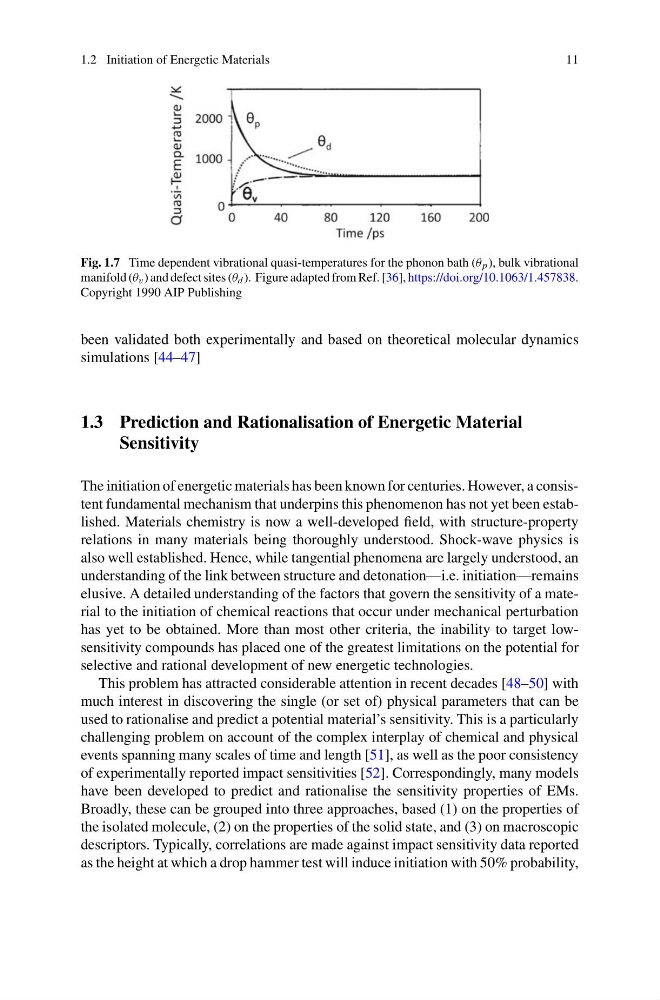
Fig. 1.7 Time dependent vibrational quasi-temperatures for the phonon bath (θ p ), bulk vibrational
manifold (θ v ) and defect sites (θ d ). Figure adapted from Ref. [36], https://doi.org/10.1063/1.457838.
Copyright 1990 AIP Publishing
been validated both experimentally and based on theoretical molecular dynamics
simulations [44–47]
1.3 Prediction and Rationalisation of Energetic Material
Sensitivity
The initiation of energetic materials has been known for centuries. However, a consistent fundamental mechanism that underpins this phenomenon has not yet been established. Materials chemistry is now a well-developed field, with structure-property
relations in many materials being thoroughly understood. Shock-wave physics is
also well established. Hence, while tangential phenomena are largely understood, an
understanding of the link between structure and detonation—i.e. initiation—remains
elusive. A detailed understanding of the factors that govern the sensitivity of a material to the initiation of chemical reactions that occur under mechanical perturbation
has yet to be obtained. More than most other criteria, the inability to target lowsensitivity compounds has placed one of the greatest limitations on the potential for
selective and rational development of new energetic technologies.
This problem has attracted considerable attention in recent decades [48–50] with
much interest in discovering the single (or set of) physical parameters that can be
used to rationalise and predict a potential material’s sensitivity. This is a particularly
challenging problem on account of the complex interplay of chemical and physical
events spanning many scales of time and length [51], as well as the poor consistency
of experimentally reported impact sensitivities [52]. Correspondingly, many models
have been developed to predict and rationalise the sensitivity properties of EMs.
Broadly, these can be grouped into three approaches, based (1) on the properties of
the isolated molecule, (2) on the properties of the solid state, and (3) on macroscopic
descriptors. Typically, correlations are made against impact sensitivity data reported
as the height at which a drop hammer test will induce initiation with 50% probability,
11
Fig. 1.7 Time dependent vibrational quasi-temperatures for the phonon bath (θ p ), bulk vibrational
manifold (θ v ) and defect sites (θ d ). Figure adapted from Ref. [36], https://doi.org/10.1063/1.457838.
Copyright 1990 AIP Publishing
been validated both experimentally and based on theoretical molecular dynamics
simulations [44–47]
1.3 Prediction and Rationalisation of Energetic Material
Sensitivity
The initiation of energetic materials has been known for centuries. However, a consistent fundamental mechanism that underpins this phenomenon has not yet been established. Materials chemistry is now a well-developed field, with structure-property
relations in many materials being thoroughly understood. Shock-wave physics is
also well established. Hence, while tangential phenomena are largely understood, an
understanding of the link between structure and detonation—i.e. initiation—remains
elusive. A detailed understanding of the factors that govern the sensitivity of a material to the initiation of chemical reactions that occur under mechanical perturbation
has yet to be obtained. More than most other criteria, the inability to target lowsensitivity compounds has placed one of the greatest limitations on the potential for
selective and rational development of new energetic technologies.
This problem has attracted considerable attention in recent decades [48–50] with
much interest in discovering the single (or set of) physical parameters that can be
used to rationalise and predict a potential material’s sensitivity. This is a particularly
challenging problem on account of the complex interplay of chemical and physical
events spanning many scales of time and length [51], as well as the poor consistency
of experimentally reported impact sensitivities [52]. Correspondingly, many models
have been developed to predict and rationalise the sensitivity properties of EMs.
Broadly, these can be grouped into three approaches, based (1) on the properties of
the isolated molecule, (2) on the properties of the solid state, and (3) on macroscopic
descriptors. Typically, correlations are made against impact sensitivity data reported
as the height at which a drop hammer test will induce initiation with 50% probability,