

182
6 General Conclusions and Future Directions
The flat, low frequency max is shared by TATB (the other insensitive layered material
studied here). This appeared to be responsible for the decrease in predicted impact
sensitivity of the FOX-7 polymorphs in the sequence α > β > γ, according to both
the overtone up-pumping and temperature-dependent two-layer models. Thus, the
vibrational up-pumping model offers a new mechanism to rationalise the decreased
sensitivity of layered materials.
With both datasets based on the ‘indirect’ up-pumping mechanism, it is possible
to consider the trends of both Chaps. 4 and 5 together. This is done based on the
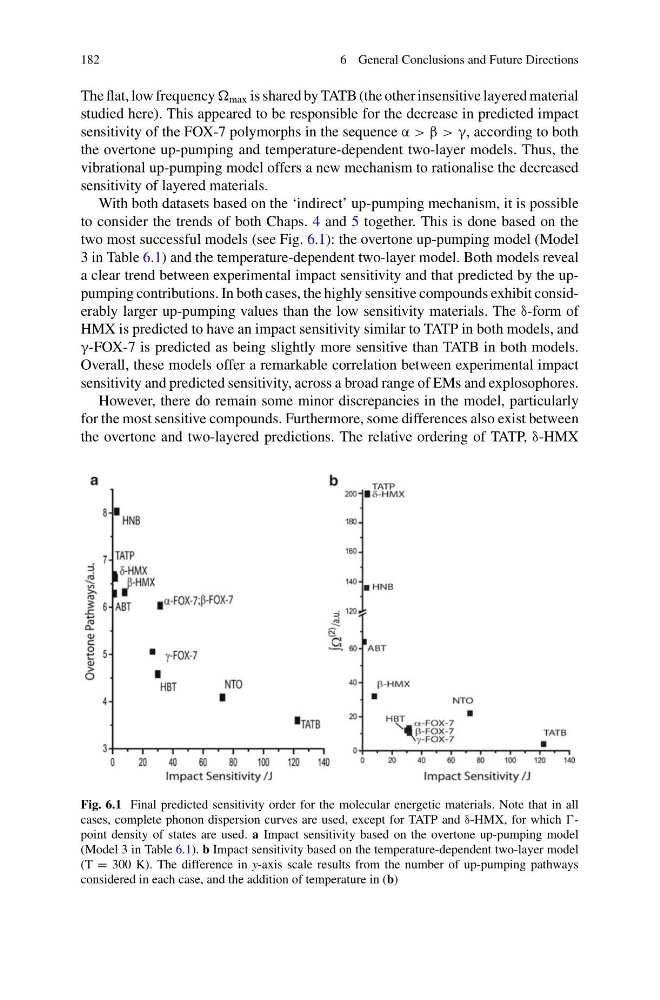
two most successful models (see Fig. 6.1): the overtone up-pumping model (Model
3 in Table 6.1) and the temperature-dependent two-layer model. Both models reveal
a clear trend between experimental impact sensitivity and that predicted by the uppumping contributions. In both cases, the highly sensitive compounds exhibit considerably larger up-pumping values than the low sensitivity materials. The δ-form of
HMX is predicted to have an impact sensitivity similar to TATP in both models, and
γ-FOX-7 is predicted as being slightly more sensitive than TATB in both models.
Overall, these models offer a remarkable correlation between experimental impact
sensitivity and predicted sensitivity, across a broad range of EMs and explosophores.
However, there do remain some minor discrepancies in the model, particularly
for the most sensitive compounds. Furthermore, some differences also exist between
the overtone and two-layered predictions. The relative ordering of TATP, δ-HMX
Fig. 6.1 Final predicted sensitivity order for the molecular energetic materials. Note that in all
cases, complete phonon dispersion curves are used, except for TATP and δ-HMX, for which -
point density of states are used. a Impact sensitivity based on the overtone up-pumping model
(Model 3 in Table 6.1). b Impact sensitivity based on the temperature-dependent two-layer model
(T = 300 K). The difference in y-axis scale results from the number of up-pumping pathways
considered in each case, and the addition of temperature in (b)
6 General Conclusions and Future Directions
The flat, low frequency max is shared by TATB (the other insensitive layered material
studied here). This appeared to be responsible for the decrease in predicted impact
sensitivity of the FOX-7 polymorphs in the sequence α > β > γ, according to both
the overtone up-pumping and temperature-dependent two-layer models. Thus, the
vibrational up-pumping model offers a new mechanism to rationalise the decreased
sensitivity of layered materials.
With both datasets based on the ‘indirect’ up-pumping mechanism, it is possible
to consider the trends of both Chaps. 4 and 5 together. This is done based on the
two most successful models (see Fig. 6.1): the overtone up-pumping model (Model
3 in Table 6.1) and the temperature-dependent two-layer model. Both models reveal
a clear trend between experimental impact sensitivity and that predicted by the uppumping contributions. In both cases, the highly sensitive compounds exhibit considerably larger up-pumping values than the low sensitivity materials. The δ-form of
HMX is predicted to have an impact sensitivity similar to TATP in both models, and
γ-FOX-7 is predicted as being slightly more sensitive than TATB in both models.
Overall, these models offer a remarkable correlation between experimental impact
sensitivity and predicted sensitivity, across a broad range of EMs and explosophores.
However, there do remain some minor discrepancies in the model, particularly
for the most sensitive compounds. Furthermore, some differences also exist between
the overtone and two-layered predictions. The relative ordering of TATP, δ-HMX
Fig. 6.1 Final predicted sensitivity order for the molecular energetic materials. Note that in all
cases, complete phonon dispersion curves are used, except for TATP and δ-HMX, for which -
point density of states are used. a Impact sensitivity based on the overtone up-pumping model
(Model 3 in Table 6.1). b Impact sensitivity based on the temperature-dependent two-layer model
(T = 300 K). The difference in y-axis scale results from the number of up-pumping pathways
considered in each case, and the addition of temperature in (b)