

180
6 General Conclusions and Future Directions
compounds, a number of notable exceptions occurred. This was largely rectified by
consideration of the combination contributions (the method applied in other previous
work [3–5]), although there are again notable exceptions. It was found that only by
considering both mechanisms could the sensitivity ordering be reproduced.
An up-pumping model was subsequently considered for a series of molecular
energetic materials: 1,1
-azobistetrazole (ABT), hexanitrobenzene (HNB), 1,3,5,7tetranitro-1,3,5,7-tetrazocane (HMX), 5,5
-hydrazinebistetrazole, 1,1-diamino-2,2dinitroethene (FOX-7), nitrotriazolone (NTO), and triaminotrinitrobenzene (TATB).
However, due to the complexity associated with dissociation of these molecules, no
target vibrational mode could be identified. Instead, the sensitivity of these materials was explored within the framework of an ‘indirect’ (or thermal) vibrational
up-pumping mechanism. The calculated vibrational spectra for a subset of the materials (α-FOX-7, NTO, TATB and β-HMX) were verified by comparison to inelastic
neutron scattering spectra. A number of models were explored based on ab initio
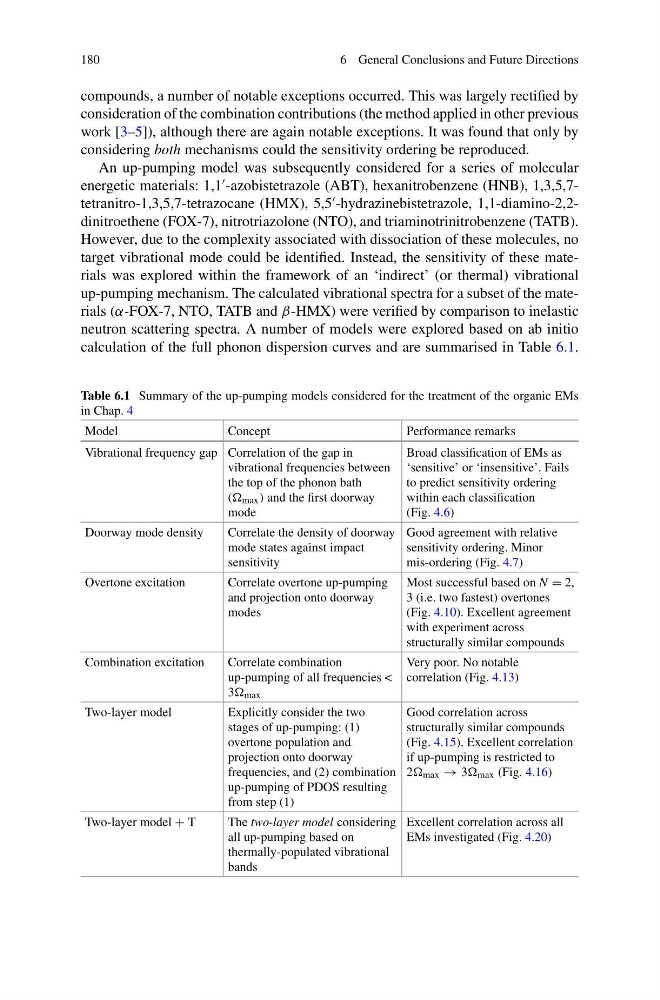
calculation of the full phonon dispersion curves and are summarised in Table 6.1.
Table 6.1 Summary of the up-pumping models considered for the treatment of the organic EMs
in Chap. 4
Model
Concept
Performance remarks
Vibrational frequency gap Correlation of the gap in
vibrational frequencies between
the top of the phonon bath
( max ) and the first doorway
mode
Broad classification of EMs as
‘sensitive’ or ‘insensitive’. Fails
to predict sensitivity ordering
within each classification
(Fig. 4.6)
Doorway mode density
Correlate the density of doorway
mode states against impact
sensitivity
Good agreement with relative
sensitivity ordering. Minor
mis-ordering (Fig. 4.7)
Overtone excitation
Correlate overtone up-pumping
and projection onto doorway
modes
Most successful based on N = 2,
3 (i.e. two fastest) overtones
(Fig. 4.10). Excellent agreement
with experiment across
structurally similar compounds
Combination excitation
Correlate combination
up-pumping of all frequencies <
3 max
Very poor. No notable
correlation (Fig. 4.13)
Two-layer model
Explicitly consider the two
stages of up-pumping: (1)
overtone population and
projection onto doorway
frequencies, and (2) combination
up-pumping of PDOS resulting
from step (1)
Good correlation across
structurally similar compounds
(Fig. 4.15). Excellent correlation
if up-pumping is restricted to
2 max → 3 max (Fig. 4.16)
Two-layer model + T
The two-layer model considering
all up-pumping based on
thermally-populated vibrational
bands
Excellent correlation across all
EMs investigated (Fig. 4.20)
6 General Conclusions and Future Directions
compounds, a number of notable exceptions occurred. This was largely rectified by
consideration of the combination contributions (the method applied in other previous
work [3–5]), although there are again notable exceptions. It was found that only by
considering both mechanisms could the sensitivity ordering be reproduced.
An up-pumping model was subsequently considered for a series of molecular
energetic materials: 1,1
-azobistetrazole (ABT), hexanitrobenzene (HNB), 1,3,5,7tetranitro-1,3,5,7-tetrazocane (HMX), 5,5
-hydrazinebistetrazole, 1,1-diamino-2,2dinitroethene (FOX-7), nitrotriazolone (NTO), and triaminotrinitrobenzene (TATB).
However, due to the complexity associated with dissociation of these molecules, no
target vibrational mode could be identified. Instead, the sensitivity of these materials was explored within the framework of an ‘indirect’ (or thermal) vibrational
up-pumping mechanism. The calculated vibrational spectra for a subset of the materials (α-FOX-7, NTO, TATB and β-HMX) were verified by comparison to inelastic
neutron scattering spectra. A number of models were explored based on ab initio
calculation of the full phonon dispersion curves and are summarised in Table 6.1.
Table 6.1 Summary of the up-pumping models considered for the treatment of the organic EMs
in Chap. 4
Model
Concept
Performance remarks
Vibrational frequency gap Correlation of the gap in
vibrational frequencies between
the top of the phonon bath
( max ) and the first doorway
mode
Broad classification of EMs as
‘sensitive’ or ‘insensitive’. Fails
to predict sensitivity ordering
within each classification
(Fig. 4.6)
Doorway mode density
Correlate the density of doorway
mode states against impact
sensitivity
Good agreement with relative
sensitivity ordering. Minor
mis-ordering (Fig. 4.7)
Overtone excitation
Correlate overtone up-pumping
and projection onto doorway
modes
Most successful based on N = 2,
3 (i.e. two fastest) overtones
(Fig. 4.10). Excellent agreement
with experiment across
structurally similar compounds
Combination excitation
Correlate combination
up-pumping of all frequencies <
3 max
Very poor. No notable
correlation (Fig. 4.13)
Two-layer model
Explicitly consider the two
stages of up-pumping: (1)
overtone population and
projection onto doorway
frequencies, and (2) combination
up-pumping of PDOS resulting
from step (1)
Good correlation across
structurally similar compounds
(Fig. 4.15). Excellent correlation
if up-pumping is restricted to
2 max → 3 max (Fig. 4.16)
Two-layer model + T
The two-layer model considering
all up-pumping based on
thermally-populated vibrational
bands
Excellent correlation across all
EMs investigated (Fig. 4.20)