

5.4 Results and Discussion
171
two lowest acoustic branches at q-point B (−0.5 0 0). This vector runs perpendicular
to the FOX-7 planes. As γ-FOX-7 is highly metastable, further work is required to
determine the validity of this result, although it is not expected to have any notable
consequence on the following discussion. As the FOX-7 layers become increasingly
planar, the energy gap between max and the doorway mode region increases, with
max found at 185 cm
−1 , 170 cm
−1 and 160 cm
−1 for the α-, β- and γ-polymorphs,
respectively. This decrease in max is due to softening of the NO 2 rocking modes that
are polarized perpendicular to the FOX-7 planes and therefore soften upon layering.
Within the framework of vibrational up-pumping, this has the effect of reducing the
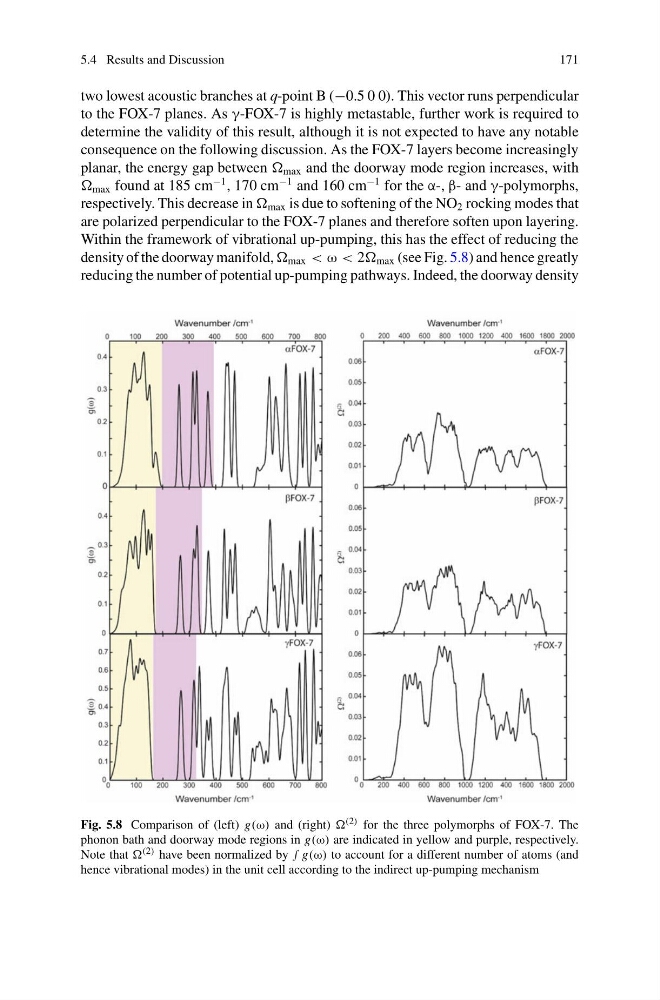
density of the doorway manifold, max < ω < 2 max (see Fig. 5.8) and hence greatly
reducing the number of potential up-pumping pathways. Indeed, the doorway density
Fig. 5.8 Comparison of (left) g(ω) and (right) (2) for the three polymorphs of FOX-7. The
phonon bath and doorway mode regions in g(ω) are indicated in yellow and purple, respectively.
Note that (2) have been normalized by ∫ g(ω) to account for a different number of atoms (and
hence vibrational modes) in the unit cell according to the indirect up-pumping mechanism
171
two lowest acoustic branches at q-point B (−0.5 0 0). This vector runs perpendicular
to the FOX-7 planes. As γ-FOX-7 is highly metastable, further work is required to
determine the validity of this result, although it is not expected to have any notable
consequence on the following discussion. As the FOX-7 layers become increasingly
planar, the energy gap between max and the doorway mode region increases, with
max found at 185 cm
−1 , 170 cm
−1 and 160 cm
−1 for the α-, β- and γ-polymorphs,
respectively. This decrease in max is due to softening of the NO 2 rocking modes that
are polarized perpendicular to the FOX-7 planes and therefore soften upon layering.
Within the framework of vibrational up-pumping, this has the effect of reducing the
density of the doorway manifold, max < ω < 2 max (see Fig. 5.8) and hence greatly
reducing the number of potential up-pumping pathways. Indeed, the doorway density
Fig. 5.8 Comparison of (left) g(ω) and (right) (2) for the three polymorphs of FOX-7. The
phonon bath and doorway mode regions in g(ω) are indicated in yellow and purple, respectively.
Note that (2) have been normalized by ∫ g(ω) to account for a different number of atoms (and
hence vibrational modes) in the unit cell according to the indirect up-pumping mechanism