

4.5 Results and Discussion
135
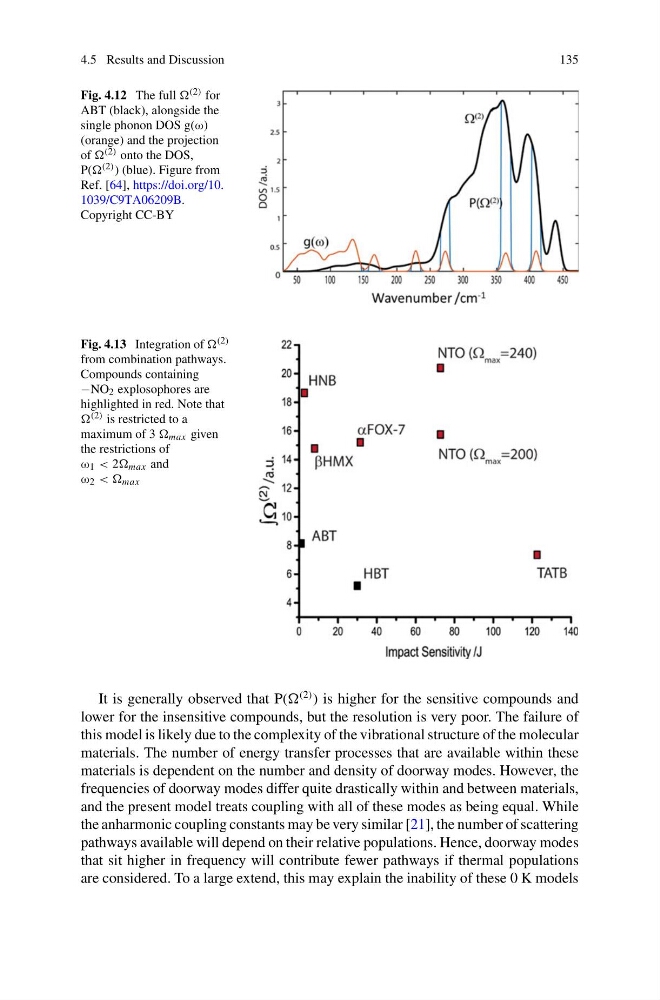
Fig. 4.12 The full (2) for
ABT (black), alongside the
single phonon DOS g(ω)
(orange) and the projection
of (2) onto the DOS,
P( (2) ) (blue). Figure from
Ref. [64], https://doi.org/10.
1039/C9TA06209B.
Copyright CC-BY
Fig. 4.13 Integration of (2)
from combination pathways.
Compounds containing
−NO 2 explosophores are
highlighted in red. Note that
(2) is restricted to a
maximum of 3 max given
the restrictions of
ω 1 < 2 max and
ω 2 < < max
It is generally observed that P(
(2) ) is higher for the sensitive compounds and
lower for the insensitive compounds, but the resolution is very poor. The failure of
this model is likely due to the complexity of the vibrational structure of the molecular
materials. The number of energy transfer processes that are available within these
materials is dependent on the number and density of doorway modes. However, the
frequencies of doorway modes differ quite drastically within and between materials,
and the present model treats coupling with all of these modes as being equal. While
the anharmonic coupling constants may be very similar [21], the number of scattering
pathways available will depend on their relative populations. Hence, doorway modes
that sit higher in frequency will contribute fewer pathways if thermal populations
are considered. To a large extend, this may explain the inability of these 0 K models
135
Fig. 4.12 The full (2) for
ABT (black), alongside the
single phonon DOS g(ω)
(orange) and the projection
of (2) onto the DOS,
P( (2) ) (blue). Figure from
Ref. [64], https://doi.org/10.
1039/C9TA06209B.
Copyright CC-BY
Fig. 4.13 Integration of (2)
from combination pathways.
Compounds containing
−NO 2 explosophores are
highlighted in red. Note that
(2) is restricted to a
maximum of 3 max given
the restrictions of
ω 1 < 2 max and
ω 2 < < max
It is generally observed that P(
(2) ) is higher for the sensitive compounds and
lower for the insensitive compounds, but the resolution is very poor. The failure of
this model is likely due to the complexity of the vibrational structure of the molecular
materials. The number of energy transfer processes that are available within these
materials is dependent on the number and density of doorway modes. However, the
frequencies of doorway modes differ quite drastically within and between materials,
and the present model treats coupling with all of these modes as being equal. While
the anharmonic coupling constants may be very similar [21], the number of scattering
pathways available will depend on their relative populations. Hence, doorway modes
that sit higher in frequency will contribute fewer pathways if thermal populations
are considered. To a large extend, this may explain the inability of these 0 K models