

4.3 Model Systems
115
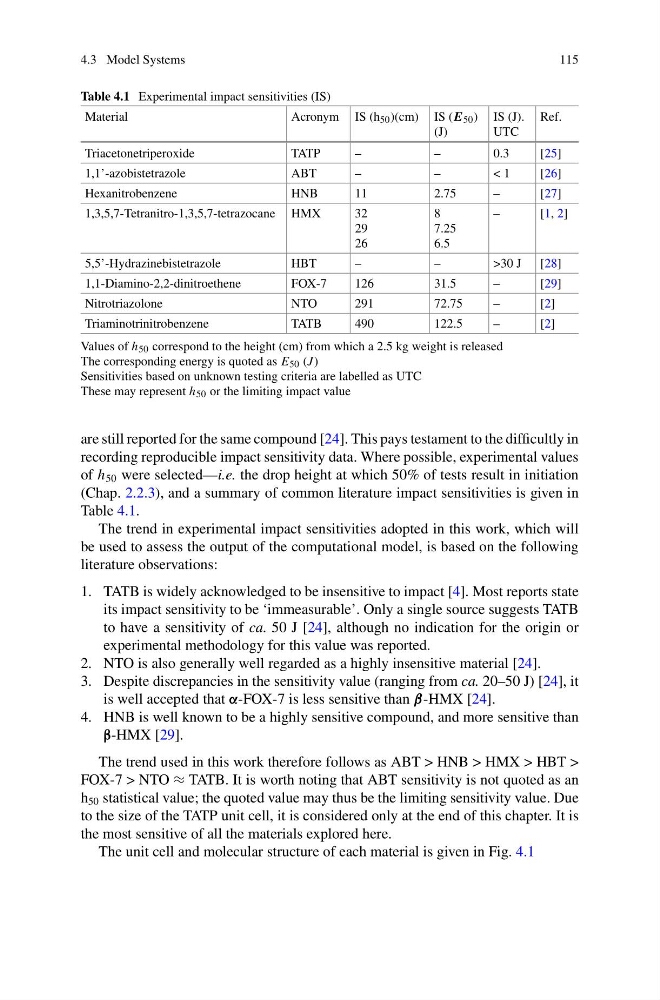
Table 4.1 Experimental impact sensitivities (IS)
Material
Acronym IS (h 50 )(cm) IS (E 50 )
(J)
IS (J).
UTC
Ref.
Triacetonetriperoxide
TATP
–
–
0.3
[25]
1,1’-azobistetrazole
ABT
–
–
< 1
[26]
Hexanitrobenzene
HNB
11
2.75
–
[27]
1,3,5,7-Tetranitro-1,3,5,7-tetrazocane HMX
32
29
26
8
7.25
6.5
–
[1, 2]
5,5’-Hydrazinebistetrazole
HBT
–
–
>30 J [28]
1,1-Diamino-2,2-dinitroethene
FOX-7
126
31.5
–
[29]
Nitrotriazolone
NTO
291
72.75
–
[2]
Triaminotrinitrobenzene
TATB
490
122.5
–
[2]
Values of h 50 correspond to the height (cm) from which a 2.5 kg weight is released
The corresponding energy is quoted as E 50 (J)
Sensitivities based on unknown testing criteria are labelled as UTC
These may represent h 50 or the limiting impact value
are still reported for the same compound [24]. This pays testament to the difficultly in
recording reproducible impact sensitivity data. Where possible, experimental values
of h 50 were selected—i.e. the drop height at which 50% of tests result in initiation
(Chap. 2.2.3), and a summary of common literature impact sensitivities is given in
Table 4.1.
The trend in experimental impact sensitivities adopted in this work, which will
be used to assess the output of the computational model, is based on the following
literature observations:
1. TATB is widely acknowledged to be insensitive to impact [4]. Most reports state
its impact sensitivity to be ‘immeasurable’. Only a single source suggests TATB
to have a sensitivity of ca. 50 J [24], although no indication for the origin or
experimental methodology for this value was reported.
2. NTO is also generally well regarded as a highly insensitive material [24].
3. Despite discrepancies in the sensitivity value (ranging from ca. 20–50 J) [24], it
is well accepted that α-FOX-7 is less sensitive than β-HMX [24].
4. HNB is well known to be a highly sensitive compound, and more sensitive than
β-HMX [29].
The trend used in this work therefore follows as ABT > HNB > HMX > HBT >
FOX-7 > NTO ≈ TATB. It is worth noting that ABT sensitivity is not quoted as an
h 50 statistical value; the quoted value may thus be the limiting sensitivity value. Due
to the size of the TATP unit cell, it is considered only at the end of this chapter. It is
the most sensitive of all the materials explored here.
The unit cell and molecular structure of each material is given in Fig. 4.1
115
Table 4.1 Experimental impact sensitivities (IS)
Material
Acronym IS (h 50 )(cm) IS (E 50 )
(J)
IS (J).
UTC
Ref.
Triacetonetriperoxide
TATP
–
–
0.3
[25]
1,1’-azobistetrazole
ABT
–
–
< 1
[26]
Hexanitrobenzene
HNB
11
2.75
–
[27]
1,3,5,7-Tetranitro-1,3,5,7-tetrazocane HMX
32
29
26
8
7.25
6.5
–
[1, 2]
5,5’-Hydrazinebistetrazole
HBT
–
–
>30 J [28]
1,1-Diamino-2,2-dinitroethene
FOX-7
126
31.5
–
[29]
Nitrotriazolone
NTO
291
72.75
–
[2]
Triaminotrinitrobenzene
TATB
490
122.5
–
[2]
Values of h 50 correspond to the height (cm) from which a 2.5 kg weight is released
The corresponding energy is quoted as E 50 (J)
Sensitivities based on unknown testing criteria are labelled as UTC
These may represent h 50 or the limiting impact value
are still reported for the same compound [24]. This pays testament to the difficultly in
recording reproducible impact sensitivity data. Where possible, experimental values
of h 50 were selected—i.e. the drop height at which 50% of tests result in initiation
(Chap. 2.2.3), and a summary of common literature impact sensitivities is given in
Table 4.1.
The trend in experimental impact sensitivities adopted in this work, which will
be used to assess the output of the computational model, is based on the following
literature observations:
1. TATB is widely acknowledged to be insensitive to impact [4]. Most reports state
its impact sensitivity to be ‘immeasurable’. Only a single source suggests TATB
to have a sensitivity of ca. 50 J [24], although no indication for the origin or
experimental methodology for this value was reported.
2. NTO is also generally well regarded as a highly insensitive material [24].
3. Despite discrepancies in the sensitivity value (ranging from ca. 20–50 J) [24], it
is well accepted that α-FOX-7 is less sensitive than β-HMX [24].
4. HNB is well known to be a highly sensitive compound, and more sensitive than
β-HMX [29].
The trend used in this work therefore follows as ABT > HNB > HMX > HBT >
FOX-7 > NTO ≈ TATB. It is worth noting that ABT sensitivity is not quoted as an
h 50 statistical value; the quoted value may thus be the limiting sensitivity value. Due
to the size of the TATP unit cell, it is considered only at the end of this chapter. It is
the most sensitive of all the materials explored here.
The unit cell and molecular structure of each material is given in Fig. 4.1