

98
3 Vibrational Up-Pumping: Predicting Impact Sensitivity of Some …
this equilibration occurs at least an order of magnitude faster than any up-conversion
beyond max [6]. The up-conversion of this energy then occurs in two stages:
1. coupling of two modes with ω j < < max to excite a mode with max < ω <
2 max , and
2. further up-pumping to modes with 2 max < ω < 3 max [19].
It is from this sequence that vibrational modes with max < ω < 2 max derive
their name: doorway modes. While step (1) is first, step (2) occurs only picoseconds
afterwards [19] and hence these processes may become important. This sequence of
steps also limits primary up-pumping steps to a maximum of 3 max .
The probability (℘) of phonon-phonon coupling processes is governed by Fermi’s
Golden rule [96],
℘(i → f ) ∝
ϕ f |H 3 |ϕ i
2 D f (E)
(3.6)
where D f (E) is the density of final states and H 3 is the third order anharmonic
Hamiltonian. Thus, the probability of scattering is a maximum when the initial and
final scattering states, | ϕ i and
ϕ f
, respectively, are coherent [16]. Qualitatively, it
follows that the greater the total change in the PDOS, the less probable the transition
will be. Within the nomenclature introduced above, it might therefore be expected that
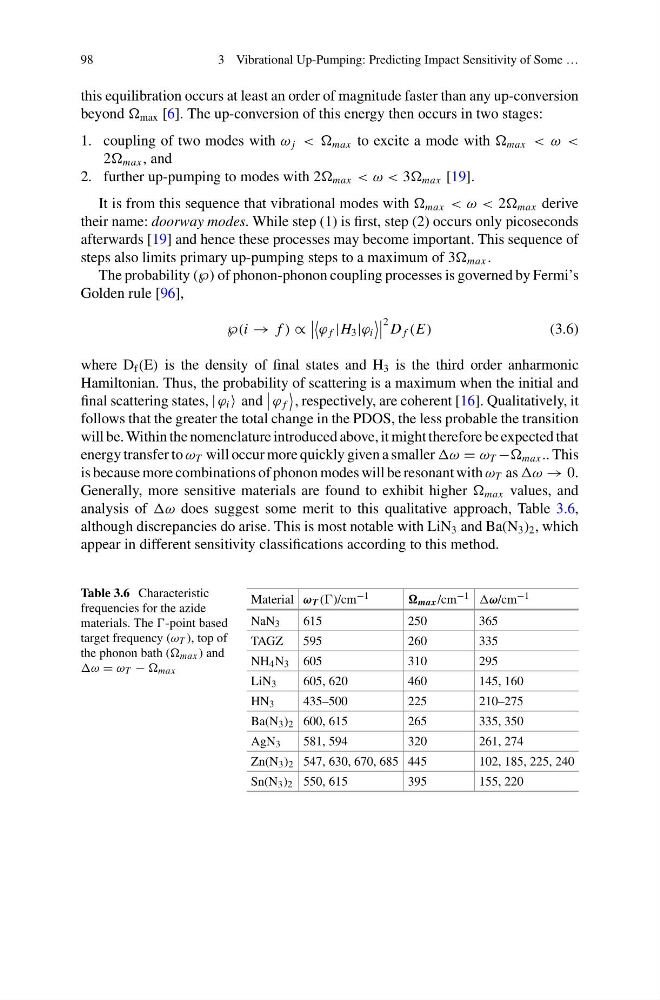
energy transfer to ω T will occur more quickly given a smaller ω = ω T − max .. This
is because more combinations of phonon modes will be resonant with ω T as ω → 0.
Generally, more sensitive materials are found to exhibit higher max values, and
analysis of ω does suggest some merit to this qualitative approach, Table 3.6,
although discrepancies do arise. This is most notable with LiN 3 and Ba(N 3 ) 2 , which
appear in different sensitivity classifications according to this method.
Table 3.6 Characteristic
frequencies for the azide
materials. The -point based
target frequency (ω T ), top of
the phonon bath ( max ) and
ω = ω T − max
Material ω T (G)/cm −1
max /cm −1 ω/cm −1
NaN 3
615
250
365
TAGZ
595
260
335
NH 4 N 3 605
310
295
LiN 3
605, 620
460
145, 160
HN 3
435–500
225
210–275
Ba(N 3 ) 2 600, 615
265
335, 350
AgN 3
581, 594
320
261, 274
Zn(N 3 ) 2 547, 630, 670, 685 445
102, 185, 225, 240
Sn(N 3 ) 2 550, 615
395
155, 220
3 Vibrational Up-Pumping: Predicting Impact Sensitivity of Some …
this equilibration occurs at least an order of magnitude faster than any up-conversion
beyond max [6]. The up-conversion of this energy then occurs in two stages:
1. coupling of two modes with ω j < < max to excite a mode with max < ω <
2 max , and
2. further up-pumping to modes with 2 max < ω < 3 max [19].
It is from this sequence that vibrational modes with max < ω < 2 max derive
their name: doorway modes. While step (1) is first, step (2) occurs only picoseconds
afterwards [19] and hence these processes may become important. This sequence of
steps also limits primary up-pumping steps to a maximum of 3 max .
The probability (℘) of phonon-phonon coupling processes is governed by Fermi’s
Golden rule [96],
℘(i → f ) ∝
ϕ f |H 3 |ϕ i
2 D f (E)
(3.6)
where D f (E) is the density of final states and H 3 is the third order anharmonic
Hamiltonian. Thus, the probability of scattering is a maximum when the initial and
final scattering states, | ϕ i and
ϕ f
, respectively, are coherent [16]. Qualitatively, it
follows that the greater the total change in the PDOS, the less probable the transition
will be. Within the nomenclature introduced above, it might therefore be expected that
energy transfer to ω T will occur more quickly given a smaller ω = ω T − max .. This
is because more combinations of phonon modes will be resonant with ω T as ω → 0.
Generally, more sensitive materials are found to exhibit higher max values, and
analysis of ω does suggest some merit to this qualitative approach, Table 3.6,
although discrepancies do arise. This is most notable with LiN 3 and Ba(N 3 ) 2 , which
appear in different sensitivity classifications according to this method.
Table 3.6 Characteristic
frequencies for the azide
materials. The -point based
target frequency (ω T ), top of
the phonon bath ( max ) and
ω = ω T − max
Material ω T (G)/cm −1
max /cm −1 ω/cm −1
NaN 3
615
250
365
TAGZ
595
260
335
NH 4 N 3 605
310
295
LiN 3
605, 620
460
145, 160
HN 3
435–500
225
210–275
Ba(N 3 ) 2 600, 615
265
335, 350
AgN 3
581, 594
320
261, 274
Zn(N 3 ) 2 547, 630, 670, 685 445
102, 185, 225, 240
Sn(N 3 ) 2 550, 615
395
155, 220