

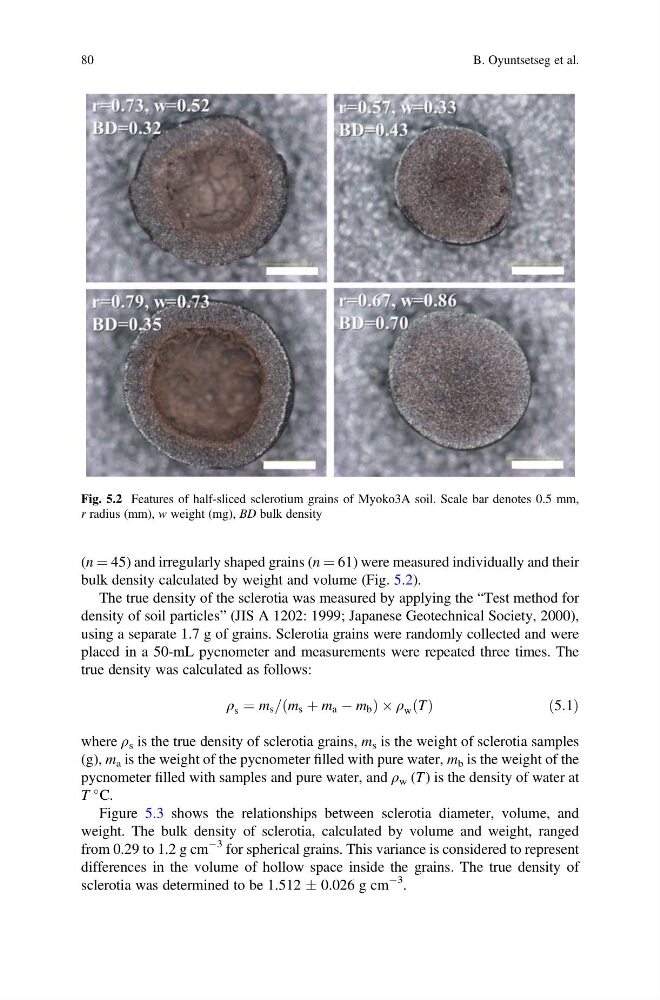
(n ¼ 45) and irregularly shaped grains (n ¼ 61) were measured individually and their
bulk density calculated by weight and volume (Fig. 5.2).
The true density of the sclerotia was measured by applying the “Test method for
density of soil particles” (JIS A 1202: 1999; Japanese Geotechnical Society, 2000),
using a separate 1.7 g of grains. Sclerotia grains were randomly collected and were
placed in a 50-mL pycnometer and measurements were repeated three times. The
true density was calculated as follows:
ρ s ¼ m s = m s þ m a À m b
ð
Þ Â ρ w T
ð Þ
ð5:1Þ
where ρ s is the true density of sclerotia grains, m s is the weight of sclerotia samples
(g), m a is the weight of the pycnometer filled with pure water, m b is the weight of the
pycnometer filled with samples and pure water, and ρ w (T) is the density of water at
T
C.
Figure 5.3 shows the relationships between sclerotia diameter, volume, and
weight. The bulk density of sclerotia, calculated by volume and weight, ranged
from 0.29 to 1.2 g cm
À3 for spherical grains. This variance is considered to represent
differences in the volume of hollow space inside the grains. The true density of
sclerotia was determined to be 1.512 Æ 0.026 g cm
À3 .
Fig. 5.2 Features of half-sliced sclerotium grains of Myoko3A soil. Scale bar denotes 0.5 mm,
r radius (mm), w weight (mg), BD bulk density
80
B. Oyuntsetseg et al.
bulk density calculated by weight and volume (Fig. 5.2).
The true density of the sclerotia was measured by applying the “Test method for
density of soil particles” (JIS A 1202: 1999; Japanese Geotechnical Society, 2000),
using a separate 1.7 g of grains. Sclerotia grains were randomly collected and were
placed in a 50-mL pycnometer and measurements were repeated three times. The
true density was calculated as follows:
ρ s ¼ m s = m s þ m a À m b
ð
Þ Â ρ w T
ð Þ
ð5:1Þ
where ρ s is the true density of sclerotia grains, m s is the weight of sclerotia samples
(g), m a is the weight of the pycnometer filled with pure water, m b is the weight of the
pycnometer filled with samples and pure water, and ρ w (T) is the density of water at
T
C.
Figure 5.3 shows the relationships between sclerotia diameter, volume, and
weight. The bulk density of sclerotia, calculated by volume and weight, ranged
from 0.29 to 1.2 g cm
À3 for spherical grains. This variance is considered to represent
differences in the volume of hollow space inside the grains. The true density of
sclerotia was determined to be 1.512 Æ 0.026 g cm
À3 .
Fig. 5.2 Features of half-sliced sclerotium grains of Myoko3A soil. Scale bar denotes 0.5 mm,
r radius (mm), w weight (mg), BD bulk density
80
B. Oyuntsetseg et al.