

the T-RFLP results in Figs. 3.12, 3.13, 3.14, 3.15 and 3.16, sclerotia-forming
ectomycorrhizal fungi such as Tuber sp., Laccaria sp., and Paxillus sp. were
detected in both soil and mesofauna samples at Minamiosawa, even though no
sclerotia were observed. As the soil pH decreased, such as at Akita, H
0 (indicating
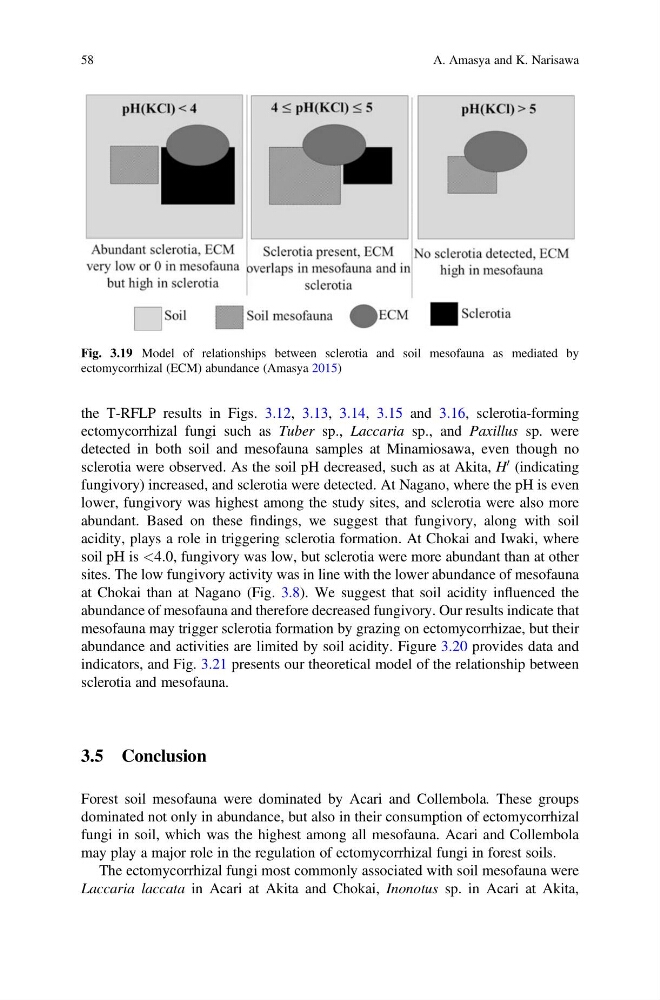
fungivory) increased, and sclerotia were detected. At Nagano, where the pH is even
lower, fungivory was highest among the study sites, and sclerotia were also more
abundant. Based on these findings, we suggest that fungivory, along with soil
acidity, plays a role in triggering sclerotia formation. At Chokai and Iwaki, where
soil pH is <4.0, fungivory was low, but sclerotia were more abundant than at other
sites. The low fungivory activity was in line with the lower abundance of mesofauna
at Chokai than at Nagano (Fig. 3.8). We suggest that soil acidity influenced the
abundance of mesofauna and therefore decreased fungivory. Our results indicate that
mesofauna may trigger sclerotia formation by grazing on ectomycorrhizae, but their
abundance and activities are limited by soil acidity. Figure 3.20 provides data and
indicators, and Fig. 3.21 presents our theoretical model of the relationship between
sclerotia and mesofauna.
3.5 Conclusion
Forest soil mesofauna were dominated by Acari and Collembola. These groups
dominated not only in abundance, but also in their consumption of ectomycorrhizal
fungi in soil, which was the highest among all mesofauna. Acari and Collembola
may play a major role in the regulation of ectomycorrhizal fungi in forest soils.
The ectomycorrhizal fungi most commonly associated with soil mesofauna were
Laccaria laccata in Acari at Akita and Chokai, Inonotus sp. in Acari at Akita,
Fig. 3.19 Model of relationships between sclerotia and soil mesofauna as mediated by
ectomycorrhizal (ECM) abundance (Amasya 2015)
58
A. Amasya and K. Narisawa
ectomycorrhizal fungi such as Tuber sp., Laccaria sp., and Paxillus sp. were
detected in both soil and mesofauna samples at Minamiosawa, even though no
sclerotia were observed. As the soil pH decreased, such as at Akita, H
0 (indicating
fungivory) increased, and sclerotia were detected. At Nagano, where the pH is even
lower, fungivory was highest among the study sites, and sclerotia were also more
abundant. Based on these findings, we suggest that fungivory, along with soil
acidity, plays a role in triggering sclerotia formation. At Chokai and Iwaki, where
soil pH is <4.0, fungivory was low, but sclerotia were more abundant than at other
sites. The low fungivory activity was in line with the lower abundance of mesofauna
at Chokai than at Nagano (Fig. 3.8). We suggest that soil acidity influenced the
abundance of mesofauna and therefore decreased fungivory. Our results indicate that
mesofauna may trigger sclerotia formation by grazing on ectomycorrhizae, but their
abundance and activities are limited by soil acidity. Figure 3.20 provides data and
indicators, and Fig. 3.21 presents our theoretical model of the relationship between
sclerotia and mesofauna.
3.5 Conclusion
Forest soil mesofauna were dominated by Acari and Collembola. These groups
dominated not only in abundance, but also in their consumption of ectomycorrhizal
fungi in soil, which was the highest among all mesofauna. Acari and Collembola
may play a major role in the regulation of ectomycorrhizal fungi in forest soils.
The ectomycorrhizal fungi most commonly associated with soil mesofauna were
Laccaria laccata in Acari at Akita and Chokai, Inonotus sp. in Acari at Akita,
Fig. 3.19 Model of relationships between sclerotia and soil mesofauna as mediated by
ectomycorrhizal (ECM) abundance (Amasya 2015)
58
A. Amasya and K. Narisawa