

(48
06
0 58
00 N, 107
25
0 37
00 E, 1640 m a.s.l.). The soil of the two sites was classified as
Dark Kastanozem according to the Mongolian soil classification system (Dorjgotov
and Shirnin 1976; Dorjgotov 2003), and as Haplic Kastanozem according to the
WRB/FAO-UNESCO 2014 classification system (Food and Agriculture Organization of the United Nations 2015), and vegetation coverage consisting of Larix
sibirica and Pinus sibirica forest and Carex lanceolata and Carex caryophyllea
understory vegetation (Oguma et al. 2015). We took two samples from the Terelj
area. (3) Sanzai (SA), located in Sukhbaatar District, Ulaanbaatar, Mongolia
(48
45
0 19.8
00 N, 106
53
0 29.9
00 E, 1540 m a.s.l.) with Haplic Kastanozem beneath
Betula dahurica, L. Sibirica, (4) Mt. Rishiri (RS) in Hokkaido Prefecture, northern
Japan (45
11
0 00
00 N, 141
11
0 40
00 E, 500 m a.s.l.), with Andic Cambisols
(WRB/FAO-UNESCO 2014 classification system (Food and Agriculture Organization of the United Nations 2015)) and vegetation consisting of Pinus pumila and
Sasa kurilensis. (5) Mt. Komado (KO), Fukushima Prefecture, central Japan
(37
12
0 51
00 N, 139
037
0 12
00 E, 1100 m a.s.l.), with Fulvic Andosols
(WRB/FAO-UNESCO 2014 classification system (Food and Agriculture Organization of the United Nations 2015)), beneath a Fagus crenata forest. (6) Ontake
(ON) located in Mt. Ontake, Gifu Prefecture, Japan (35
55
0 10
00 N, 137
27
0 50
00 E,
2130 m a.s.l.), with Fulvic Andosols (WRB/FAO-UNESCO 2014 classification
system (Food and Agriculture Organization of the United Nations 2015)) beneath
Tsuga diversifolia and Abies veitchii forest.
Soil samples were collected from the A horizons (0–15 cm) at the three Mongolian sites (TT, TE), and from the A horizons (0–10 cm) at the three Japanese sites
(RS, KO, and ON) using a stainless cylinder (diameter, ø8 cm  10 cm).
11.2.2 Soil and Sclerotia Grain Analyses
Soil samples were air-dried and passed through a 2-mm sieve prior to pH (H 2 O) and
C and N content analyses. Soil pH in H 2 O was measured with a pH meter (S20
Mettler Toledo, Ulaanbaatar, Mongolia) in a soil suspension containing a volume of
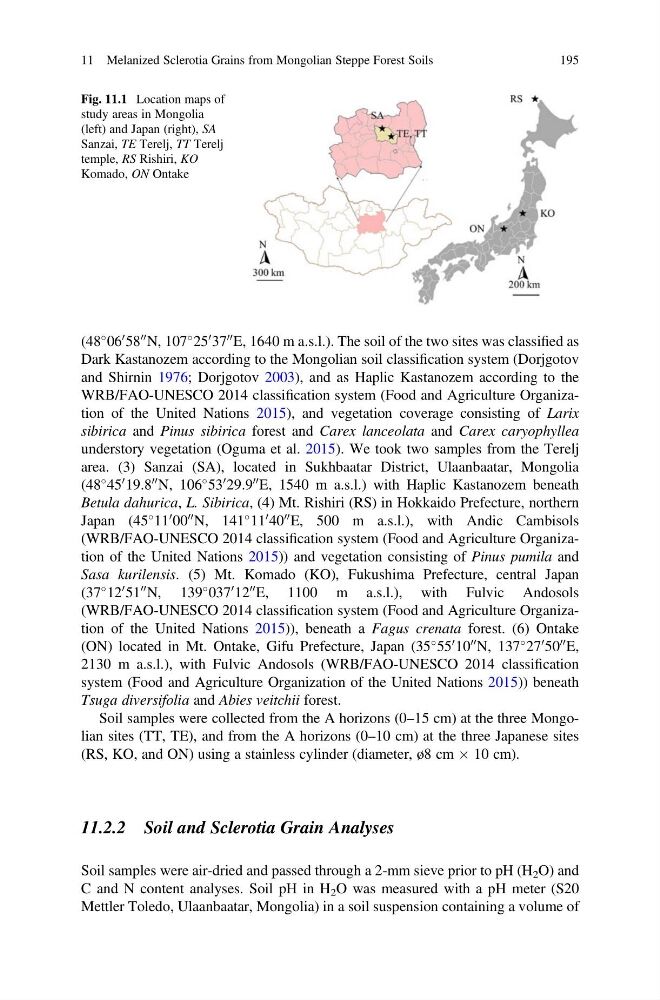
Fig. 11.1 Location maps of
study areas in Mongolia
(left) and Japan (right), SA
Sanzai, TE Terelj, TT Terelj
temple, RS Rishiri, KO
Komado, ON Ontake
11 Melanized Sclerotia Grains from Mongolian Steppe Forest Soils
195
06
0 58
00 N, 107
25
0 37
00 E, 1640 m a.s.l.). The soil of the two sites was classified as
Dark Kastanozem according to the Mongolian soil classification system (Dorjgotov
and Shirnin 1976; Dorjgotov 2003), and as Haplic Kastanozem according to the
WRB/FAO-UNESCO 2014 classification system (Food and Agriculture Organization of the United Nations 2015), and vegetation coverage consisting of Larix
sibirica and Pinus sibirica forest and Carex lanceolata and Carex caryophyllea
understory vegetation (Oguma et al. 2015). We took two samples from the Terelj
area. (3) Sanzai (SA), located in Sukhbaatar District, Ulaanbaatar, Mongolia
(48
45
0 19.8
00 N, 106
53
0 29.9
00 E, 1540 m a.s.l.) with Haplic Kastanozem beneath
Betula dahurica, L. Sibirica, (4) Mt. Rishiri (RS) in Hokkaido Prefecture, northern
Japan (45
11
0 00
00 N, 141
11
0 40
00 E, 500 m a.s.l.), with Andic Cambisols
(WRB/FAO-UNESCO 2014 classification system (Food and Agriculture Organization of the United Nations 2015)) and vegetation consisting of Pinus pumila and
Sasa kurilensis. (5) Mt. Komado (KO), Fukushima Prefecture, central Japan
(37
12
0 51
00 N, 139
037
0 12
00 E, 1100 m a.s.l.), with Fulvic Andosols
(WRB/FAO-UNESCO 2014 classification system (Food and Agriculture Organization of the United Nations 2015)), beneath a Fagus crenata forest. (6) Ontake
(ON) located in Mt. Ontake, Gifu Prefecture, Japan (35
55
0 10
00 N, 137
27
0 50
00 E,
2130 m a.s.l.), with Fulvic Andosols (WRB/FAO-UNESCO 2014 classification
system (Food and Agriculture Organization of the United Nations 2015)) beneath
Tsuga diversifolia and Abies veitchii forest.
Soil samples were collected from the A horizons (0–15 cm) at the three Mongolian sites (TT, TE), and from the A horizons (0–10 cm) at the three Japanese sites
(RS, KO, and ON) using a stainless cylinder (diameter, ø8 cm  10 cm).
11.2.2 Soil and Sclerotia Grain Analyses
Soil samples were air-dried and passed through a 2-mm sieve prior to pH (H 2 O) and
C and N content analyses. Soil pH in H 2 O was measured with a pH meter (S20
Mettler Toledo, Ulaanbaatar, Mongolia) in a soil suspension containing a volume of
Fig. 11.1 Location maps of
study areas in Mongolia
(left) and Japan (right), SA
Sanzai, TE Terelj, TT Terelj
temple, RS Rishiri, KO
Komado, ON Ontake
11 Melanized Sclerotia Grains from Mongolian Steppe Forest Soils
195