

the distribution of free Fe oxides in profiles. It is understandable that Fe leaching
gradually becomes intensive in profiles at higher elevations.
From the viewpoint of soil genesis and soil organic chemistry, sclerotia of Cg
were assumed to be one of the sources of “Pg,” the green fraction of humic acid by
Kumada and Hurst (1967). They examined Cg sclerotia in British and Swedish
Podzols and showed that the distribution of sclerotia was larger in A or B horizon.
Among Mt. Chokai soils, there was a positive relationship between count of sclerotia
and Pg index (Fig. 9.9), although the count of sclerotia in the Chokai 3 profile was
exceptionally high. Kobayashi et al. (2005, 2006) reported on the chloroformextractable green fraction (CEGF), whose color is green in alkaline solution, as
one of the components of, or a closely related substance to Pg, and considered Cg
sclerotia as one of the origins of CEGF. Although the causes of variance of
distribution (i.e., decomposition and formation) of sclerotia are not clear, a large
variance of formation and decomposition of sclerotia may result in P-type humic
acids accumulating in forest soils. Quantitative analyses on relationships between
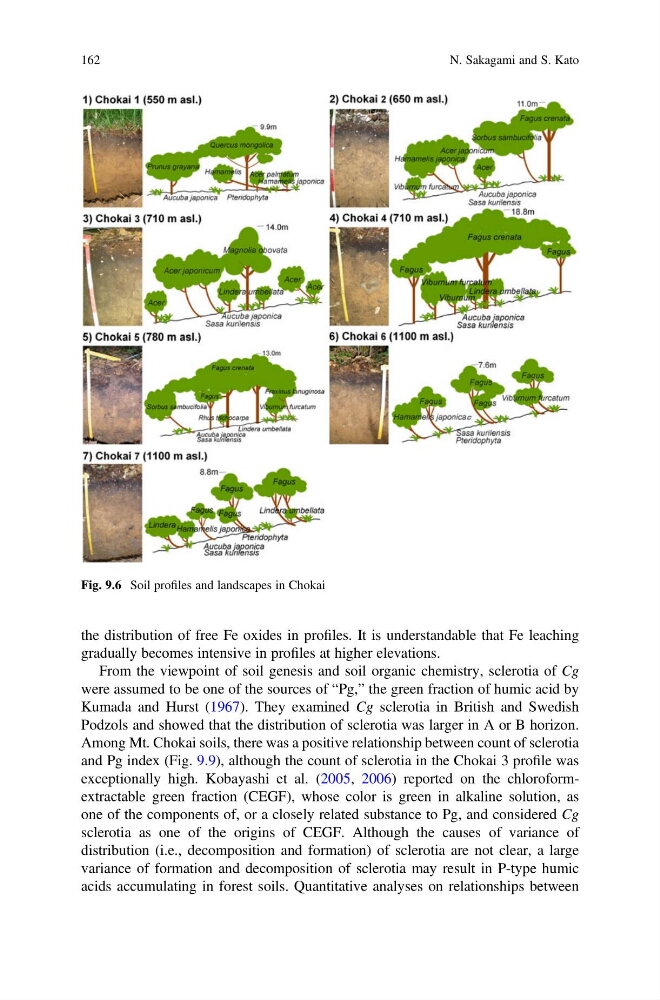
Fig. 9.6 Soil profiles and landscapes in Chokai
162
N. Sakagami and S. Kato
gradually becomes intensive in profiles at higher elevations.
From the viewpoint of soil genesis and soil organic chemistry, sclerotia of Cg
were assumed to be one of the sources of “Pg,” the green fraction of humic acid by
Kumada and Hurst (1967). They examined Cg sclerotia in British and Swedish
Podzols and showed that the distribution of sclerotia was larger in A or B horizon.
Among Mt. Chokai soils, there was a positive relationship between count of sclerotia
and Pg index (Fig. 9.9), although the count of sclerotia in the Chokai 3 profile was
exceptionally high. Kobayashi et al. (2005, 2006) reported on the chloroformextractable green fraction (CEGF), whose color is green in alkaline solution, as
one of the components of, or a closely related substance to Pg, and considered Cg
sclerotia as one of the origins of CEGF. Although the causes of variance of
distribution (i.e., decomposition and formation) of sclerotia are not clear, a large
variance of formation and decomposition of sclerotia may result in P-type humic
acids accumulating in forest soils. Quantitative analyses on relationships between
Fig. 9.6 Soil profiles and landscapes in Chokai
162
N. Sakagami and S. Kato