

Mt. Sasamori profiles (Fig. 9.2 (9, 10)) are podzolic soils near Mt. AkitaKomagatake (39
45
0 40
00 N, 140
47
0 58
00 E; 1637 m asl.). In this site only surface
soils showed strong acidity and the sclerotia only distributed in their thin surface
layers.
In Mt. Rishiri (Fig. 9.2 (11, 12)), sclerotia were collected from two different
Fulvic Andosols under Pinus pumila (Rishiri Pd.: 500 m asl.; and Rishiri Mt.:
1000 m asl.). Sakagami et al. (2007) reported that the Fe/Al ratios of internal parts
of sclerotia tend to be high (Fe/Al ratio > 1) in sclerotia in Rishiri Mt. comparing to
them in Rishiri Pd., and concluded that the chemical composition of sclerotia can
strongly be influenced by soil-environmental conditions.
Watanabe et al. (2001) noticed that C was the major element in sclerotia associated with a relatively large concentration of octahedral Al, which suggested an
Al-humus complex, and Watanabe et al. (2002, 2004) concluded that formation of
sclerotia was regulated by the content of exchangeable Al and the status of active Al
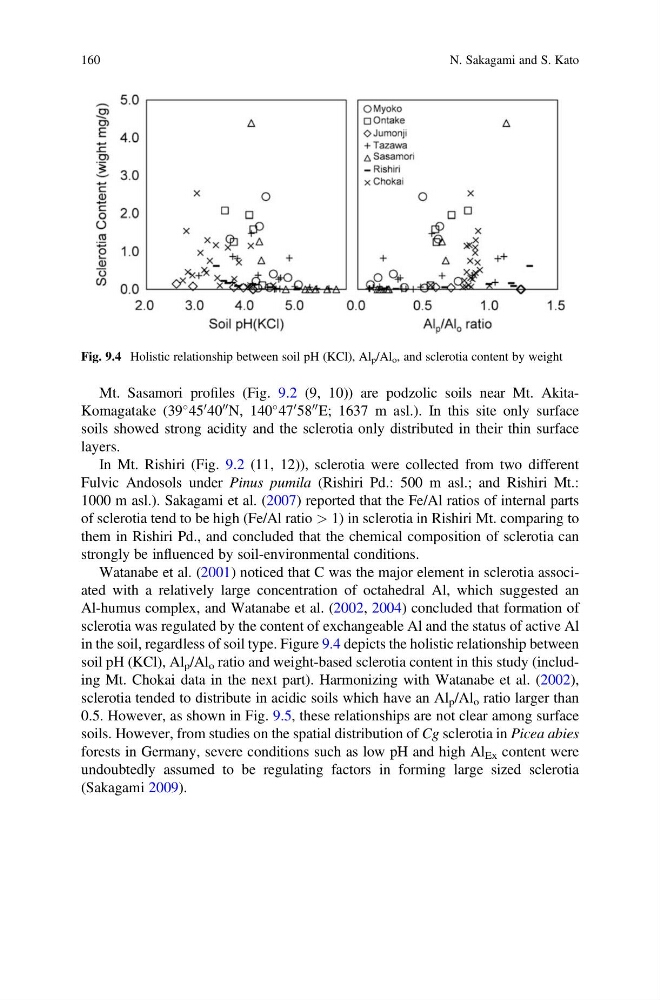
in the soil, regardless of soil type. Figure 9.4 depicts the holistic relationship between
soil pH (KCl), Al p /Al o ratio and weight-based sclerotia content in this study (including Mt. Chokai data in the next part). Harmonizing with Watanabe et al. (2002),
sclerotia tended to distribute in acidic soils which have an Al p /Al o ratio larger than
0.5. However, as shown in Fig. 9.5, these relationships are not clear among surface
soils. However, from studies on the spatial distribution of Cg sclerotia in Picea abies
forests in Germany, severe conditions such as low pH and high Al Ex content were
undoubtedly assumed to be regulating factors in forming large sized sclerotia
(Sakagami 2009).
Fig. 9.4 Holistic relationship between soil pH (KCl), Al p /Al o , and sclerotia content by weight
160
N. Sakagami and S. Kato
45
0 40
00 N, 140
47
0 58
00 E; 1637 m asl.). In this site only surface
soils showed strong acidity and the sclerotia only distributed in their thin surface
layers.
In Mt. Rishiri (Fig. 9.2 (11, 12)), sclerotia were collected from two different
Fulvic Andosols under Pinus pumila (Rishiri Pd.: 500 m asl.; and Rishiri Mt.:
1000 m asl.). Sakagami et al. (2007) reported that the Fe/Al ratios of internal parts
of sclerotia tend to be high (Fe/Al ratio > 1) in sclerotia in Rishiri Mt. comparing to
them in Rishiri Pd., and concluded that the chemical composition of sclerotia can
strongly be influenced by soil-environmental conditions.
Watanabe et al. (2001) noticed that C was the major element in sclerotia associated with a relatively large concentration of octahedral Al, which suggested an
Al-humus complex, and Watanabe et al. (2002, 2004) concluded that formation of
sclerotia was regulated by the content of exchangeable Al and the status of active Al
in the soil, regardless of soil type. Figure 9.4 depicts the holistic relationship between
soil pH (KCl), Al p /Al o ratio and weight-based sclerotia content in this study (including Mt. Chokai data in the next part). Harmonizing with Watanabe et al. (2002),
sclerotia tended to distribute in acidic soils which have an Al p /Al o ratio larger than
0.5. However, as shown in Fig. 9.5, these relationships are not clear among surface
soils. However, from studies on the spatial distribution of Cg sclerotia in Picea abies
forests in Germany, severe conditions such as low pH and high Al Ex content were
undoubtedly assumed to be regulating factors in forming large sized sclerotia
(Sakagami 2009).
Fig. 9.4 Holistic relationship between soil pH (KCl), Al p /Al o , and sclerotia content by weight
160
N. Sakagami and S. Kato