

6.5.3 Production and Stability in Soil of ECM Fungal
Sclerotial Polysaccharides
A large proportion of the total net primary production of the host plant allocated to
total mycorrhizal fungal components, namely sclerotia, mycorrhizal sheath, and
epigenous and hypogenous sporocarps, is distributed to sclerotia (Dahlberg et al.
1997; Vote et al. 1982). Biomass of sclerotia produced by C.geophyum in a Pacific
silver fir stand was estimated to be 2700 kg ha
À1 year
À1 (Vogt et al. 1982). ECM
fungal sclerotia persist in soil for several years forming a reservoir of fungal inocula
(Lo Buglio 1999), some of which, even in low numbers persist for a long time as
coherent organic bodies (Watanabe et al. 2007b: Tonosaki et al. 2007, 2008).
ECM fungal sclerotia have a tough melanized rind (Massicotte et al. 1992) and a
minute honeycomb structure inside (Watanabe et al. 2004). These features seem to
make the grain tough and resistant, thereby hindering decomposition by other
microbes. Furthermore, the SG contains considerable amounts of metal elements
such as Al and Zn (Watanabe et al. 2001, 2002, 2007a), which may stabilize
polysaccharides by forming chemical complexes (Cheshire 1979).
Thus, the high rate of production of sclerotia and persistent nature of SG result in
accumulation of SG poysaccharides in forest soil. Sclerota-forming ECM fungal
species such as C.geophilum may be key sources of forest soil polysccharides
(Sugiura et al. 2017).
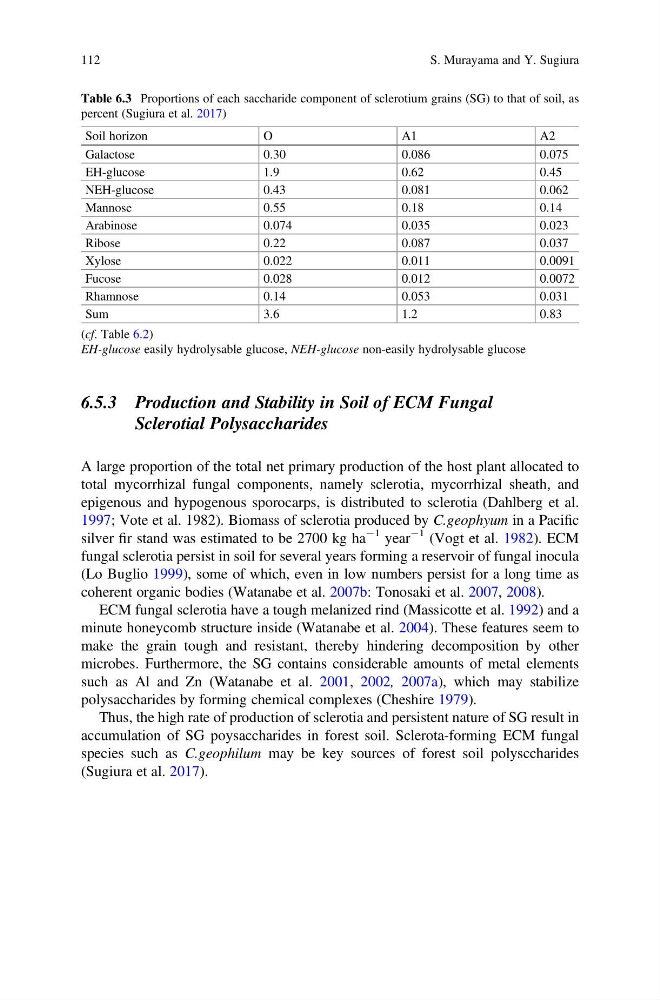
Table 6.3 Proportions of each saccharide component of sclerotium grains (SG) to that of soil, as
percent (Sugiura et al. 2017)
Soil horizon
O
A1
A2
Galactose
0.30
0.086
0.075
EH-glucose
1.9
0.62
0.45
NEH-glucose
0.43
0.081
0.062
Mannose
0.55
0.18
0.14
Arabinose
0.074
0.035
0.023
Ribose
0.22
0.087
0.037
Xylose
0.022
0.011
0.0091
Fucose
0.028
0.012
0.0072
Rhamnose
0.14
0.053
0.031
Sum
3.6
1.2
0.83
(cf. Table 6.2)
EH-glucose easily hydrolysable glucose, NEH-glucose non-easily hydrolysable glucose
112
S. Murayama and Y. Sugiura
Sclerotial Polysaccharides
A large proportion of the total net primary production of the host plant allocated to
total mycorrhizal fungal components, namely sclerotia, mycorrhizal sheath, and
epigenous and hypogenous sporocarps, is distributed to sclerotia (Dahlberg et al.
1997; Vote et al. 1982). Biomass of sclerotia produced by C.geophyum in a Pacific
silver fir stand was estimated to be 2700 kg ha
À1 year
À1 (Vogt et al. 1982). ECM
fungal sclerotia persist in soil for several years forming a reservoir of fungal inocula
(Lo Buglio 1999), some of which, even in low numbers persist for a long time as
coherent organic bodies (Watanabe et al. 2007b: Tonosaki et al. 2007, 2008).
ECM fungal sclerotia have a tough melanized rind (Massicotte et al. 1992) and a
minute honeycomb structure inside (Watanabe et al. 2004). These features seem to
make the grain tough and resistant, thereby hindering decomposition by other
microbes. Furthermore, the SG contains considerable amounts of metal elements
such as Al and Zn (Watanabe et al. 2001, 2002, 2007a), which may stabilize
polysaccharides by forming chemical complexes (Cheshire 1979).
Thus, the high rate of production of sclerotia and persistent nature of SG result in
accumulation of SG poysaccharides in forest soil. Sclerota-forming ECM fungal
species such as C.geophilum may be key sources of forest soil polysccharides
(Sugiura et al. 2017).
Table 6.3 Proportions of each saccharide component of sclerotium grains (SG) to that of soil, as
percent (Sugiura et al. 2017)
Soil horizon
O
A1
A2
Galactose
0.30
0.086
0.075
EH-glucose
1.9
0.62
0.45
NEH-glucose
0.43
0.081
0.062
Mannose
0.55
0.18
0.14
Arabinose
0.074
0.035
0.023
Ribose
0.22
0.087
0.037
Xylose
0.022
0.011
0.0091
Fucose
0.028
0.012
0.0072
Rhamnose
0.14
0.053
0.031
Sum
3.6
1.2
0.83
(cf. Table 6.2)
EH-glucose easily hydrolysable glucose, NEH-glucose non-easily hydrolysable glucose
112
S. Murayama and Y. Sugiura