

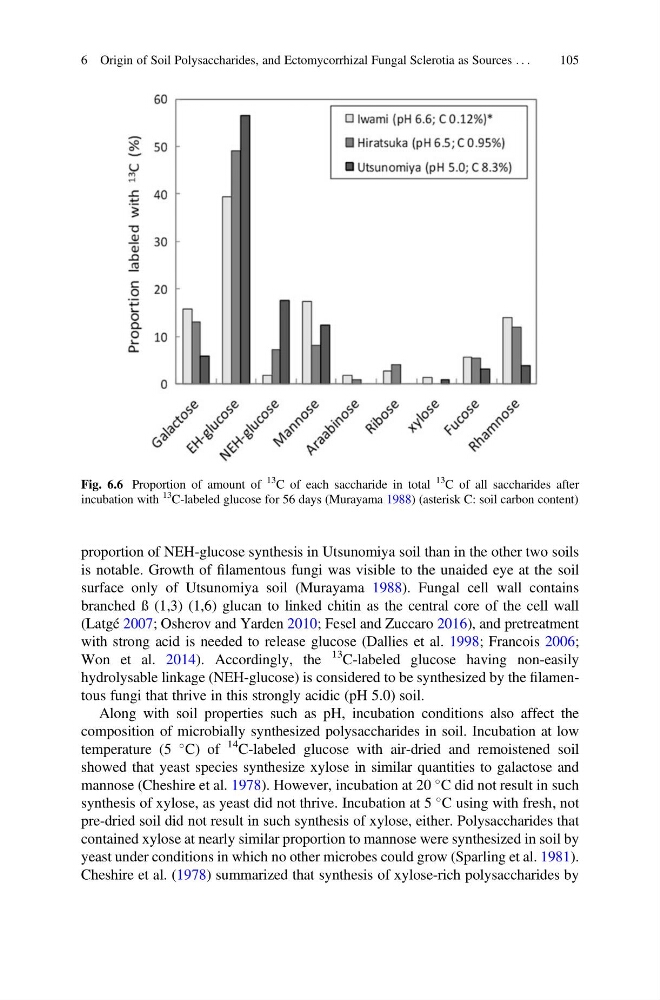
proportion of NEH-glucose synthesis in Utsunomiya soil than in the other two soils
is notable. Growth of filamentous fungi was visible to the unaided eye at the soil
surface only of Utsunomiya soil (Murayama 1988). Fungal cell wall contains
branched ß (1,3) (1,6) glucan to linked chitin as the central core of the cell wall
(Latgé 2007; Osherov and Yarden 2010; Fesel and Zuccaro 2016), and pretreatment
with strong acid is needed to release glucose (Dallies et al. 1998; Francois 2006;
Won et al. 2014). Accordingly, the
13 C-labeled glucose having non-easily
hydrolysable linkage (NEH-glucose) is considered to be synthesized by the filamentous fungi that thrive in this strongly acidic (pH 5.0) soil.
Along with soil properties such as pH, incubation conditions also affect the
composition of microbially synthesized polysaccharides in soil. Incubation at low
temperature (5
C) of
14 C-labeled glucose with air-dried and remoistened soil
showed that yeast species synthesize xylose in similar quantities to galactose and
mannose (Cheshire et al. 1978). However, incubation at 20
C did not result in such
synthesis of xylose, as yeast did not thrive. Incubation at 5
C using with fresh, not
pre-dried soil did not result in such synthesis of xylose, either. Polysaccharides that
contained xylose at nearly similar proportion to mannose were synthesized in soil by
yeast under conditions in which no other microbes could grow (Sparling et al. 1981).
Cheshire et al. (1978) summarized that synthesis of xylose-rich polysaccharides by
Fig. 6.6 Proportion of amount of
13
C of each saccharide in total
13
C of all saccharides after
incubation with
13
C-labeled glucose for 56 days (Murayama 1988) (asterisk C: soil carbon content)
6 Origin of Soil Polysaccharides, and Ectomycorrhizal Fungal Sclerotia as Sources . . .
105
is notable. Growth of filamentous fungi was visible to the unaided eye at the soil
surface only of Utsunomiya soil (Murayama 1988). Fungal cell wall contains
branched ß (1,3) (1,6) glucan to linked chitin as the central core of the cell wall
(Latgé 2007; Osherov and Yarden 2010; Fesel and Zuccaro 2016), and pretreatment
with strong acid is needed to release glucose (Dallies et al. 1998; Francois 2006;
Won et al. 2014). Accordingly, the
13 C-labeled glucose having non-easily
hydrolysable linkage (NEH-glucose) is considered to be synthesized by the filamentous fungi that thrive in this strongly acidic (pH 5.0) soil.
Along with soil properties such as pH, incubation conditions also affect the
composition of microbially synthesized polysaccharides in soil. Incubation at low
temperature (5
C) of
14 C-labeled glucose with air-dried and remoistened soil
showed that yeast species synthesize xylose in similar quantities to galactose and
mannose (Cheshire et al. 1978). However, incubation at 20
C did not result in such
synthesis of xylose, as yeast did not thrive. Incubation at 5
C using with fresh, not
pre-dried soil did not result in such synthesis of xylose, either. Polysaccharides that
contained xylose at nearly similar proportion to mannose were synthesized in soil by
yeast under conditions in which no other microbes could grow (Sparling et al. 1981).
Cheshire et al. (1978) summarized that synthesis of xylose-rich polysaccharides by
Fig. 6.6 Proportion of amount of
13
C of each saccharide in total
13
C of all saccharides after
incubation with
13
C-labeled glucose for 56 days (Murayama 1988) (asterisk C: soil carbon content)
6 Origin of Soil Polysaccharides, and Ectomycorrhizal Fungal Sclerotia as Sources . . .
105