

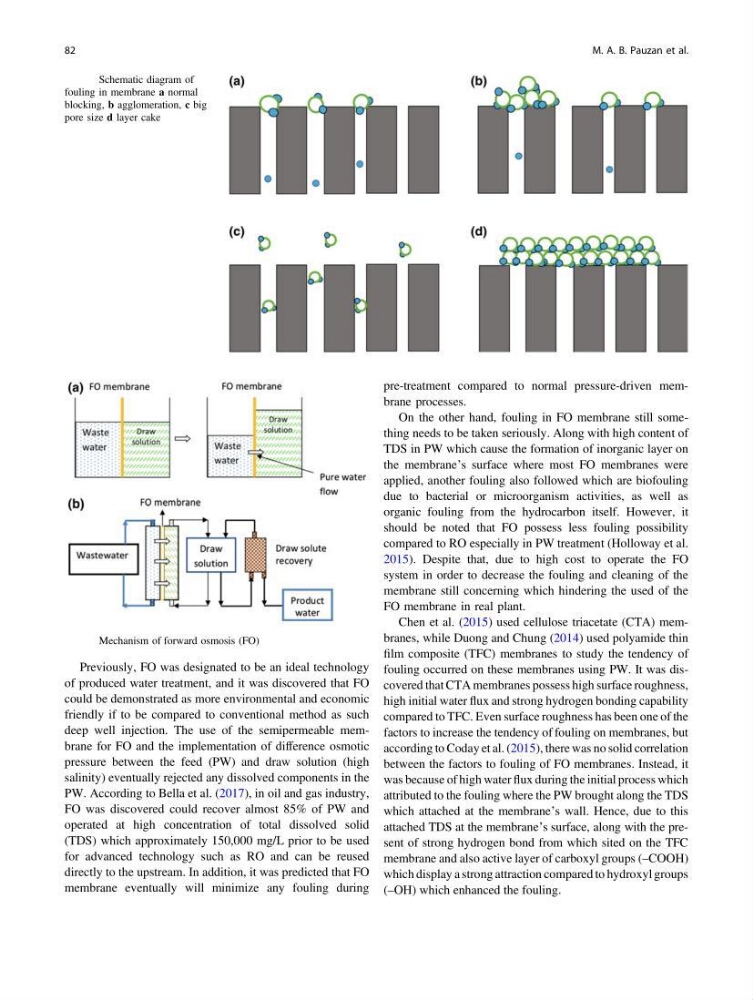
Previously, FO was designated to be an ideal technology
of produced water treatment, and it was discovered that FO
could be demonstrated as more environmental and economic
friendly if to be compared to conventional method as such
deep well injection. The use of the semipermeable membrane for FO and the implementation of difference osmotic
pressure between the feed (PW) and draw solution (high
salinity) eventually rejected any dissolved components in the
PW. According to Bella et al. (2017), in oil and gas industry,
FO was discovered could recover almost 85% of PW and
operated at high concentration of total dissolved solid
(TDS) which approximately 150,000 mg/L prior to be used
for advanced technology such as RO and can be reused
directly to the upstream. In addition, it was predicted that FO
membrane eventually will minimize any fouling during
pre-treatment compared to normal pressure-driven membrane processes.
On the other hand, fouling in FO membrane still something needs to be taken seriously. Along with high content of
TDS in PW which cause the formation of inorganic layer on
the membrane’s surface where most FO membranes were
applied, another fouling also followed which are biofouling
due to bacterial or microorganism activities, as well as
organic fouling from the hydrocarbon itself. However, it
should be noted that FO possess less fouling possibility
compared to RO especially in PW treatment (Holloway et al.
2015). Despite that, due to high cost to operate the FO
system in order to decrease the fouling and cleaning of the
membrane still concerning which hindering the used of the
FO membrane in real plant.
Chen et al. (2015) used cellulose triacetate (CTA) membranes, while Duong and Chung (2014) used polyamide thin
film composite (TFC) membranes to study the tendency of
fouling occurred on these membranes using PW. It was discovered that CTA membranes possess high surface roughness,
high initial water flux and strong hydrogen bonding capability
compared to TFC. Even surface roughness has been one of the
factors to increase the tendency of fouling on membranes, but
according to Coday et al. (2015), there was no solid correlation
between the factors to fouling of FO membranes. Instead, it
was because of high water flux during the initial process which
attributed to the fouling where the PW brought along the TDS
which attached at the membrane’s wall. Hence, due to this
attached TDS at the membrane’s surface, along with the present of strong hydrogen bond from which sited on the TFC
membrane and also active layer of carboxyl groups (–COOH)
which display a strong attraction compared to hydroxyl groups
(–OH) which enhanced the fouling.
Fig. 7 Schematic diagram of
fouling in membrane a normal
blocking, b agglomeration, c big
pore size d layer cake
Fig. 8 Mechanism of forward osmosis (FO)
82
M. A. B. Pauzan et al.
of produced water treatment, and it was discovered that FO
could be demonstrated as more environmental and economic
friendly if to be compared to conventional method as such
deep well injection. The use of the semipermeable membrane for FO and the implementation of difference osmotic
pressure between the feed (PW) and draw solution (high
salinity) eventually rejected any dissolved components in the
PW. According to Bella et al. (2017), in oil and gas industry,
FO was discovered could recover almost 85% of PW and
operated at high concentration of total dissolved solid
(TDS) which approximately 150,000 mg/L prior to be used
for advanced technology such as RO and can be reused
directly to the upstream. In addition, it was predicted that FO
membrane eventually will minimize any fouling during
pre-treatment compared to normal pressure-driven membrane processes.
On the other hand, fouling in FO membrane still something needs to be taken seriously. Along with high content of
TDS in PW which cause the formation of inorganic layer on
the membrane’s surface where most FO membranes were
applied, another fouling also followed which are biofouling
due to bacterial or microorganism activities, as well as
organic fouling from the hydrocarbon itself. However, it
should be noted that FO possess less fouling possibility
compared to RO especially in PW treatment (Holloway et al.
2015). Despite that, due to high cost to operate the FO
system in order to decrease the fouling and cleaning of the
membrane still concerning which hindering the used of the
FO membrane in real plant.
Chen et al. (2015) used cellulose triacetate (CTA) membranes, while Duong and Chung (2014) used polyamide thin
film composite (TFC) membranes to study the tendency of
fouling occurred on these membranes using PW. It was discovered that CTA membranes possess high surface roughness,
high initial water flux and strong hydrogen bonding capability
compared to TFC. Even surface roughness has been one of the
factors to increase the tendency of fouling on membranes, but
according to Coday et al. (2015), there was no solid correlation
between the factors to fouling of FO membranes. Instead, it
was because of high water flux during the initial process which
attributed to the fouling where the PW brought along the TDS
which attached at the membrane’s wall. Hence, due to this
attached TDS at the membrane’s surface, along with the present of strong hydrogen bond from which sited on the TFC
membrane and also active layer of carboxyl groups (–COOH)
which display a strong attraction compared to hydroxyl groups
(–OH) which enhanced the fouling.
Fig. 7 Schematic diagram of
fouling in membrane a normal
blocking, b agglomeration, c big
pore size d layer cake
Fig. 8 Mechanism of forward osmosis (FO)
82
M. A. B. Pauzan et al.