

the outcome it was clearly implied that the optimization was
important to achieve a best result depending on the PW
quality and operating parameters unit of the membrane.
Another related study by Salahi et al. (2012) where two
commercial UF membranes, i.e. PAN and PSf, were used to
investigate the membrane operating parameter for operational optimization in pilot-scale PW treatment. In order to
compare from the existing conventional biological treatment,
refinery wastewater taken from Tehran API was used. It was
discovered that except COD removal, all parameters
including TMP, CFV, pH and temperature were highly
removed by the UF membrane compared to existing biological treatment used in the refinery plant. In addition, the
study also indicated that PSf UF membrane showed less
water flux performance and low resistance to fouling compared to PAN UF membrane.
Furthermore, studies on the use of UF for inorganic or
ceramic membrane were reported by Ebrahimi et al. (2009),
for TiO 2 /Al 2 O 3 UF membrane performance in PW treatment. From the result, almost 80% of organic content was
removed along with the capability of the membrane to work
at low pressures, 0.5 bar for salt removal. Besides, the efficiency of the ceramic UF membranes was improvized in
order to investigate the effect of pressure of the membrane
by increasing the applied pressure up to 2 bar, instead of
0.5–1.5 bar at ambient pressure.
Ultimately, the main focus of UF membrane in PW
treatment is more to develop an anti-fouling membrane or
modification in order to reduce the membrane’s fouling
where fouling has been the major drawback to apply the UF
membrane system in large scale of PW treatment plant.
Hence, the future of anti-fouling and smart UF membrane is
still in research, and the ongoing process will be better for
membrane technology in PW treatment.
2.3 Nanofiltration (NF) and Reverse Osmosis
(RO)
Considered as latest in membrane technology, NF and RO
membranes possess the smallest pore size compared to MF
and UF where the pore size ranges below 0.1 lm to 50 nm.
Normally, the membranes operated at high pressure and
relatively effective to remove inorganic minerals. Furthermore, the significant difference amid NF and RO membrane
is their selectivity. For RO membrane, the water permeation
flux is directly proportional to the operating pressure,
whereas the salt permeation is independent of pressure,
Baker (2004). Apparently, RO membrane can reject almost
all iconic species including monovalent ions whereas NF
more to selected divalent ions, and only allows several
monovalent ions such as Na
+ and Cl
− . Mostly, the membranes were fabricated as thin film composite (TFC) and
deposited on the surface asymmetric UF membrane (acted as
a support). These membranes are considerably simply prone
to fouling due to its very particular selectivity and required
to operate at high pressure condition. Hence, a relative clean
feed must be required such as clay, organic foulants, suspended solids, etc.
Study on the use of ultra low pressure RO (ULPRO) and
NF membranes by Xu and Drewes (2006) for methane
recovery in PW has discovered that, enhanced fouling
resistance and high permeation flux using pure water were
recorded by the membrane which possess high hydrophilic
properties and low surface roughness. It was hypothesized
that from the result of FESEM and FTIR taken, the decline
in flux was not majorly due by organic fouling. From the
study also, the NF membrane passed the standard to be used
as primary drinking water, nevertheless, failed to be considered at secondary drinking water standards due to high
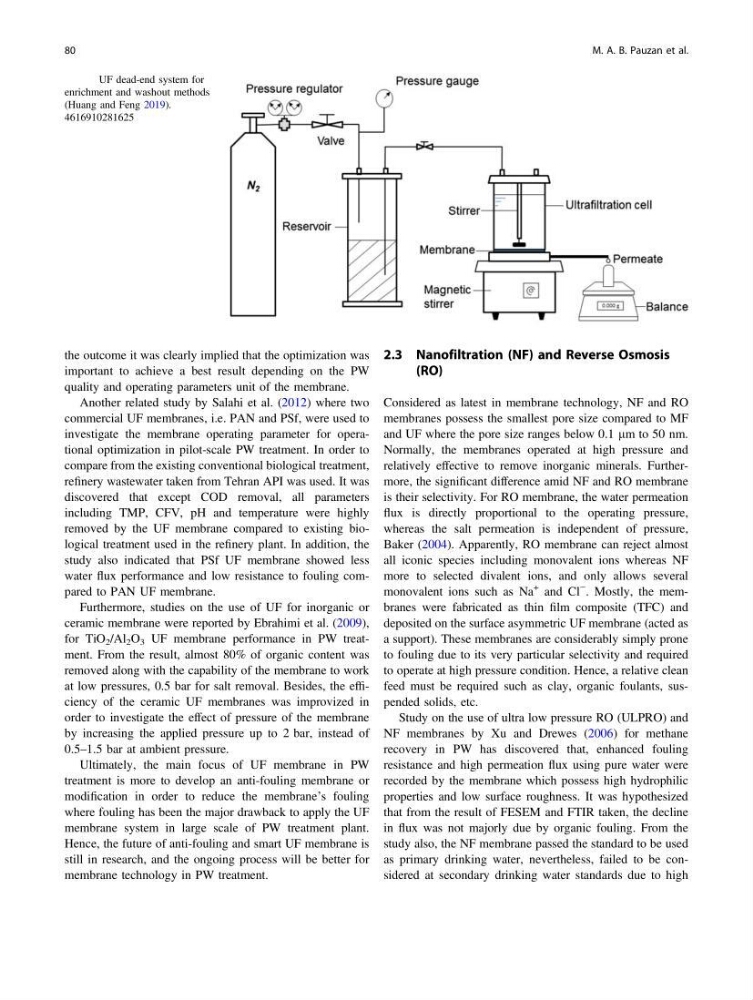
Fig. 6 UF dead-end system for
enrichment and washout methods
(Huang and Feng 2019).
4616910281625
80
M. A. B. Pauzan et al.
important to achieve a best result depending on the PW
quality and operating parameters unit of the membrane.
Another related study by Salahi et al. (2012) where two
commercial UF membranes, i.e. PAN and PSf, were used to
investigate the membrane operating parameter for operational optimization in pilot-scale PW treatment. In order to
compare from the existing conventional biological treatment,
refinery wastewater taken from Tehran API was used. It was
discovered that except COD removal, all parameters
including TMP, CFV, pH and temperature were highly
removed by the UF membrane compared to existing biological treatment used in the refinery plant. In addition, the
study also indicated that PSf UF membrane showed less
water flux performance and low resistance to fouling compared to PAN UF membrane.
Furthermore, studies on the use of UF for inorganic or
ceramic membrane were reported by Ebrahimi et al. (2009),
for TiO 2 /Al 2 O 3 UF membrane performance in PW treatment. From the result, almost 80% of organic content was
removed along with the capability of the membrane to work
at low pressures, 0.5 bar for salt removal. Besides, the efficiency of the ceramic UF membranes was improvized in
order to investigate the effect of pressure of the membrane
by increasing the applied pressure up to 2 bar, instead of
0.5–1.5 bar at ambient pressure.
Ultimately, the main focus of UF membrane in PW
treatment is more to develop an anti-fouling membrane or
modification in order to reduce the membrane’s fouling
where fouling has been the major drawback to apply the UF
membrane system in large scale of PW treatment plant.
Hence, the future of anti-fouling and smart UF membrane is
still in research, and the ongoing process will be better for
membrane technology in PW treatment.
2.3 Nanofiltration (NF) and Reverse Osmosis
(RO)
Considered as latest in membrane technology, NF and RO
membranes possess the smallest pore size compared to MF
and UF where the pore size ranges below 0.1 lm to 50 nm.
Normally, the membranes operated at high pressure and
relatively effective to remove inorganic minerals. Furthermore, the significant difference amid NF and RO membrane
is their selectivity. For RO membrane, the water permeation
flux is directly proportional to the operating pressure,
whereas the salt permeation is independent of pressure,
Baker (2004). Apparently, RO membrane can reject almost
all iconic species including monovalent ions whereas NF
more to selected divalent ions, and only allows several
monovalent ions such as Na
+ and Cl
− . Mostly, the membranes were fabricated as thin film composite (TFC) and
deposited on the surface asymmetric UF membrane (acted as
a support). These membranes are considerably simply prone
to fouling due to its very particular selectivity and required
to operate at high pressure condition. Hence, a relative clean
feed must be required such as clay, organic foulants, suspended solids, etc.
Study on the use of ultra low pressure RO (ULPRO) and
NF membranes by Xu and Drewes (2006) for methane
recovery in PW has discovered that, enhanced fouling
resistance and high permeation flux using pure water were
recorded by the membrane which possess high hydrophilic
properties and low surface roughness. It was hypothesized
that from the result of FESEM and FTIR taken, the decline
in flux was not majorly due by organic fouling. From the
study also, the NF membrane passed the standard to be used
as primary drinking water, nevertheless, failed to be considered at secondary drinking water standards due to high
Fig. 6 UF dead-end system for
enrichment and washout methods
(Huang and Feng 2019).
4616910281625
80
M. A. B. Pauzan et al.