

aspects yet to be solved such as concentration polarization
and reverse salt flux. These aspects will be further discussed
in the following sections of this chapter.
FO application in chemical industry usually deals with
the originated wastes by manufacturing process. FO has
been also proposed for many food industry areas such as
dairy industry, juice processing, tea extracts and olive mill
wastewater. Furthermore, pharmaceutical industry has also
pointed out for FO utilization to treat pharmaceutical liquids
and to recover the organic solvents from pharmaceutical
active ingredients (Haupt and Lerch 2018).
As a consequence of above-mentioned advantages, an
increase of publications has been observed during the last
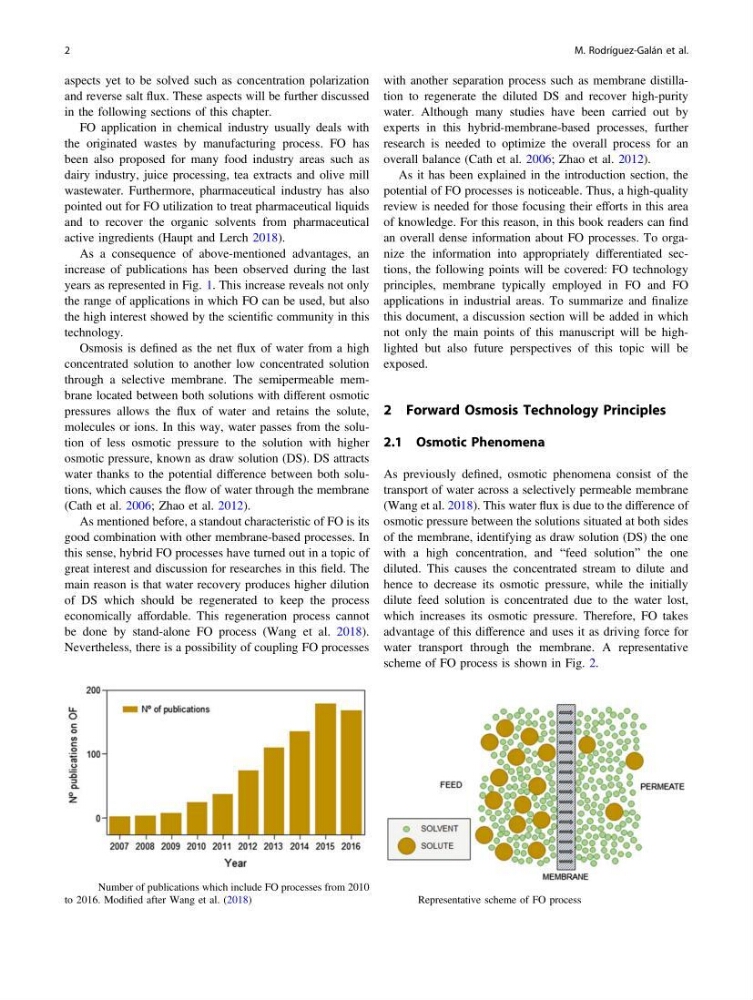
years as represented in Fig. 1. This increase reveals not only
the range of applications in which FO can be used, but also
the high interest showed by the scientific community in this
technology.
Osmosis is defined as the net flux of water from a high
concentrated solution to another low concentrated solution
through a selective membrane. The semipermeable membrane located between both solutions with different osmotic
pressures allows the flux of water and retains the solute,
molecules or ions. In this way, water passes from the solution of less osmotic pressure to the solution with higher
osmotic pressure, known as draw solution (DS). DS attracts
water thanks to the potential difference between both solutions, which causes the flow of water through the membrane
(Cath et al. 2006; Zhao et al. 2012).
As mentioned before, a standout characteristic of FO is its
good combination with other membrane-based processes. In
this sense, hybrid FO processes have turned out in a topic of
great interest and discussion for researches in this field. The
main reason is that water recovery produces higher dilution
of DS which should be regenerated to keep the process
economically affordable. This regeneration process cannot
be done by stand-alone FO process (Wang et al. 2018).
Nevertheless, there is a possibility of coupling FO processes
with another separation process such as membrane distillation to regenerate the diluted DS and recover high-purity
water. Although many studies have been carried out by
experts in this hybrid-membrane-based processes, further
research is needed to optimize the overall process for an
overall balance (Cath et al. 2006; Zhao et al. 2012).
As it has been explained in the introduction section, the
potential of FO processes is noticeable. Thus, a high-quality
review is needed for those focusing their efforts in this area
of knowledge. For this reason, in this book readers can find
an overall dense information about FO processes. To organize the information into appropriately differentiated sections, the following points will be covered: FO technology
principles, membrane typically employed in FO and FO
applications in industrial areas. To summarize and finalize
this document, a discussion section will be added in which
not only the main points of this manuscript will be highlighted but also future perspectives of this topic will be
exposed.
2 Forward Osmosis Technology Principles
2.1 Osmotic Phenomena
As previously defined, osmotic phenomena consist of the
transport of water across a selectively permeable membrane
(Wang et al. 2018). This water flux is due to the difference of
osmotic pressure between the solutions situated at both sides
of the membrane, identifying as draw solution (DS) the one
with a high concentration, and “feed solution” the one
diluted. This causes the concentrated stream to dilute and
hence to decrease its osmotic pressure, while the initially
dilute feed solution is concentrated due to the water lost,
which increases its osmotic pressure. Therefore, FO takes
advantage of this difference and uses it as driving force for
water transport through the membrane. A representative
scheme of FO process is shown in Fig. 2.
Fig. 1 Number of publications which include FO processes from 2010
to 2016. Modified after Wang et al. (2018)
Fig. 2 Representative scheme of FO process
2
M. Rodríguez-Galán et al.
and reverse salt flux. These aspects will be further discussed
in the following sections of this chapter.
FO application in chemical industry usually deals with
the originated wastes by manufacturing process. FO has
been also proposed for many food industry areas such as
dairy industry, juice processing, tea extracts and olive mill
wastewater. Furthermore, pharmaceutical industry has also
pointed out for FO utilization to treat pharmaceutical liquids
and to recover the organic solvents from pharmaceutical
active ingredients (Haupt and Lerch 2018).
As a consequence of above-mentioned advantages, an
increase of publications has been observed during the last
years as represented in Fig. 1. This increase reveals not only
the range of applications in which FO can be used, but also
the high interest showed by the scientific community in this
technology.
Osmosis is defined as the net flux of water from a high
concentrated solution to another low concentrated solution
through a selective membrane. The semipermeable membrane located between both solutions with different osmotic
pressures allows the flux of water and retains the solute,
molecules or ions. In this way, water passes from the solution of less osmotic pressure to the solution with higher
osmotic pressure, known as draw solution (DS). DS attracts
water thanks to the potential difference between both solutions, which causes the flow of water through the membrane
(Cath et al. 2006; Zhao et al. 2012).
As mentioned before, a standout characteristic of FO is its
good combination with other membrane-based processes. In
this sense, hybrid FO processes have turned out in a topic of
great interest and discussion for researches in this field. The
main reason is that water recovery produces higher dilution
of DS which should be regenerated to keep the process
economically affordable. This regeneration process cannot
be done by stand-alone FO process (Wang et al. 2018).
Nevertheless, there is a possibility of coupling FO processes
with another separation process such as membrane distillation to regenerate the diluted DS and recover high-purity
water. Although many studies have been carried out by
experts in this hybrid-membrane-based processes, further
research is needed to optimize the overall process for an
overall balance (Cath et al. 2006; Zhao et al. 2012).
As it has been explained in the introduction section, the
potential of FO processes is noticeable. Thus, a high-quality
review is needed for those focusing their efforts in this area
of knowledge. For this reason, in this book readers can find
an overall dense information about FO processes. To organize the information into appropriately differentiated sections, the following points will be covered: FO technology
principles, membrane typically employed in FO and FO
applications in industrial areas. To summarize and finalize
this document, a discussion section will be added in which
not only the main points of this manuscript will be highlighted but also future perspectives of this topic will be
exposed.
2 Forward Osmosis Technology Principles
2.1 Osmotic Phenomena
As previously defined, osmotic phenomena consist of the
transport of water across a selectively permeable membrane
(Wang et al. 2018). This water flux is due to the difference of
osmotic pressure between the solutions situated at both sides
of the membrane, identifying as draw solution (DS) the one
with a high concentration, and “feed solution” the one
diluted. This causes the concentrated stream to dilute and
hence to decrease its osmotic pressure, while the initially
dilute feed solution is concentrated due to the water lost,
which increases its osmotic pressure. Therefore, FO takes
advantage of this difference and uses it as driving force for
water transport through the membrane. A representative
scheme of FO process is shown in Fig. 2.
Fig. 1 Number of publications which include FO processes from 2010
to 2016. Modified after Wang et al. (2018)
Fig. 2 Representative scheme of FO process
2
M. Rodríguez-Galán et al.