

Commercially available polymeric materials for gas separation are polyimide (PI), polycarbonate (PC), polysulfone
(PSF), cellulose acetate (CA), and polydimethylsiloxane
(PDMS). They have exceptional mechanical strength with
low cost and high permeability. CA is the first polymeric
material commercialized for gas separation (Scholz et al.
2013). It is relatively low priced due to abundant resources of
cellulose with excellent separation properties. However, the
CA is prone to plasticization (P Plasticization = 8 bar) (Bos et al.
1999) owing to its −OH rich functional groups that dissolve
CO 2 during the process. PI is another crystalline polymer
material with high permeability and selectivity used for gas
separation. Matrimid
® is a commercially available PI which
is very rigid and stable with stiff polymer backbone which
can be used in harsh conditions. But, it is very expensive and
susceptible to plasticization (P Plasticization = 17 bar) (Bos
et al. 1999). PSF is another important polymeric material
with excellent mechanical and thermal strength, high rigidity,
and acceptable gas pair selectivity. Although the PSF is
still lacking in separation properties compared to PI, it is
inexpensive with acceptable plasticization resistance
(P Plasticization = 34 bar) (Bos et al. 1999).
Although polymeric membranes showed convincing
results in gas separation, they suffer from drawbacks
(Vinoba et al. 2017). Low membrane selectivity was the
major inconvenient loss in gas separation that demands a
multi-stage separation system which likely to impart higher
capital cost. In addition, polymeric membranes commonly
could not maintain their performance and thus deteriorate in
extreme environmental operating conditions of high temperature and pressure. The chain swelling in the presence of
highly corrosive components in the feed, plasticization,
compaction, and aging of membranes were the main reasons
for problematic phenomena (Vinoba et al. 2017). The performance of the polymeric materials for gas separation is
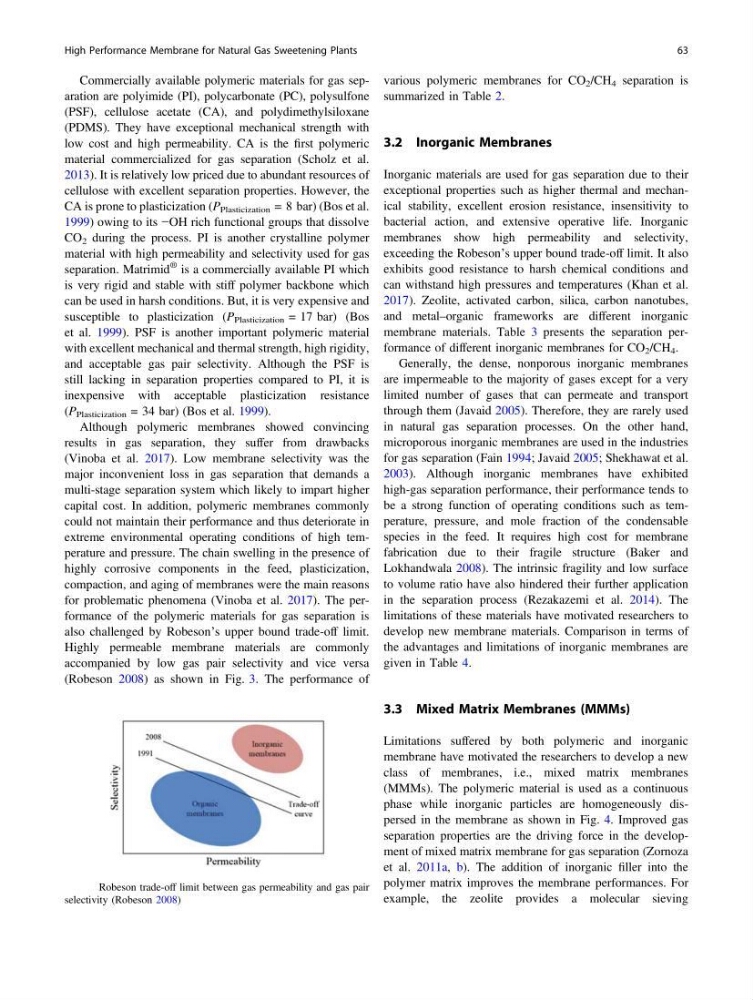
also challenged by Robeson’s upper bound trade-off limit.
Highly permeable membrane materials are commonly
accompanied by low gas pair selectivity and vice versa
(Robeson 2008) as shown in Fig. 3. The performance of
various polymeric membranes for CO 2 /CH 4 separation is
summarized in Table 2.
3.2 Inorganic Membranes
Inorganic materials are used for gas separation due to their
exceptional properties such as higher thermal and mechanical stability, excellent erosion resistance, insensitivity to
bacterial action, and extensive operative life. Inorganic
membranes show high permeability and selectivity,
exceeding the Robeson’s upper bound trade-off limit. It also
exhibits good resistance to harsh chemical conditions and
can withstand high pressures and temperatures (Khan et al.
2017). Zeolite, activated carbon, silica, carbon nanotubes,
and metal–organic frameworks are different inorganic
membrane materials. Table 3 presents the separation performance of different inorganic membranes for CO 2 /CH 4 .
Generally, the dense, nonporous inorganic membranes
are impermeable to the majority of gases except for a very
limited number of gases that can permeate and transport
through them (Javaid 2005). Therefore, they are rarely used
in natural gas separation processes. On the other hand,
microporous inorganic membranes are used in the industries
for gas separation (Fain 1994; Javaid 2005; Shekhawat et al.
2003). Although inorganic membranes have exhibited
high-gas separation performance, their performance tends to
be a strong function of operating conditions such as temperature, pressure, and mole fraction of the condensable
species in the feed. It requires high cost for membrane
fabrication due to their fragile structure (Baker and
Lokhandwala 2008). The intrinsic fragility and low surface
to volume ratio have also hindered their further application
in the separation process (Rezakazemi et al. 2014). The
limitations of these materials have motivated researchers to
develop new membrane materials. Comparison in terms of
the advantages and limitations of inorganic membranes are
given in Table 4.
3.3 Mixed Matrix Membranes (MMMs)
Limitations suffered by both polymeric and inorganic
membrane have motivated the researchers to develop a new
class of membranes, i.e., mixed matrix membranes
(MMMs). The polymeric material is used as a continuous
phase while inorganic particles are homogeneously dispersed in the membrane as shown in Fig. 4. Improved gas
separation properties are the driving force in the development of mixed matrix membrane for gas separation (Zornoza
et al. 2011a, b). The addition of inorganic filler into the
polymer matrix improves the membrane performances. For
example, the zeolite provides a molecular sieving
Fig. 3 Robeson trade-off limit between gas permeability and gas pair
selectivity (Robeson 2008)
High Performance Membrane for Natural Gas Sweetening Plants
63
(PSF), cellulose acetate (CA), and polydimethylsiloxane
(PDMS). They have exceptional mechanical strength with
low cost and high permeability. CA is the first polymeric
material commercialized for gas separation (Scholz et al.
2013). It is relatively low priced due to abundant resources of
cellulose with excellent separation properties. However, the
CA is prone to plasticization (P Plasticization = 8 bar) (Bos et al.
1999) owing to its −OH rich functional groups that dissolve
CO 2 during the process. PI is another crystalline polymer
material with high permeability and selectivity used for gas
separation. Matrimid
® is a commercially available PI which
is very rigid and stable with stiff polymer backbone which
can be used in harsh conditions. But, it is very expensive and
susceptible to plasticization (P Plasticization = 17 bar) (Bos
et al. 1999). PSF is another important polymeric material
with excellent mechanical and thermal strength, high rigidity,
and acceptable gas pair selectivity. Although the PSF is
still lacking in separation properties compared to PI, it is
inexpensive with acceptable plasticization resistance
(P Plasticization = 34 bar) (Bos et al. 1999).
Although polymeric membranes showed convincing
results in gas separation, they suffer from drawbacks
(Vinoba et al. 2017). Low membrane selectivity was the
major inconvenient loss in gas separation that demands a
multi-stage separation system which likely to impart higher
capital cost. In addition, polymeric membranes commonly
could not maintain their performance and thus deteriorate in
extreme environmental operating conditions of high temperature and pressure. The chain swelling in the presence of
highly corrosive components in the feed, plasticization,
compaction, and aging of membranes were the main reasons
for problematic phenomena (Vinoba et al. 2017). The performance of the polymeric materials for gas separation is
also challenged by Robeson’s upper bound trade-off limit.
Highly permeable membrane materials are commonly
accompanied by low gas pair selectivity and vice versa
(Robeson 2008) as shown in Fig. 3. The performance of
various polymeric membranes for CO 2 /CH 4 separation is
summarized in Table 2.
3.2 Inorganic Membranes
Inorganic materials are used for gas separation due to their
exceptional properties such as higher thermal and mechanical stability, excellent erosion resistance, insensitivity to
bacterial action, and extensive operative life. Inorganic
membranes show high permeability and selectivity,
exceeding the Robeson’s upper bound trade-off limit. It also
exhibits good resistance to harsh chemical conditions and
can withstand high pressures and temperatures (Khan et al.
2017). Zeolite, activated carbon, silica, carbon nanotubes,
and metal–organic frameworks are different inorganic
membrane materials. Table 3 presents the separation performance of different inorganic membranes for CO 2 /CH 4 .
Generally, the dense, nonporous inorganic membranes
are impermeable to the majority of gases except for a very
limited number of gases that can permeate and transport
through them (Javaid 2005). Therefore, they are rarely used
in natural gas separation processes. On the other hand,
microporous inorganic membranes are used in the industries
for gas separation (Fain 1994; Javaid 2005; Shekhawat et al.
2003). Although inorganic membranes have exhibited
high-gas separation performance, their performance tends to
be a strong function of operating conditions such as temperature, pressure, and mole fraction of the condensable
species in the feed. It requires high cost for membrane
fabrication due to their fragile structure (Baker and
Lokhandwala 2008). The intrinsic fragility and low surface
to volume ratio have also hindered their further application
in the separation process (Rezakazemi et al. 2014). The
limitations of these materials have motivated researchers to
develop new membrane materials. Comparison in terms of
the advantages and limitations of inorganic membranes are
given in Table 4.
3.3 Mixed Matrix Membranes (MMMs)
Limitations suffered by both polymeric and inorganic
membrane have motivated the researchers to develop a new
class of membranes, i.e., mixed matrix membranes
(MMMs). The polymeric material is used as a continuous
phase while inorganic particles are homogeneously dispersed in the membrane as shown in Fig. 4. Improved gas
separation properties are the driving force in the development of mixed matrix membrane for gas separation (Zornoza
et al. 2011a, b). The addition of inorganic filler into the
polymer matrix improves the membrane performances. For
example, the zeolite provides a molecular sieving
Fig. 3 Robeson trade-off limit between gas permeability and gas pair
selectivity (Robeson 2008)
High Performance Membrane for Natural Gas Sweetening Plants
63