

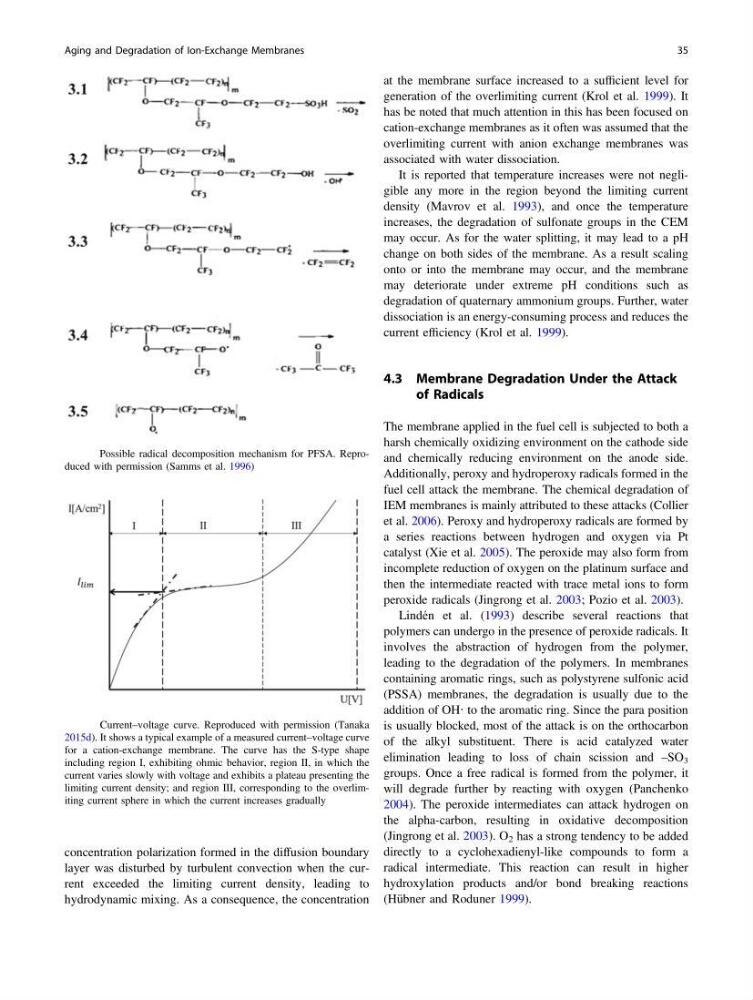
concentration polarization formed in the diffusion boundary
layer was disturbed by turbulent convection when the current exceeded the limiting current density, leading to
hydrodynamic mixing. As a consequence, the concentration
at the membrane surface increased to a sufficient level for
generation of the overlimiting current (Krol et al. 1999). It
has be noted that much attention in this has been focused on
cation-exchange membranes as it often was assumed that the
overlimiting current with anion exchange membranes was
associated with water dissociation.
It is reported that temperature increases were not negligible any more in the region beyond the limiting current
density (Mavrov et al. 1993), and once the temperature
increases, the degradation of sulfonate groups in the CEM
may occur. As for the water splitting, it may lead to a pH
change on both sides of the membrane. As a result scaling
onto or into the membrane may occur, and the membrane
may deteriorate under extreme pH conditions such as
degradation of quaternary ammonium groups. Further, water
dissociation is an energy-consuming process and reduces the
current efficiency (Krol et al. 1999).
4.3 Membrane Degradation Under the Attack
of Radicals
The membrane applied in the fuel cell is subjected to both a
harsh chemically oxidizing environment on the cathode side
and chemically reducing environment on the anode side.
Additionally, peroxy and hydroperoxy radicals formed in the
fuel cell attack the membrane. The chemical degradation of
IEM membranes is mainly attributed to these attacks (Collier
et al. 2006). Peroxy and hydroperoxy radicals are formed by
a series reactions between hydrogen and oxygen via Pt
catalyst (Xie et al. 2005). The peroxide may also form from
incomplete reduction of oxygen on the platinum surface and
then the intermediate reacted with trace metal ions to form
peroxide radicals (Jingrong et al. 2003; Pozio et al. 2003).
Lindén et al. (1993) describe several reactions that
polymers can undergo in the presence of peroxide radicals. It
involves the abstraction of hydrogen from the polymer,
leading to the degradation of the polymers. In membranes
containing aromatic rings, such as polystyrene sulfonic acid
(PSSA) membranes, the degradation is usually due to the
addition of OH⋅ to the aromatic ring. Since the para position
is usually blocked, most of the attack is on the orthocarbon
of the alkyl substituent. There is acid catalyzed water
elimination leading to loss of chain scission and –SO 3
groups. Once a free radical is formed from the polymer, it
will degrade further by reacting with oxygen (Panchenko
2004). The peroxide intermediates can attack hydrogen on
the alpha-carbon, resulting in oxidative decomposition
(Jingrong et al. 2003). O 2 has a strong tendency to be added
directly to a cyclohexadienyl-like compounds to form a
radical intermediate. This reaction can result in higher
hydroxylation products and/or bond breaking reactions
(Hübner and Roduner 1999).
Fig. 3 Possible radical decomposition mechanism for PFSA. Reproduced with permission (Samms et al. 1996)
Fig. 4 Current–voltage curve. Reproduced with permission (Tanaka
2015d). It shows a typical example of a measured current–voltage curve
for a cation-exchange membrane. The curve has the S-type shape
including region I, exhibiting ohmic behavior, region II, in which the
current varies slowly with voltage and exhibits a plateau presenting the
limiting current density; and region III, corresponding to the overlimiting current sphere in which the current increases gradually
Aging and Degradation of Ion-Exchange Membranes
35
layer was disturbed by turbulent convection when the current exceeded the limiting current density, leading to
hydrodynamic mixing. As a consequence, the concentration
at the membrane surface increased to a sufficient level for
generation of the overlimiting current (Krol et al. 1999). It
has be noted that much attention in this has been focused on
cation-exchange membranes as it often was assumed that the
overlimiting current with anion exchange membranes was
associated with water dissociation.
It is reported that temperature increases were not negligible any more in the region beyond the limiting current
density (Mavrov et al. 1993), and once the temperature
increases, the degradation of sulfonate groups in the CEM
may occur. As for the water splitting, it may lead to a pH
change on both sides of the membrane. As a result scaling
onto or into the membrane may occur, and the membrane
may deteriorate under extreme pH conditions such as
degradation of quaternary ammonium groups. Further, water
dissociation is an energy-consuming process and reduces the
current efficiency (Krol et al. 1999).
4.3 Membrane Degradation Under the Attack
of Radicals
The membrane applied in the fuel cell is subjected to both a
harsh chemically oxidizing environment on the cathode side
and chemically reducing environment on the anode side.
Additionally, peroxy and hydroperoxy radicals formed in the
fuel cell attack the membrane. The chemical degradation of
IEM membranes is mainly attributed to these attacks (Collier
et al. 2006). Peroxy and hydroperoxy radicals are formed by
a series reactions between hydrogen and oxygen via Pt
catalyst (Xie et al. 2005). The peroxide may also form from
incomplete reduction of oxygen on the platinum surface and
then the intermediate reacted with trace metal ions to form
peroxide radicals (Jingrong et al. 2003; Pozio et al. 2003).
Lindén et al. (1993) describe several reactions that
polymers can undergo in the presence of peroxide radicals. It
involves the abstraction of hydrogen from the polymer,
leading to the degradation of the polymers. In membranes
containing aromatic rings, such as polystyrene sulfonic acid
(PSSA) membranes, the degradation is usually due to the
addition of OH⋅ to the aromatic ring. Since the para position
is usually blocked, most of the attack is on the orthocarbon
of the alkyl substituent. There is acid catalyzed water
elimination leading to loss of chain scission and –SO 3
groups. Once a free radical is formed from the polymer, it
will degrade further by reacting with oxygen (Panchenko
2004). The peroxide intermediates can attack hydrogen on
the alpha-carbon, resulting in oxidative decomposition
(Jingrong et al. 2003). O 2 has a strong tendency to be added
directly to a cyclohexadienyl-like compounds to form a
radical intermediate. This reaction can result in higher
hydroxylation products and/or bond breaking reactions
(Hübner and Roduner 1999).
Fig. 3 Possible radical decomposition mechanism for PFSA. Reproduced with permission (Samms et al. 1996)
Fig. 4 Current–voltage curve. Reproduced with permission (Tanaka
2015d). It shows a typical example of a measured current–voltage curve
for a cation-exchange membrane. The curve has the S-type shape
including region I, exhibiting ohmic behavior, region II, in which the
current varies slowly with voltage and exhibits a plateau presenting the
limiting current density; and region III, corresponding to the overlimiting current sphere in which the current increases gradually
Aging and Degradation of Ion-Exchange Membranes
35