

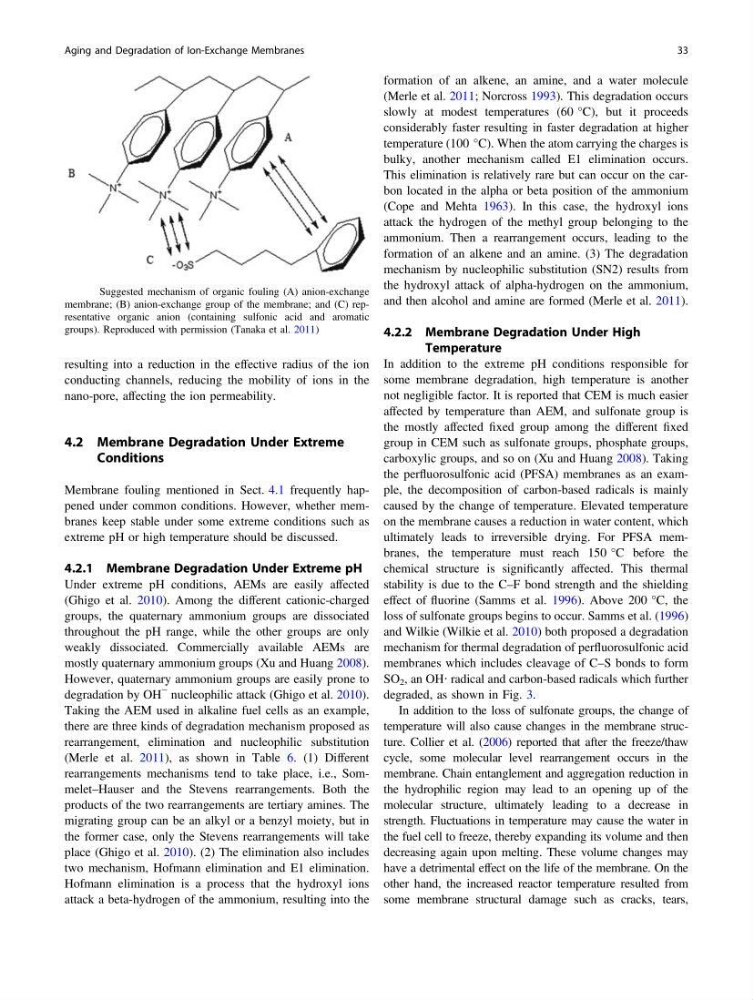
resulting into a reduction in the effective radius of the ion
conducting channels, reducing the mobility of ions in the
nano-pore, affecting the ion permeability.
4.2 Membrane Degradation Under Extreme
Conditions
Membrane fouling mentioned in Sect. 4.1 frequently happened under common conditions. However, whether membranes keep stable under some extreme conditions such as
extreme pH or high temperature should be discussed.
4.2.1 Membrane Degradation Under Extreme pH
Under extreme pH conditions, AEMs are easily affected
(Ghigo et al. 2010). Among the different cationic-charged
groups, the quaternary ammonium groups are dissociated
throughout the pH range, while the other groups are only
weakly dissociated. Commercially available AEMs are
mostly quaternary ammonium groups (Xu and Huang 2008).
However, quaternary ammonium groups are easily prone to
degradation by OH
− nucleophilic attack (Ghigo et al. 2010).
Taking the AEM used in alkaline fuel cells as an example,
there are three kinds of degradation mechanism proposed as
rearrangement, elimination and nucleophilic substitution
(Merle et al. 2011), as shown in Table 6. (1) Different
rearrangements mechanisms tend to take place, i.e., Sommelet–Hauser and the Stevens rearrangements. Both the
products of the two rearrangements are tertiary amines. The
migrating group can be an alkyl or a benzyl moiety, but in
the former case, only the Stevens rearrangements will take
place (Ghigo et al. 2010). (2) The elimination also includes
two mechanism, Hofmann elimination and E1 elimination.
Hofmann elimination is a process that the hydroxyl ions
attack a beta-hydrogen of the ammonium, resulting into the
formation of an alkene, an amine, and a water molecule
(Merle et al. 2011; Norcross 1993). This degradation occurs
slowly at modest temperatures (60 °C), but it proceeds
considerably faster resulting in faster degradation at higher
temperature (100 °C). When the atom carrying the charges is
bulky, another mechanism called E1 elimination occurs.
This elimination is relatively rare but can occur on the carbon located in the alpha or beta position of the ammonium
(Cope and Mehta 1963). In this case, the hydroxyl ions
attack the hydrogen of the methyl group belonging to the
ammonium. Then a rearrangement occurs, leading to the
formation of an alkene and an amine. (3) The degradation
mechanism by nucleophilic substitution (SN2) results from
the hydroxyl attack of alpha-hydrogen on the ammonium,
and then alcohol and amine are formed (Merle et al. 2011).
4.2.2 Membrane Degradation Under High
Temperature
In addition to the extreme pH conditions responsible for
some membrane degradation, high temperature is another
not negligible factor. It is reported that CEM is much easier
affected by temperature than AEM, and sulfonate group is
the mostly affected fixed group among the different fixed
group in CEM such as sulfonate groups, phosphate groups,
carboxylic groups, and so on (Xu and Huang 2008). Taking
the perfluorosulfonic acid (PFSA) membranes as an example, the decomposition of carbon-based radicals is mainly
caused by the change of temperature. Elevated temperature
on the membrane causes a reduction in water content, which
ultimately leads to irreversible drying. For PFSA membranes, the temperature must reach 150 °C before the
chemical structure is significantly affected. This thermal
stability is due to the C–F bond strength and the shielding
effect of fluorine (Samms et al. 1996). Above 200 °C, the
loss of sulfonate groups begins to occur. Samms et al. (1996)
and Wilkie (Wilkie et al. 2010) both proposed a degradation
mechanism for thermal degradation of perfluorosulfonic acid
membranes which includes cleavage of C–S bonds to form
SO 2 , an OH⋅ radical and carbon-based radicals which further
degraded, as shown in Fig. 3.
In addition to the loss of sulfonate groups, the change of
temperature will also cause changes in the membrane structure. Collier et al. (2006) reported that after the freeze/thaw
cycle, some molecular level rearrangement occurs in the
membrane. Chain entanglement and aggregation reduction in
the hydrophilic region may lead to an opening up of the
molecular structure, ultimately leading to a decrease in
strength. Fluctuations in temperature may cause the water in
the fuel cell to freeze, thereby expanding its volume and then
decreasing again upon melting. These volume changes may
have a detrimental effect on the life of the membrane. On the
other hand, the increased reactor temperature resulted from
some membrane structural damage such as cracks, tears,
Fig. 2 Suggested mechanism of organic fouling (A) anion-exchange
membrane; (B) anion-exchange group of the membrane; and (C) representative organic anion (containing sulfonic acid and aromatic
groups). Reproduced with permission (Tanaka et al. 2011)
Aging and Degradation of Ion-Exchange Membranes
33
conducting channels, reducing the mobility of ions in the
nano-pore, affecting the ion permeability.
4.2 Membrane Degradation Under Extreme
Conditions
Membrane fouling mentioned in Sect. 4.1 frequently happened under common conditions. However, whether membranes keep stable under some extreme conditions such as
extreme pH or high temperature should be discussed.
4.2.1 Membrane Degradation Under Extreme pH
Under extreme pH conditions, AEMs are easily affected
(Ghigo et al. 2010). Among the different cationic-charged
groups, the quaternary ammonium groups are dissociated
throughout the pH range, while the other groups are only
weakly dissociated. Commercially available AEMs are
mostly quaternary ammonium groups (Xu and Huang 2008).
However, quaternary ammonium groups are easily prone to
degradation by OH
− nucleophilic attack (Ghigo et al. 2010).
Taking the AEM used in alkaline fuel cells as an example,
there are three kinds of degradation mechanism proposed as
rearrangement, elimination and nucleophilic substitution
(Merle et al. 2011), as shown in Table 6. (1) Different
rearrangements mechanisms tend to take place, i.e., Sommelet–Hauser and the Stevens rearrangements. Both the
products of the two rearrangements are tertiary amines. The
migrating group can be an alkyl or a benzyl moiety, but in
the former case, only the Stevens rearrangements will take
place (Ghigo et al. 2010). (2) The elimination also includes
two mechanism, Hofmann elimination and E1 elimination.
Hofmann elimination is a process that the hydroxyl ions
attack a beta-hydrogen of the ammonium, resulting into the
formation of an alkene, an amine, and a water molecule
(Merle et al. 2011; Norcross 1993). This degradation occurs
slowly at modest temperatures (60 °C), but it proceeds
considerably faster resulting in faster degradation at higher
temperature (100 °C). When the atom carrying the charges is
bulky, another mechanism called E1 elimination occurs.
This elimination is relatively rare but can occur on the carbon located in the alpha or beta position of the ammonium
(Cope and Mehta 1963). In this case, the hydroxyl ions
attack the hydrogen of the methyl group belonging to the
ammonium. Then a rearrangement occurs, leading to the
formation of an alkene and an amine. (3) The degradation
mechanism by nucleophilic substitution (SN2) results from
the hydroxyl attack of alpha-hydrogen on the ammonium,
and then alcohol and amine are formed (Merle et al. 2011).
4.2.2 Membrane Degradation Under High
Temperature
In addition to the extreme pH conditions responsible for
some membrane degradation, high temperature is another
not negligible factor. It is reported that CEM is much easier
affected by temperature than AEM, and sulfonate group is
the mostly affected fixed group among the different fixed
group in CEM such as sulfonate groups, phosphate groups,
carboxylic groups, and so on (Xu and Huang 2008). Taking
the perfluorosulfonic acid (PFSA) membranes as an example, the decomposition of carbon-based radicals is mainly
caused by the change of temperature. Elevated temperature
on the membrane causes a reduction in water content, which
ultimately leads to irreversible drying. For PFSA membranes, the temperature must reach 150 °C before the
chemical structure is significantly affected. This thermal
stability is due to the C–F bond strength and the shielding
effect of fluorine (Samms et al. 1996). Above 200 °C, the
loss of sulfonate groups begins to occur. Samms et al. (1996)
and Wilkie (Wilkie et al. 2010) both proposed a degradation
mechanism for thermal degradation of perfluorosulfonic acid
membranes which includes cleavage of C–S bonds to form
SO 2 , an OH⋅ radical and carbon-based radicals which further
degraded, as shown in Fig. 3.
In addition to the loss of sulfonate groups, the change of
temperature will also cause changes in the membrane structure. Collier et al. (2006) reported that after the freeze/thaw
cycle, some molecular level rearrangement occurs in the
membrane. Chain entanglement and aggregation reduction in
the hydrophilic region may lead to an opening up of the
molecular structure, ultimately leading to a decrease in
strength. Fluctuations in temperature may cause the water in
the fuel cell to freeze, thereby expanding its volume and then
decreasing again upon melting. These volume changes may
have a detrimental effect on the life of the membrane. On the
other hand, the increased reactor temperature resulted from
some membrane structural damage such as cracks, tears,
Fig. 2 Suggested mechanism of organic fouling (A) anion-exchange
membrane; (B) anion-exchange group of the membrane; and (C) representative organic anion (containing sulfonic acid and aromatic
groups). Reproduced with permission (Tanaka et al. 2011)
Aging and Degradation of Ion-Exchange Membranes
33