

As a key composition to any electromembrane processes,
IEMs are typically composed of hydrophobic substrates,
immobilized ion-functionalized groups and movable counterions. Since they do not contain distinct pores, IEMs are often
very dense membranes. IEMs can be divided into anionexchange membrane (AEM) and cation-exchange membrane
(CEM) according to their charge, where in any case high
permselectivity, conductivity, stability (mechanical, chemical
and thermal stabilities), low cost and simple fabrication procedures are desirable (Suwal et al. 2015; Ran et al. 2017;
Campione et al. 2018). Although IEMs are not prone to fouling
comparing to the other membrane processes (e.g., pressuredriven ones), recent reports show that the fouling of IEM is an
un-negligible issue in the operation of the IEM-based process,
making anti-fouling a new desirable property for IEM (Liu
et al. 2019; Mikhaylin and Bazinet 2016).
Fouling is the phenomenon of undesirable attachment of
colloidal matter, inorganic compounds or macromolecules to
the membrane surface or inside the materials like inner pore
or free volume (Yooprasertchuti and Dechadilok 2018;
Cifuentes-Araya et al. 2011; Park et al. 2003). This often
results in an increased electrical resistance or energy
consumption, decreased ion migration or permselectivity,
even a decreased membrane lifetime with physical damages
(Park et al. 2003), largely hampering its industrial application (Mikhaylin and Bazinet 2016).
The membrane fouling usually originates from the
chemical and/or physical interactions between membranes
and foulants. Such an interaction refers to many key material
properties such as hydrophilicity, charge nature and surface
roughness. For example, since most organic substances are
negatively charged in natural waters, the AEMs (of positively charged nature) are more prone to fouling than CEM
(of negatively charged nature) under the electrostatic interaction (Wang et al. 2017, 2011).
Therefore, the main strategy for mitigating or preventing
membrane fouling is to prevent undesirable adhesive interaction between the foulant and the membrane. This review
paper thus outlines the mechanisms of IEM fouling and
surmises latest studies where the modification of the membrane surface and development of new membrane structure
are attempted toward the anti-fouling effect. Hopefully, the
review will shed light on advancing the development of
future anti-fouling IEMs.
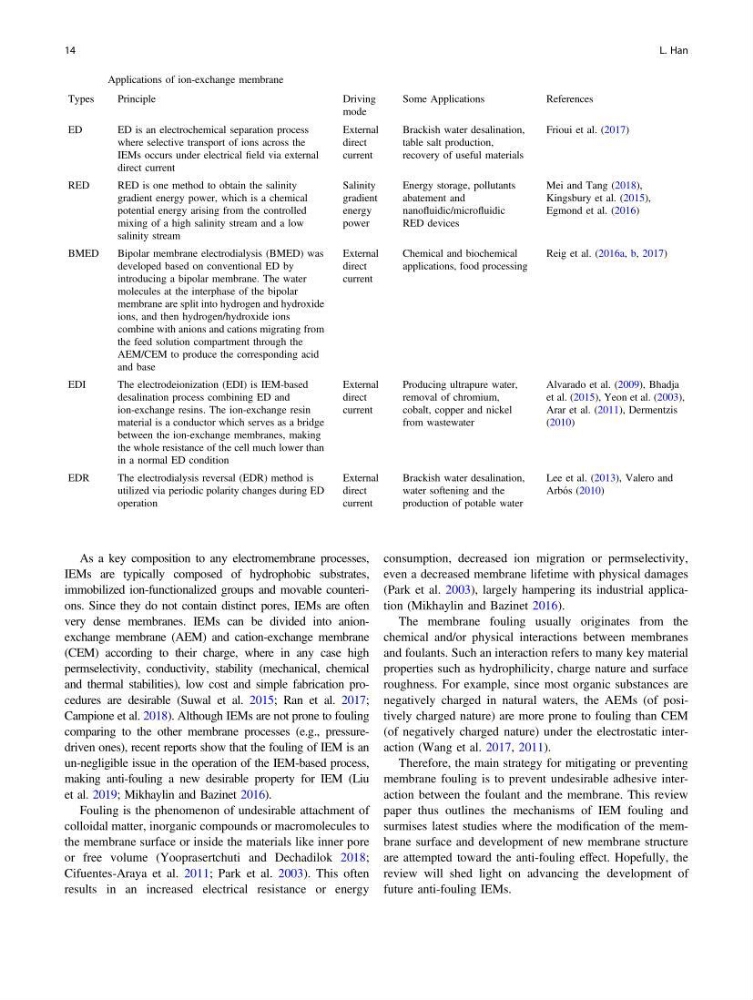
Table 1 Applications of ion-exchange membrane
Types
Principle
Driving
mode
Some Applications
References
ED
ED is an electrochemical separation process
where selective transport of ions across the
IEMs occurs under electrical field via external
direct current
External
direct
current
Brackish water desalination,
table salt production,
recovery of useful materials
Frioui et al. (2017)
RED
RED is one method to obtain the salinity
gradient energy power, which is a chemical
potential energy arising from the controlled
mixing of a high salinity stream and a low
salinity stream
Salinity
gradient
energy
power
Energy storage, pollutants
abatement and
nanofluidic/microfluidic
RED devices
Mei and Tang (2018),
Kingsbury et al. (2015),
Egmond et al. (2016)
BMED
Bipolar membrane electrodialysis (BMED) was
developed based on conventional ED by
introducing a bipolar membrane. The water
molecules at the interphase of the bipolar
membrane are split into hydrogen and hydroxide
ions, and then hydrogen/hydroxide ions
combine with anions and cations migrating from
the feed solution compartment through the
AEM/CEM to produce the corresponding acid
and base
External
direct
current
Chemical and biochemical
applications, food processing
Reig et al. (2016a, b, 2017)
EDI
The electrodeionization (EDI) is IEM-based
desalination process combining ED and
ion-exchange resins. The ion-exchange resin
material is a conductor which serves as a bridge
between the ion-exchange membranes, making
the whole resistance of the cell much lower than
in a normal ED condition
External
direct
current
Producing ultrapure water,
removal of chromium,
cobalt, copper and nickel
from wastewater
Alvarado et al. (2009), Bhadja
et al. (2015), Yeon et al. (2003),
Arar et al. (2011), Dermentzis
(2010)
EDR
The electrodialysis reversal (EDR) method is
utilized via periodic polarity changes during ED
operation
External
direct
current
Brackish water desalination,
water softening and the
production of potable water
Lee et al. (2013), Valero and
Arbós (2010)
14
L. Han
IEMs are typically composed of hydrophobic substrates,
immobilized ion-functionalized groups and movable counterions. Since they do not contain distinct pores, IEMs are often
very dense membranes. IEMs can be divided into anionexchange membrane (AEM) and cation-exchange membrane
(CEM) according to their charge, where in any case high
permselectivity, conductivity, stability (mechanical, chemical
and thermal stabilities), low cost and simple fabrication procedures are desirable (Suwal et al. 2015; Ran et al. 2017;
Campione et al. 2018). Although IEMs are not prone to fouling
comparing to the other membrane processes (e.g., pressuredriven ones), recent reports show that the fouling of IEM is an
un-negligible issue in the operation of the IEM-based process,
making anti-fouling a new desirable property for IEM (Liu
et al. 2019; Mikhaylin and Bazinet 2016).
Fouling is the phenomenon of undesirable attachment of
colloidal matter, inorganic compounds or macromolecules to
the membrane surface or inside the materials like inner pore
or free volume (Yooprasertchuti and Dechadilok 2018;
Cifuentes-Araya et al. 2011; Park et al. 2003). This often
results in an increased electrical resistance or energy
consumption, decreased ion migration or permselectivity,
even a decreased membrane lifetime with physical damages
(Park et al. 2003), largely hampering its industrial application (Mikhaylin and Bazinet 2016).
The membrane fouling usually originates from the
chemical and/or physical interactions between membranes
and foulants. Such an interaction refers to many key material
properties such as hydrophilicity, charge nature and surface
roughness. For example, since most organic substances are
negatively charged in natural waters, the AEMs (of positively charged nature) are more prone to fouling than CEM
(of negatively charged nature) under the electrostatic interaction (Wang et al. 2017, 2011).
Therefore, the main strategy for mitigating or preventing
membrane fouling is to prevent undesirable adhesive interaction between the foulant and the membrane. This review
paper thus outlines the mechanisms of IEM fouling and
surmises latest studies where the modification of the membrane surface and development of new membrane structure
are attempted toward the anti-fouling effect. Hopefully, the
review will shed light on advancing the development of
future anti-fouling IEMs.
Table 1 Applications of ion-exchange membrane
Types
Principle
Driving
mode
Some Applications
References
ED
ED is an electrochemical separation process
where selective transport of ions across the
IEMs occurs under electrical field via external
direct current
External
direct
current
Brackish water desalination,
table salt production,
recovery of useful materials
Frioui et al. (2017)
RED
RED is one method to obtain the salinity
gradient energy power, which is a chemical
potential energy arising from the controlled
mixing of a high salinity stream and a low
salinity stream
Salinity
gradient
energy
power
Energy storage, pollutants
abatement and
nanofluidic/microfluidic
RED devices
Mei and Tang (2018),
Kingsbury et al. (2015),
Egmond et al. (2016)
BMED
Bipolar membrane electrodialysis (BMED) was
developed based on conventional ED by
introducing a bipolar membrane. The water
molecules at the interphase of the bipolar
membrane are split into hydrogen and hydroxide
ions, and then hydrogen/hydroxide ions
combine with anions and cations migrating from
the feed solution compartment through the
AEM/CEM to produce the corresponding acid
and base
External
direct
current
Chemical and biochemical
applications, food processing
Reig et al. (2016a, b, 2017)
EDI
The electrodeionization (EDI) is IEM-based
desalination process combining ED and
ion-exchange resins. The ion-exchange resin
material is a conductor which serves as a bridge
between the ion-exchange membranes, making
the whole resistance of the cell much lower than
in a normal ED condition
External
direct
current
Producing ultrapure water,
removal of chromium,
cobalt, copper and nickel
from wastewater
Alvarado et al. (2009), Bhadja
et al. (2015), Yeon et al. (2003),
Arar et al. (2011), Dermentzis
(2010)
EDR
The electrodialysis reversal (EDR) method is
utilized via periodic polarity changes during ED
operation
External
direct
current
Brackish water desalination,
water softening and the
production of potable water
Lee et al. (2013), Valero and
Arbós (2010)
14
L. Han