

biopolymers (Ramachandran et al. 2014), such as polylactic
acid (PLA), polycaprolacone (PCL), cellulose, starch, or
chitosan. The blend of PHA/PLA has been the most investigated since PLA is a biopolymer with a similar structure
and similar properties to PHAs (Zhang and Thomas 2011;
Loureiro et al. 2015; Szuman et al. 2016). PLA is also one of
the most produced biobased/biodegradable polymers and has
a competitive price to other polymers (Mirabal et al. 2013).
Adding 25 and 50 wt% of PLA in the P(3HB) continuous
phase tends to reduce the size of the crystallites and increase
the mechanical properties, both elongation and tensile stress
at break (Loureiro et al. 2015). Similar observations were
described with P(3HB3HV)/PBAT blends (Javadi et al.
2010).
In addition to blends with plasticizers and other polymers,
which is not always favored because of poor interfacial
interactions, the chemical modification of PHAs is a good
way to modulate the material properties. It can be achieved
via either graft copolymerization or block copolymerization.
These techniques have been previously well summarized (Li
et al. 2016). For instance, chemical conjugation with
polyethyleneglycols can lead to amphiphilic polymers with
suitable properties for drug delivery systems.
Knowing that the PHAs properties may be improved by
blending or chemical modification, it is then interesting to
focus on the different possible techniques used to process
PHAs materials. As mentioned above, PHAs can be processed by thermal techniques to get dense films. Nevertheless, membrane materials are made of both dense and porous
structures. Hence, another technique to prepare porous
structures must be discussed.
The phase inversion is a well-developed fabrication process and is one of the most commonly used techniques for
preparation of polymeric membranes with dense or porous
structure (Lalia et al. 2013). This technique involves a
demixing mechanism from a homogeneous polymer solution
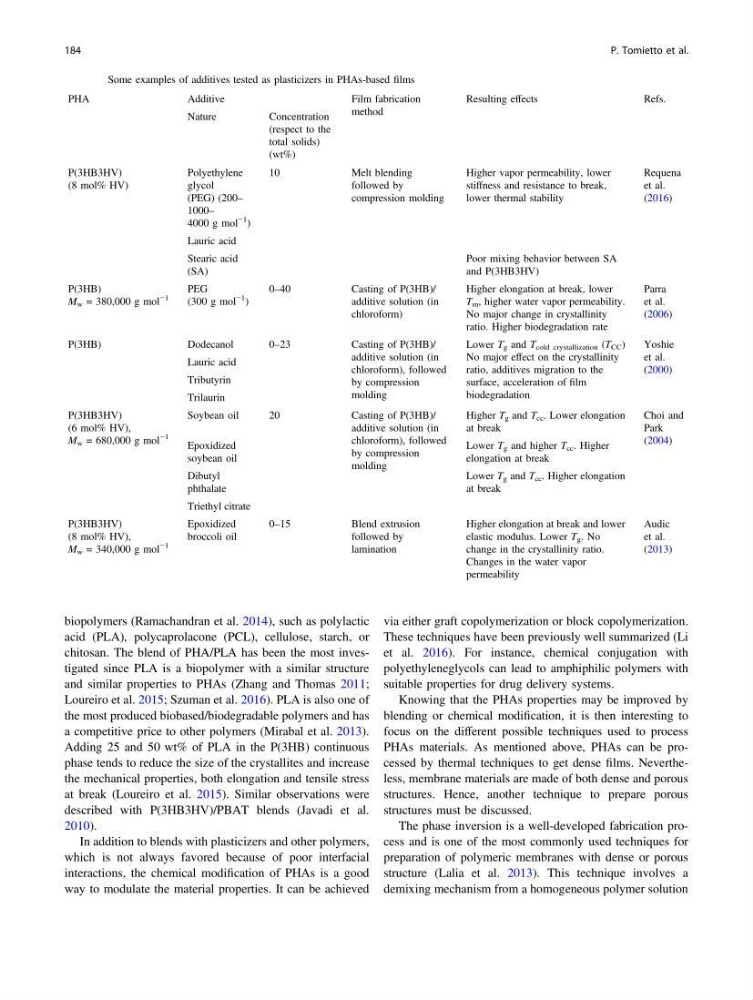
Table 5 Some examples of additives tested as plasticizers in PHAs-based films
PHA
Additive
Film fabrication
method
Resulting effects
Refs.
Nature
Concentration
(respect to the
total solids)
(wt%)
P(3HB3HV)
(8 mol% HV)
Polyethylene
glycol
(PEG) (200–
1000–
4000 g mol
−1
)
10
Melt blending
followed by
compression molding
Higher vapor permeability, lower
stiffness and resistance to break,
lower thermal stability
Requena
et al.
(2016)
Lauric acid
Stearic acid
(SA)
Poor mixing behavior between SA
and P(3HB3HV)
P(3HB)
M w = 380,000 g mol
−1
PEG
(300 g mol
−1
)
0–40
Casting of P(3HB)/
additive solution (in
chloroform)
Higher elongation at break, lower
T m , higher water vapor permeability.
No major change in crystallinity
ratio. Higher biodegradation rate
Parra
et al.
(2006)
P(3HB)
Dodecanol
0–23
Casting of P(3HB)/
additive solution (in
chloroform), followed
by compression
molding
Lower T g and T cold crystallization (T CC )
No major effect on the crystallinity
ratio, additives migration to the
surface, acceleration of film
biodegradation
Yoshie
et al.
(2000)
Lauric acid
Tributyrin
Trilaurin
P(3HB3HV)
(6 mol% HV),
M w = 680,000 g mol
−1
Soybean oil
20
Casting of P(3HB)/
additive solution (in
chloroform), followed
by compression
molding
Higher T g and T cc . Lower elongation
at break
Choi and
Park
(2004)
Epoxidized
soybean oil
Lower T g and higher T cc . Higher
elongation at break
Dibutyl
phthalate
Lower T g and T cc . Higher elongation
at break
Triethyl citrate
P(3HB3HV)
(8 mol% HV),
M w = 340,000 g mol
−1
Epoxidized
broccoli oil
0–15
Blend extrusion
followed by
lamination
Higher elongation at break and lower
elastic modulus. Lower T g . No
change in the crystallinity ratio.
Changes in the water vapor
permeability
Audic
et al.
(2013)
184
P. Tomietto et al.
acid (PLA), polycaprolacone (PCL), cellulose, starch, or
chitosan. The blend of PHA/PLA has been the most investigated since PLA is a biopolymer with a similar structure
and similar properties to PHAs (Zhang and Thomas 2011;
Loureiro et al. 2015; Szuman et al. 2016). PLA is also one of
the most produced biobased/biodegradable polymers and has
a competitive price to other polymers (Mirabal et al. 2013).
Adding 25 and 50 wt% of PLA in the P(3HB) continuous
phase tends to reduce the size of the crystallites and increase
the mechanical properties, both elongation and tensile stress
at break (Loureiro et al. 2015). Similar observations were
described with P(3HB3HV)/PBAT blends (Javadi et al.
2010).
In addition to blends with plasticizers and other polymers,
which is not always favored because of poor interfacial
interactions, the chemical modification of PHAs is a good
way to modulate the material properties. It can be achieved
via either graft copolymerization or block copolymerization.
These techniques have been previously well summarized (Li
et al. 2016). For instance, chemical conjugation with
polyethyleneglycols can lead to amphiphilic polymers with
suitable properties for drug delivery systems.
Knowing that the PHAs properties may be improved by
blending or chemical modification, it is then interesting to
focus on the different possible techniques used to process
PHAs materials. As mentioned above, PHAs can be processed by thermal techniques to get dense films. Nevertheless, membrane materials are made of both dense and porous
structures. Hence, another technique to prepare porous
structures must be discussed.
The phase inversion is a well-developed fabrication process and is one of the most commonly used techniques for
preparation of polymeric membranes with dense or porous
structure (Lalia et al. 2013). This technique involves a
demixing mechanism from a homogeneous polymer solution
Table 5 Some examples of additives tested as plasticizers in PHAs-based films
PHA
Additive
Film fabrication
method
Resulting effects
Refs.
Nature
Concentration
(respect to the
total solids)
(wt%)
P(3HB3HV)
(8 mol% HV)
Polyethylene
glycol
(PEG) (200–
1000–
4000 g mol
−1
)
10
Melt blending
followed by
compression molding
Higher vapor permeability, lower
stiffness and resistance to break,
lower thermal stability
Requena
et al.
(2016)
Lauric acid
Stearic acid
(SA)
Poor mixing behavior between SA
and P(3HB3HV)
P(3HB)
M w = 380,000 g mol
−1
PEG
(300 g mol
−1
)
0–40
Casting of P(3HB)/
additive solution (in
chloroform)
Higher elongation at break, lower
T m , higher water vapor permeability.
No major change in crystallinity
ratio. Higher biodegradation rate
Parra
et al.
(2006)
P(3HB)
Dodecanol
0–23
Casting of P(3HB)/
additive solution (in
chloroform), followed
by compression
molding
Lower T g and T cold crystallization (T CC )
No major effect on the crystallinity
ratio, additives migration to the
surface, acceleration of film
biodegradation
Yoshie
et al.
(2000)
Lauric acid
Tributyrin
Trilaurin
P(3HB3HV)
(6 mol% HV),
M w = 680,000 g mol
−1
Soybean oil
20
Casting of P(3HB)/
additive solution (in
chloroform), followed
by compression
molding
Higher T g and T cc . Lower elongation
at break
Choi and
Park
(2004)
Epoxidized
soybean oil
Lower T g and higher T cc . Higher
elongation at break
Dibutyl
phthalate
Lower T g and T cc . Higher elongation
at break
Triethyl citrate
P(3HB3HV)
(8 mol% HV),
M w = 340,000 g mol
−1
Epoxidized
broccoli oil
0–15
Blend extrusion
followed by
lamination
Higher elongation at break and lower
elastic modulus. Lower T g . No
change in the crystallinity ratio.
Changes in the water vapor
permeability
Audic
et al.
(2013)
184
P. Tomietto et al.